Introduction
In Kolkata, many property transfers don???t break at the price stage. They break when the paperwork isn???t ready: one owner can???t sign on time, the bank NOC hasn???t arrived, or the society suddenly asks for a form no one talked about earlier.
This guide explains the property transfer process in Kolkata (2026) in plain language: what to confirm before paying token money, what gets checked in the file, what to expect on registration day, and what to do after registration so your records stay clean.
Quick note
This is general information, not legal or financial advice. Rules and charges can change. If the property is inherited, jointly owned, under a home loan, or has any dispute/occupation, take professional help before you sign or pay a large advance. Contact us if you???d like help with document checks.
What ???property transfer??? means in Kolkata
In simple terms, property transfer means ownership shifts from one person to another through a registered document. That registered document is what banks rely on for loans, and what future buyers rely on when you sell later.
In Kolkata, transfers usually happen through one of these documents:
- Sale deed: resale purchase of a flat/house/plot.
- Gift deed: transfer to a family member without sale consideration.
- Partition deed / family settlement: when jointly held property is divided.
- Release deed: one co-owner releases their share in favor of another co-owner.
- Will + probate/letters of administration (where applicable): for inheritance-driven transfers.
For most buyers, it???s a resale purchase and the sale deed is the key document. If the deed is drafted or registered incorrectly, you can face trouble later with bank processing, society transfer, mutation, and resale.
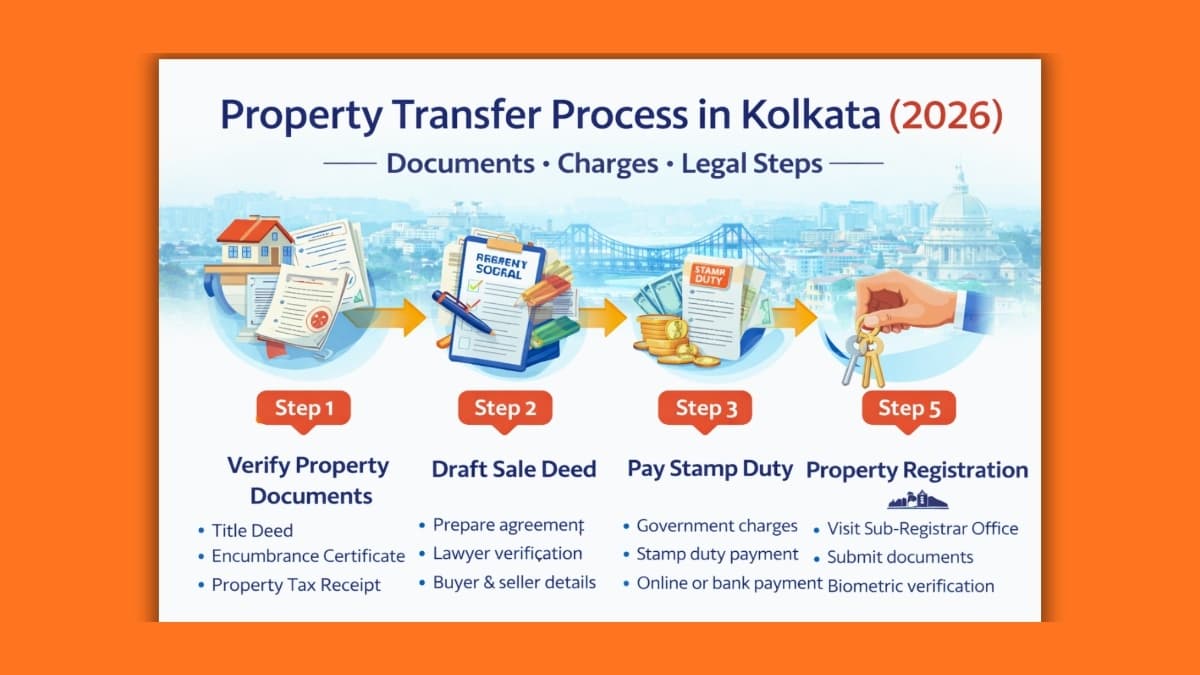
Step-by-step: property transfer process in Kolkata (2026)
Below is a practical flow that fits most resale deals. Your checklist can change if the property is inherited, jointly owned, under a home loan, tenanted, or part of an allotment/authority-managed development.
1) Before token money: get the basics written
Token money should come after clarity, not before it. Don???t pay token until these basics are clear in writing.
- Who will sign: all owners sign, or a valid Power of Attorney (POA) holder signs.
- Loan status: loan-free, or loan running with a clear closure plan and bank NOC timeline.
- Possession plan: vacant/self-occupied/tenanted, and the handover date in writing.
- Society requirements: transfer forms, no-dues status, and any restrictions that can delay your name change.
If you hear ???the other owner will come later??? or ???NOC is almost done,??? pause. Ask for the exact date and the supporting proof before you move forward.
2) Title and document check (this protects your money)
This step checks whether the seller can legally transfer ownership without future claims coming back to you. A basic title check usually includes:
- Title chain: how the property moved to the current owner (older deeds, allotment papers, conveyance, etc.).
- Name consistency: spelling, initials, and addresses matching across documents.
- Encumbrance/charges: mortgage, charge, or any claim that needs closure.
- Taxes and dues: recent receipts and any pending amounts.
Most delays come from small gaps: a missing link in the chain, a name mismatch in an older deed, or society records showing a different spelling than the deed.
Real example (New Town resale)
A buyer agrees to a resale flat in New Town. The price works, but the seller???s home loan is still running. The safer order is: close the loan, collect the bank???s NOC/release papers, and then fix the registration date.
3) Draft the right document (sale deed / gift / release)
The document type matters. A resale purchase needs a sale deed. A family transfer may need a gift deed. If one co-owner is giving up their share, a release deed is commonly used. Choose the correct instrument based on the exact ownership situation.
Whichever document is used, the draft should clearly mention:
- Property description (flat/plot identifiers, location, boundaries where relevant).
- Consideration and payment terms (for sale deeds).
- Share details (especially for joint owners).
- Possession and handover date.
- List of inclusions (parking rights, store room, fixtures if agreed).
For apartments, match the flat number, tower/block, and society name exactly to society records. Small mismatches create big headaches later.
4) Plan charges and keep payments clean
Stamp duty and registration fee are usually the biggest government charges in the property transfer process in Kolkata. The exact amount depends on location, property value, and transfer type, so confirm the latest charges from official sources before you lock your budget. For a Kolkata-specific registration checklist, see Kolkata property registration guide.
Keep payments traceable (bank transfer/UPI). If you are taking a home loan, the bank will expect proof of payments and a deed draft that matches their requirements.
5) Book the sub-registrar date and line up the people
Registration goes smoothly when everyone is ready. Confirm availability of all signers and witnesses before you book the appointment.
- All sellers and buyers (or POA holder) present with ID proofs.
- Witnesses (as required) with their IDs.
- Original documents and a clean set of photocopies.
- Payment proofs for stamp duty/registration and transaction receipts.
If any signer is outside Kolkata, arrange a proper POA well in advance. Last-minute fixes are where deals start slipping.
6) Registration day (what to expect)
On registration day, the office verifies identities and documents, captures biometrics/photos where applicable, and completes the registration entry.
Carry IDs and photocopies in one folder, and keep the acknowledgment and deed reference safe.
7) After registration: mutation, society transfer, and utilities
Registration completes the legal transfer, but day-to-day ownership gets easier only after records are updated. In the property transfer process in Kolkata, plan for (Kolkata guides and local records):
- Municipal mutation: update records for property tax purposes (KMC / Bidhannagar Municipality / relevant local body).
- Society transfer: submit deed copy, transfer form, and apply for share certificate/name update (if applicable).
- Utilities: electric meter (CESC/WBSEDCL), water, and other bills where needed.
- Bank records: if you take a loan, the bank will keep its own document file and property security record.
Documents checklist (practical, Kolkata-friendly)
Documents vary by property history, but this is a practical baseline for the property transfer process in Kolkata. If the seller cannot show most of these, slow down and understand what???s missing. For more reading, see our legal guides.
Core property documents
- Latest title document (sale deed / conveyance deed / allotment paper as applicable).
- Chain documents supporting ownership history (older deeds, supporting links).
- Tax paid receipts and last paid proof.
- Society maintenance paid receipts and no-dues position (if your society issues it).
Seller-side documents
- Government ID and address proof for each owner.
- PAN (commonly required for property transactions).
- Bank loan closure papers / NOC (if a loan existed).
- POA documents if any owner cannot attend (properly executed and acceptable for registration).
Buyer-side documents
- Government ID and address proof.
- PAN and payment proofs.
- Loan sanction/disbursal plan if you are financing the purchase.
Special situations: what changes
- Inherited property: you may need legal heir documents, succession support, and additional proof depending on the family situation.
- Joint owners: ensure share clarity and all signers??? presence/authorization.
- Tenanted property: keep tenancy terms and handover plan in writing before transfer.
- Under-construction / allotment-based transfers: builder/HIDCO/NKDA documentation and transfer rules can apply.
- Thika/leasehold or unclear land status: if the file has land-status complexity, take specialist advice before you pay a large amount.
Charges to plan for in 2026
Charges vary by transaction type and value, but these are the usual cost buckets in the property transfer process in Kolkata:
Stamp duty and registration fee
This is usually the largest government cost. Confirm current rates using official sources, because rates and rebates can change. Also confirm whether the calculation is based on consideration value, market value, or whichever is higher for your case.
Legal and documentation costs
Drafting the deed, title search, and document verification usually involve professional fees. Cutting corners here is risky: one missed title issue can cost far more than the legal fee.
Society transfer charges and move-in formalities
Many Kolkata societies have their own transfer forms and processing fees. Ask for the checklist early so you are not scrambling after registration.
Mutation and utility update costs
Mutation is often treated like ???later work???, but it is part of closing cleanly. Keep time and a small budget for this step.
Important factors (what actually decides if your transfer is smooth)
If you want the property transfer process in Kolkata to move without delays, focus on these first:
- Signer clarity: all owners available, or a valid POA ready well in advance.
- Clean title chain: no missing links, no unresolved disputes, no hidden claims.
- Loan closure proof: bank paperwork and NOC are not optional.
- Society coordination: no dues, transfer forms, and parking rights clearly stated.
- Possession clarity: the handover date is written and realistic.
Practical tips (Kolkata reality)
- Do a quick ???file rehearsal???: open every document once and check names and flat numbers line by line.
- Keep payments traceable: use bank transfer/UPI and keep receipts. Avoid cash without proof.
- Use one folder: originals + photocopies + IDs together, so nothing gets lost on registration day.
- Confirm society rules early: some buildings will not update records until dues and forms are complete.
- Don???t rush token money: tie token to clear conditions like lawyer review and loan approval.
If your deal is non-standard (inheritance, POA signing, old title gaps, unclear possession), slow down and get professional advice before you pay a large amount.
Conclusion
The property transfer process in Kolkata becomes much easier when you treat it like a checklist with deadlines. Confirm who will sign, confirm loan closure, keep the file complete, and then book registration.
After registration, finish the last mile: mutation and society record updates. That???s what keeps your ownership clean for taxes, resale, and bank work later.
Product Details
FEDUS PU Leather Document File Folder ??? Jute Brown
If your paperwork is getting scattered, this folder keeps everything in one place.
It comes in a classic jute-brown look and has a PU leather cover that???s easy to wipe clean.
Because it fits foolscap sheets, you can store larger property papers without folding them.
Useful for keeping deed copies, agreements, bank papers, certificates, and receipts together.
Good for office meetings, travel, or as one ???important documents??? folder at home.
???? Check Price on Amazon
Disclosure: This is an affiliate link. If you buy through it, we may earn a commission at no extra cost to you.
FlatsCare Property Calculator
Use these quick tools while comparing options:
Common Questions (FAQs)
Q1: Is registration mandatory for property transfer in Kolkata?
For most ownership transfers like sale deeds and gift deeds, registration is the standard and safest route. It makes the ownership change legally stronger and keeps resale, loans, and mutation smoother later.
Q2: Can I transfer property if one co-owner is outside Kolkata?
Yes. Don???t rely on informal authorizations. Use a properly executed Power of Attorney that is acceptable for registration, and keep IDs and supporting papers ready for verification.
Q3: What documents do buyers usually ask for before paying token money?
Buyers commonly ask for the latest deed, key chain papers, proof of loan status (if any), recent tax/maintenance receipts, and clarity on who will sign. A clean document list early prevents last-minute surprises.
Q4: What happens after the deed is registered?
Registration is the legal transfer step, but day-to-day ownership becomes smoother after mutation and society record updates. Update tax records, society membership/share certificate (if applicable), and utilities where needed.
Q5: How do I avoid delays in the property transfer process in Kolkata?
Keep one organized document file, confirm all signers early, close loan paperwork in advance, and match names across documents. Most Kolkata delays come from missing papers or last-minute coordination issues.
Q6: Is mutation the same thing as registration?
No. Registration records the transfer document. Mutation updates municipal/property-tax records (and often society records). For a clean ownership experience, you usually want both completed.