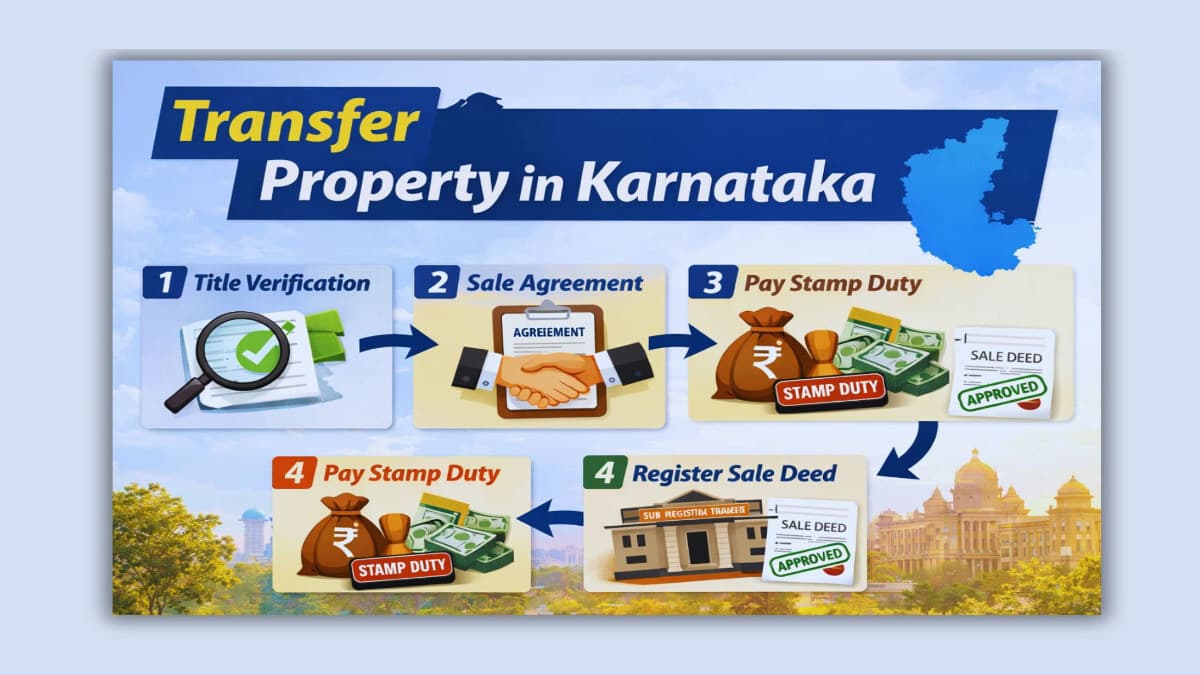
Transferring property in Karnataka is not as simple as handing over the keys and collecting a cheque. It is a detailed legal process that involves multiple government bodies???the Sub-Registrar, the BBMP (or local municipality), and the Income Tax Department.
Whether you are buying a flat in Bangalore, gifting a heritage home in Mysore, or inheriting a plot in Mangalore or Hubli, the "Transfer of Title" is the only thing that makes you the legal owner. In 2026, with the introduction of Kaveri 2.0 and the mandatory e-Khata system, the rules have changed significantly across the state.
This guide breaks down the entire lifecycle of property transfer in Karnataka, from the initial agreement to the final name change in electricity bills.
1. Types of Property Transfer
The process depends entirely on how the property is being transferred. Each method has different tax implications and document requirements.
A. Sale Deed (The Most Common)
This is when money changes hands. It applies to resale flats, new apartments, and plots.
Cost: High (~6.6% of value).
Process: Requires full registration and stamp duty payment.
B. Gift Deed (Family Transfer)
If you are transferring property to a "blood relative" (Spouse, Child, Parent, Sibling) out of love and affection.
Cost: Very Low (Flat ???5,000 Stamp Duty + ???1,000 Registration).
Warning: If you gift to a non-relative (e.g., Nephew, Friend), it is treated as a Sale, and full commercial tax applies.
C. Release Deed (Relinquishment)
Used in inheritance cases. For example, if a father dies leaving a house to two sons, and one son wants to give up his share to the other.
Cost: Low (Similar to Gift Deed rates for family).
D. Will (Testamentary Succession)
A Will comes into effect only after the death of the owner.
Process: The beneficiary needs to get the Will probated (court verification) and then apply for Khata Transfer. No registration at the Sub-Registrar is needed for the Will itself during transfer, but the "Khata Transfer" is mandatory.
2. Documents Required for Transfer
Before you approach the Sub-Registrar, ensure this file is ready. Missing even one can halt the process.
- Title Deeds: The original Sale Deed or Mother Deed of the current owner.
- Khata Certificate (e-Khata): The 18-digit PID number is mandatory in 2026. Without an e-Khata, the Kaveri 2.0 system will reject your application.
- Encumbrance Certificate (EC): Form 15 showing the history of transactions for the last 15-30 years.
- Tax Paid Receipts: Latest property tax receipts (SAS) showing no arrears.
- Identity Proofs: PAN Card and Aadhaar Card for both Transferor and Transferee.
- NOC: No Objection Certificate from the Apartment Association (if applicable).
See our detailed Property Selling Documents Guide for a deep dive into each document.
3. The Step-by-Step Transfer Process
Let's assume you are doing a standard Sale Deed Transfer.
Step 1: Legal Verification
Never pay the full amount without verifying the title. A lawyer checks the "Flow of Title" to ensure the seller actually owns the property. This is where you catch issues like "Missing Mother Deeds" or "Pending Litigation."
Step 2: Sale Agreement
Draft a Sale Agreement on stamp paper. This document locks the price and the timeframe (usually 45-60 days) for the transfer.
Tip: Mention a penalty clause if the seller backs out.
Step 3: Apply for e-Khata (Seller's Duty)
The seller must digitize their Khata. This involves GPS-tagging the property.
- Bangalore (BBMP): Use the BBMP e-Khata portal.
- Mysore/Mangalore/Hubli: Use the e-Swathu portal for properties under municipal corporations or gram panchayats.
Once the e-Khata is generated, the PID number is shared with the buyer for registration.
Step 4: Draft the Sale Deed
Your lawyer drafts the final Sale Deed. This document contains:
- Details of the property (Schedule A and B).
- Consideration amount (Price).
- Handover of possession clauses.
- Indemnity clauses protecting the buyer.
Step 5: Registration & Stamp Duty
Book a slot on the Kaveri 2.0 portal.
- Upload the draft deed and documents.
- Pay the Stamp Duty and Registration Fees online.
- Visit the Sub-Registrar Office (SRO) for biometric verification.
Once signed, the Sale Deed is scanned and given to you. Congratulations, you are now the legal owner!
4. The Cost of Transfer (2026 Rates)
Budgeting is crucial. Here is what you will pay to the government:
| Transfer Type |
Stamp Duty |
Registration Fee |
Total Approx Cost |
| Sale (Men) |
5.6% (incl Cess) |
1% |
6.6% of Value |
| Sale (Women) |
5.6% (No specific rebate currently) |
1% |
6.6% of Value |
| Gift (Family) |
???5,000 (Fixed) |
???1,000 (Fixed) |
~???6,000 + Cess |
| Gift (Non-Family) |
5.6% |
1% |
6.6% of Value |
5. Post-Registration: The Khata Transfer (Mutation)
Many people think the job is done after registration. Wrong.
The Sale Deed proves you bought the property. The Khata proves you are liable to pay tax for it.
The Process:
1. With the Registered Sale Deed, apply for Khata Transfer online (Sakala Services).
2. Upload the Encumbrance Certificate (Form 15) showing your name.
3. Pay the Khata Transfer Fee (approx 2% of Stamp Duty paid).
4. The Revenue Officer verifies and issues the Khata Certificate in your name within 30-45 days.
Without this, you cannot sell the property later or get a building plan approval.
6. Transferring Utility Bills (Bescom, Mescom, Chescom)
Don't let the previous owner's name stay on the bills. It causes issues during address verification for Passports or Aadhar.
Electricity
Visit the local sub-division office:
- Bangalore: BESCOM.
- Mysore: CHESCOM.
- Mangalore: MESCOM.
- Hubli: HESCOM.
Submit the Sale Deed and Khata copy. Pay the name change fee and transfer the security deposit.
Water (BWSSB)
Similar process. Ensure the previous owner has cleared all arrears. If there are pending dues, the new owner is liable to pay them before the transfer.
7. Common Pitfalls to Avoid
- Undervaluation: Don't try to register below the Guidance Value. The Sub-Registrar will impound the deed and demand the difference with penalty.
- Cash Payments: Any cash payment above ???20,000 for property can be disallowed under Section 269SS of the IT Act. Stick to DD/Cheque.
- Ignoring TDS: If you forget to deduct 1% TDS (for properties > ???50L), the Income Tax department will send you (the buyer) a notice, not the seller.
Conclusion
Transferring property in Karnataka requires patience. The key is to be methodical. Secure the e-Khata first, ensure the Stamp Duty is calculated correctly, and don't rest until the Khata and Electricity bills are in your name. A property with clean titles and updated records is a liquid asset; anything else is a liability.
Need Help with Property Transfer?
From Sale Deed drafting to Khata Transfer, let experts handle the bureaucracy.
Get Legal Assistance
Frequently Asked Questions (FAQs)
FAQs on Property Transfer
Q1: How long does the entire process take?
Registration takes 1 day (if booked). Khata Transfer takes 30-45 days. Overall, budget for 2 months.
Q2: Can I do the registration online?
Partially. You can upload documents and pay fees online via Kaveri 2.0. However, physical presence for biometric verification is mandatory at the SRO.
Q3: Is e-Khata mandatory for Gift Deeds too?
Yes. Any transfer of title (Sale, Gift, Release) requires the property to have a valid e-Khata PID.
Q4: What if the seller is abroad?
The seller can give a specific Power of Attorney (POA) to a relative in India to sign the Sale Deed on their behalf.
Disclaimer: This guide provides general legal information. For complex title issues, always consult a qualified Property Lawyer.