Introduction
A flat resale in Kolkata usually doesn???t fail because the buyer and seller can???t agree on the price. It fails when the paperwork and timing don???t line up: one co-owner can???t sign on time, the bank NOC is still pending, or the society asks for a transfer form at the last minute.
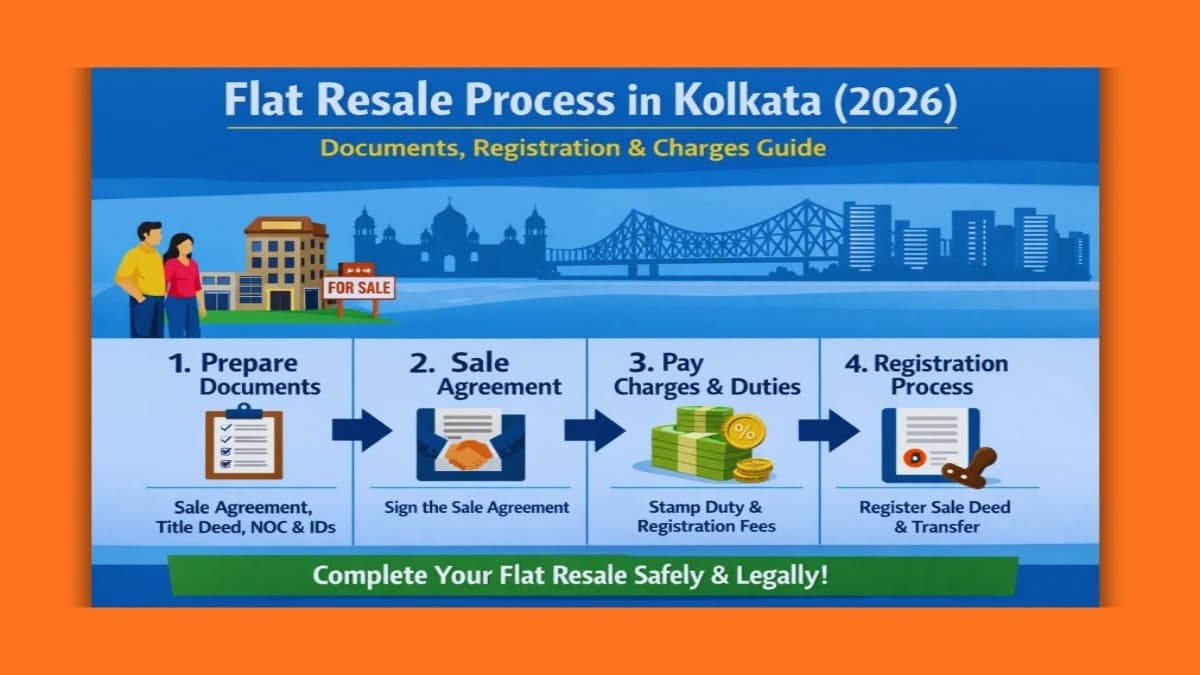
This guide walks you through the flat resale process in Kolkata (2026) in the same order real deals move: what to verify before token money, which documents matter most, what registration day looks like, and what you should update after registration so your ownership is clean in day-to-day records.
Quick note
This is general information, not legal or financial advice. Charges and rules can change. If the file involves inheritance, multiple owners, an ongoing loan, tenancy, or any dispute/occupation, take professional help before you sign or pay a large advance. If you need help reviewing documents, contact us.
Detailed explanation of the flat resale process in Kolkata (2026)
Resale works best when you treat it like a checklist. If you clear each checkpoint early, registration day is straightforward. If you skip steps, you usually pay for it in extra visits, delays, and last-minute stress.
If this is your first resale purchase, don???t learn everything on registration day. Spend one evening organizing the file and confirming who will sign.
Step 1: Before token money, confirm the basics
In a Kolkata resale, token money is not the ???start??? of the deal. It???s a small hold amount you pay after the basics are confirmed. Before you pay anything meaningful, write down these points (even a short WhatsApp summary is better than assumptions).
- Who will sign: all owners sign, or a valid Power of Attorney holder signs.
- Loan status: loan-free, or loan running with a clear closure plan and bank NOC timeline.
- Possession plan: vacant/self-occupied/tenanted, with a handover date.
- Society position: dues status, transfer forms, and any restrictions for name change.
If you hear ???the other owner will come later??? or ???NOC is almost done,??? pause and ask for proof with a date. In Kolkata, many delays are simple coordination problems dressed up as ???small pending work???.
Step 2: Do a document and title check
The goal here is simple: make sure the seller can legally transfer ownership, and that no old issue comes back after you???ve paid. A practical title check typically includes:
- Title chain: how the flat reached the current owner (older deeds/allotment/conveyance documents).
- Name consistency: spelling, initials, addresses matching across the chain and IDs.
- Encumbrance: mortgage/charge/loan details and the closure papers needed.
- Dues and taxes: property tax, maintenance, electricity, and any society dues.
If you want a broader ownership checklist, this guide also helps: Property transfer process in Kolkata (2026).
Step 3: Draft the agreement and the sale deed properly
In a resale, two drafts matter: the agreement (if you???re doing one) and the final sale deed. The sale deed should clearly mention the property description, consideration and payment schedule, possession terms, parking rights (if any), and what is included (fixtures, store room, etc.).
For apartments, small mistakes become expensive later. Match the flat number, tower/block, and society name exactly to the society???s records. A ???minor mismatch??? can delay your society transfer and can also slow down a home loan file.
Step 4: Plan fees (stamp duty + registration) without guessing
Government fees are usually the biggest non-price cost in the flat resale process in Kolkata. The exact amount depends on location, value, and the document type, so confirm current charges from official sources before you lock your budget.
For a Kolkata-focused checklist for registration day, see Kolkata property registration guide.
If you???re comparing flats across areas and sizes, do a quick per-sq-ft comparison so you don???t mix different carpet/built-up numbers.
Step 5: If you are taking a home loan, align the bank timeline
If you???re taking a loan, align the bank steps with the seller???s timeline. The bank will ask for specific documents, and disbursal happens only after those checks are complete. Keep these points fixed: when the bank will approve, when it will disburse, and what it needs before releasing funds.
Before you commit, do a quick EMI check and decide your comfort range first.
Step 6: Registration day (what happens in real life)
On registration day, the office verifies identity documents, signatures, and payments, captures biometrics/photos where applicable, and completes the registration entry.
- Carry IDs and photocopies in one folder.
- Keep payment proofs and receipts ready.
- Confirm witnesses and their IDs (as required).
After registration, keep the acknowledgment and the registered deed reference safe. This is what banks and future buyers rely on later.
Step 7: After registration, finish the ???last mile??? updates
Registration completes the legal transfer, but daily ownership feels ???real??? only after record updates. Plan for:
- Mutation: update municipal records for property tax (KMC / Bidhannagar Municipality / relevant local body).
- Society transfer: submit deed copy, apply for name update/share certificate where applicable.
- Utilities: electricity (CESC/WBSEDCL), water, and other bill name changes if needed.
For city-specific pages and local guidance, see Kolkata.
Documents you should collect before you set a registration date
In the flat resale process in Kolkata, the fastest deals are the ones where the document file is ready in one place. Collect these early so you don???t get stuck waiting after the price is already fixed.
Seller-side documents (common list)
- Latest registered sale deed and key chain documents (older deeds/links where applicable).
- PAN and government ID/address proof of each owner.
- Latest property tax receipt and society maintenance receipts (plus dues clarity).
- Loan closure papers and bank NOC/release documents if a loan existed.
- POA documents if any owner cannot attend (executed correctly and acceptable for registration).
Buyer-side documents (common list)
- PAN and government ID/address proof.
- Payment proofs for token/advance and a clear payment schedule for the balance.
- Loan sanction and disbursal plan if you are using bank funding.
For apartments, also ask for whatever your society uses for ownership records (membership/share certificate or transfer register entry). Even when the deed is perfect, society paperwork is often the slowest step.
Fees to plan for (beyond the property price)
Many buyers budget only for the flat price and forget the closing costs. To keep your resale smooth, plan for these buckets:
- Stamp duty and registration fee: confirm current charges before you lock the date.
- Legal and documentation fees: deed drafting, title search, and verification.
- Society transfer charges: transfer forms, processing fees, and move-in requirements (varies by society).
- Mutation and record updates: municipal name change work and utility updates.
- Brokerage (if applicable): clarify who pays and when it is due.
If you treat these as part of the deal from day one, you avoid the common situation where the buyer is ???ready to register??? but suddenly short on the final cash needed for duties and transfers.
A common Kolkata scenario: seller loan closure + buyer loan disbursal
A common timing problem looks like this: the seller???s loan is still running, and the buyer is also taking a loan. The practical fix is to write the sequence down: how the seller???s loan will close, when the NOC will arrive, and when the buyer???s bank will release funds. If the sequence isn???t clear, the registration date keeps shifting and both sides get frustrated.
Important factors (what decides whether your resale is smooth)
In many Kolkata resale deals, delays don???t come from big legal fights. They come from a few avoidable gaps. Focus on these first:
- Signer clarity: all owners available, or POA prepared early and valid for registration.
- Loan closure proof: if a loan existed, NOC/release papers are non-negotiable.
- Clean names: consistent spelling across deed, ID, society records, and utility bills.
- Possession clarity: written handover date and vacancy status.
- Society coordination: no dues, transfer forms, and parking/inclusion clarity.
Practical tips (Kolkata reality)
- Do a ???file rehearsal???: open every document once and check names, flat number, and addresses line by line.
- Keep payments traceable: use bank transfer/UPI and keep receipts. Avoid cash without proof.
- Don???t rush token money: tie token to conditions like lawyer review and loan approval.
- Confirm society rules early: some societies won???t update records until dues and forms are complete.
- Keep one folder: originals + photocopies + IDs together so nothing gets lost on registration day.
Conclusion
The flat resale process in Kolkata becomes easier when you treat it like a checklist with deadlines. Confirm who will sign, confirm loan closure, keep the file clean, and then book registration.
After registration, finish the last mile: mutation and society record updates. That???s what keeps your ownership clean for taxes, resale, and bank work later.
LED
Orient Electric Eternal Shine LED Bulb (50W) ??? Cool White
If you need strong lighting for a large room, this 50W LED bulb is a simple, high-output option. It gives a cool white tone (6500K) and wide 180?? coverage, so the light spreads evenly instead of forming a harsh spot.
- Wattage: 50W
- Brightness: 3000 lumen
- Colour temperature: 6500K (Cool White)
- Base: B22D
- Rated life: up to 25,000 hours
- Certification: BIS certified
- Warranty: 12 months
???? Check Price on Amazon
Disclosure: This is an affiliate link. If you buy through it, we may earn a commission at no extra cost to you.
FlatsCare Property Calculator
Use these quick tools while budgeting and comparing options:
Common Questions (FAQs)
Q1: How long does the flat resale process in Kolkata usually take?
A clean file can move quickly, but the timeline depends on signer availability, society paperwork, and bank loan steps. Most delays happen when loan closure papers or a missing document push the registration date.
Q2: Should I pay token money before my lawyer checks the documents?
Avoid paying a large token before a basic title and document review. If you pay token, keep it conditional on verification and loan approval.
Q3: What are the most important documents in a Kolkata resale?
The latest deed, key chain documents, loan closure proof (if any), recent tax and maintenance receipts, and clear signer IDs/POA if someone cannot attend.
Q4: Is mutation required after registration?
Registration is the legal transfer document. Mutation updates municipal/property-tax records (and society records often separately). For a clean ownership experience, you usually want both completed.
Q5: How do I avoid last-minute delays at the sub-registrar office?
Confirm signers and witnesses early, keep IDs and photocopies in one folder, keep payment proofs ready, and ensure the deed draft matches names and flat details exactly.