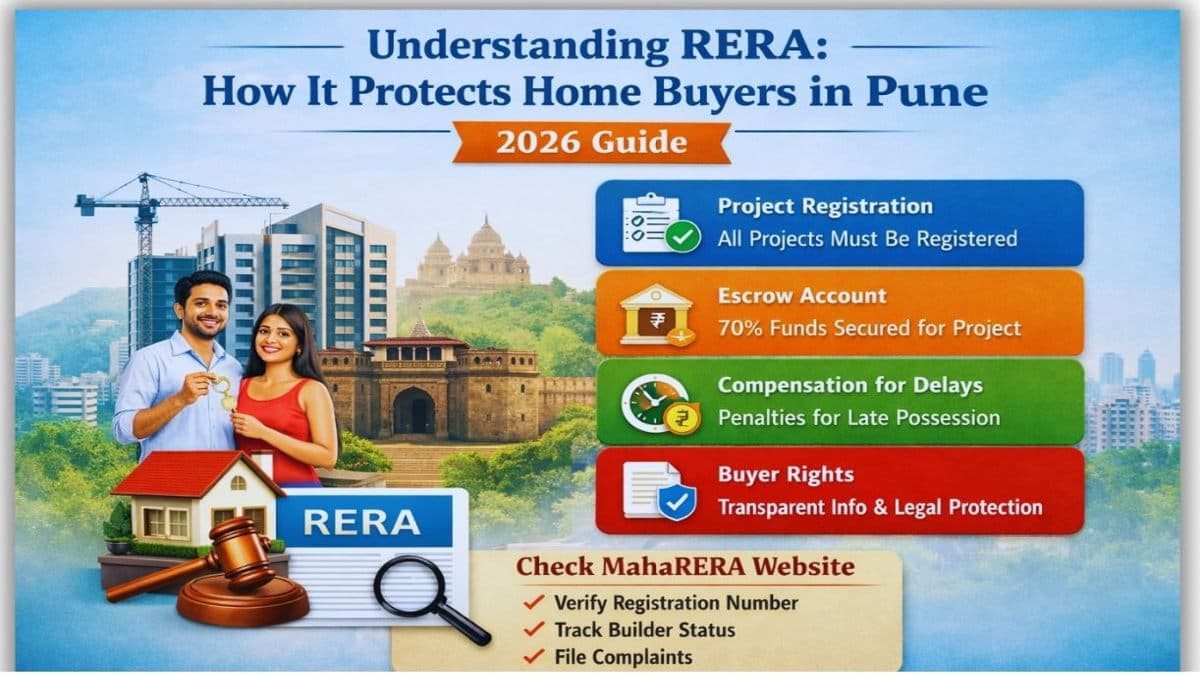
What is RERA?
RERA is the Real Estate (Regulation and Development) Act, 2016. It created a real estate regulator in every state so buyers don???t have to rely only on brochures, sales calls, and verbal ???sir, don???t worry??? promises. In Maharashtra, that regulator is MahaRERA.
For a Pune homebuyer, these RERA rules in Pune matter for one simple reason: they turn ???claims??? into ???records.??? Registration details, timelines, plans, and quarterly updates are all supposed to be available publicly. And if a commitment is broken (delay, mismatch, or non-disclosure), you can respond with proof instead of arguments.
This guide???s intent (informational, buyer-first)
This is not a sales pitch for any specific project. Think of it as a Pune buyer???s notebook: what to check, what to ask, what to save in writing, and what to avoid. Use it whether you???re looking in Wakad, Baner, Kharadi, or anywhere else in Pune.
Quick facts (2026): RERA rules that directly protect buyers
If you read nothing else, read this part. These are the rules that reduce the biggest buyer losses: delays, misinformation, and last-minute ???changes.???
- RERA number first, booking later: if a project is eligible, it should be registered on MahaRERA before it???s marketed or sold. No valid registration details usually means unnecessary risk.
- Applicability threshold: as a rule of thumb, projects on land above 500 sq. m. or with 8+ apartments fall under RERA registration (smaller ones can be exempt, so verify on the portal).
- The 10% payment gate: avoid paying beyond 10% until you have a registered Agreement for Sale. This one habit saves buyers from most ???token trap??? situations.
- Buyer money should stay in the same project: RERA requires stronger control on how collections are used, to reduce diversion from your project to someone else???s project.
- Carpet area is the real size: compare flats using carpet area (usable space). Treat ???saleable??? numbers as marketing, not measurement.
- Defect liability window: if there are serious defects after possession, buyers can push for rectification within the defect liability period.
- Big changes need buyer approval: for major layout/common-area changes, buyer consent is required as per RERA rules (don???t accept ???sir it will be minor??? as a substitute for written consent).
- Portal > promise: MahaRERA disclosures matter more than sales talk. Use the portal as your source of truth.
Step 1: A 12-minute MahaRERA check (before you visit any site)
Before you visit a site or pay a token amount, open the MahaRERA Portal and do this quick check. You???re looking for consistency between what???s being said in the sales office and what???s written on the official portal.
- Confirm the RERA registration number: match the project name, promoter name, and location spelling.
- Check the committed completion date: treat the portal date as the real timeline, not the brochure headline.
- Scan quarterly updates: if progress is repeatedly revised downward, expect delays.
- Look at litigations: a few minor items can happen, but repeated buyer complaints or land-owner disputes are serious.
What to save for your own records
Before you even book a site visit, save proof. It takes two minutes and it protects you later if the builder ???changes the story.??? Keep a simple folder on your phone called ???RERA - Project Name??? and save:
- A screenshot of the project overview page (project name, promoter name, RERA number).
- A screenshot of the committed completion date.
- A screenshot of the tower/phase details that match the unit you???re being sold.
- If available, a copy of the sanctioned plan / layout that the sales office is referencing.
A fast way to compare two projects
If you???re choosing between two areas, don???t compare only price. Compare risk. For example, when deciding between projects in Wakad and Baner, use the same checklist and write down the answers side-by-side:
- Carpet area: what you actually live in (ignore ???saleable area???).
- Committed completion date: what the portal says, not what the salesperson says.
- Litigations: none / minor / serious patterns.
- Phase clarity: your tower must be in the registered phase you???re paying for.
If you want a locality-first shortlist before you compare projects, start with our Pune locality guide for buyers: premium Pune projects.
Step 2: What to ask in the sales office (so you don???t get trapped)
Most buyers ask about the clubhouse and the view. Ask these instead. If the sales executive answers clearly and in writing, it???s a good sign. If they dodge, deflect, or push you to ???just pay the token,??? take that seriously.
- Carpet area: ???Show me the carpet area on the sanctioned plan and the RERA details.??? This is how you avoid paying for ???saleable area??? loading. Compare projects using carpet area, especially when you???re deciding between premium Pune projects.
- Possession commitment: ???What is the committed date on the MahaRERA portal and what grace period is written in the agreement draft????
- Floor / tower clarity: ???Is my tower and my floor in the currently registered phase, or is it ???future phase???????
- Token rule: ???Will you keep the total payment before registration within 10%???? If the answer is no, stop and reassess.
Copy-paste message you can send on WhatsApp or email
If you want to keep the conversation clean (and avoid ???sir, we said it on call???), send this message after your site visit:
???Hi, please share (1) MahaRERA registration number and committed completion date, (2) carpet area and unit plan for the flat I???m considering, (3) the draft Agreement for Sale with the grace period and payment schedule, and (4) a breakup of all charges including parking and maintenance. Thanks.???
Step 3: Agreement-day checks (where money leaks)
This is where buyers lose power: they sign fast, then try to ???fix??? problems later. Use this checklist before you sign and before you pay beyond the booking amount.
1) The 10% rule (your safety gate)
Keep your total payment before a registered Agreement for Sale within 10% of the total cost. A receipt or ???allotment letter??? is not equal to a registered agreement. If you???re unsure how the paperwork works, read our step-by-step registration guide.
Also, don???t underestimate your total cost at this stage. Many buyers calculate only ???flat price??? and forget the government charges. Use our detailed stamp duty and registration guide to estimate your real outflow before you commit.
2) The project fund discipline (70% account rule)
RERA requires most buyer collections to be used for that specific project. You don???t need to become a CA, but you should know this rule exists because it???s one of the biggest reasons RERA reduces fund diversion.
3) Charges that deserve extra scrutiny
Don???t accept surprise line-items at the last moment. If you???re funding through a bank, even ???small??? extra charges can snowball through your home loan planning and your monthly budget.
- Parking: ask what is covered and what is open, and what exactly you???re paying for.
- Maintenance advance: ask how it will be handled until the society is formed.
- Payment schedule: prefer milestone-based schedules over calendar-date schedules.
4) Possession date and grace period (read it like a buyer)
In Pune, many buyers hear a ???marketing date??? on the first visit and discover the real date only in the draft agreement. Don???t argue later???verify now. Ask the sales team to show the committed completion date on the portal and then check what the agreement says about any grace period. Treat the date after the grace period as your realistic deadline when planning rent and EMIs.
5) If the builder delays: your two clean options
When a delay happens, buyers usually get stuck because they respond emotionally. Keep it simple and choose one route:
- Stay invested: continue with the project, but claim interest for the delay as per RERA rules and your agreement.
- Exit: if you???ve lost confidence, ask for a refund with applicable interest, and move on to a cleaner project.
Six Pune red flags that should pause your booking
- No RERA number / ???soft launch???: if it isn???t registered, don???t pay.
- ???Proposed NA??? without clarity: treat legal uncertainty as risk, not as opportunity.
- Pressure tactics: ???price valid only today??? is not a reason to skip verification.
- Phase confusion: your tower must be in the registered phase, not ???coming soon.???
- Frequent completion-date extensions: patterns repeat.
- Unclear handover and society formation: it becomes your daily headache after possession.
If something feels wrong: a calm 3-step response plan
Most buyers lose leverage because they don???t keep records. If you face a clear mismatch between what was promised and what is being delivered, do this:
- Document: save screenshots, payment receipts, marketing PDFs, and messages. Keep dates.
- Write formally: send a short email summarizing the issue and what you want (correction, timeline, refund, interest).
- Escalate: if there???s no resolution, use the MahaRERA complaint route. Even if you later settle privately, having a documented trail keeps you protected.
After possession: where RERA still helps you
1) The 5-year defect window (use it properly)
If you see structural issues or serious workmanship problems within five years, document it with dated photos, write to the builder formally, and keep records. This is not about shouting on WhatsApp groups; it???s about creating evidence.
On possession day, do a slow walk-through and check the basics that cause long-term pain: seepage marks, window sealing, bathroom slopes, kitchen plumbing pressure, balcony drains, and electrical load. If you find something, record it on email immediately and ask for a closure timeline.
2) Society and conveyance (ownership beyond the flat)
Homebuyers often think ownership ends at keys. In reality, a clean society handover and proper conveyance matter for your long-term peace and for resale value. When society and conveyance are delayed, small issues (parking allocation, maintenance transparency, shared electricity/water bills) become everyday fights.
If you???re not comfortable reading the legal language, use a lawyer once and get clarity. It costs far less than fixing a mistake after registration. This connects directly to the paperwork discipline in our registration guide.
Conclusion: the buyer advantage in 2026
RERA doesn???t make every project perfect, but it gives honest buyers a clear advantage: you can verify claims, hold builders to written commitments, and avoid most ???surprise??? traps by doing basic checks early. If you???re researching more, follow our updates on Pinterest and keep your checklist handy during every site visit.
Mini checklist (save this before you book)
- RERA number verified on portal.
- Committed completion date saved as screenshot.
- Carpet area confirmed on plan, not just a sales PDF.
- Phase/tower is in the registered phase being sold.
- Payment schedule is milestone-based.
- All charges are written in the cost sheet (parking, maintenance, taxes).
FAQs
Q: Does RERA help if I???m buying a resale flat in Pune?
A: RERA is strongest for the builder-to-first-buyer relationship. For resale, your safety comes from document clarity, a clean chain, and proper society records. Still, learning RERA discipline helps you avoid weak projects and weak paperwork.
Q: Can a builder change layout or common areas after booking?
A: Major changes generally require buyer consent under RERA rules. Practically, always ask for the sanctioned plan and keep everything in writing.
Q: Should I take possession without an Occupancy Certificate (OC)?
A: Avoid taking possession without an OC. Without it, you can face problems with utilities, society approvals, and resale. If you???re considering it anyway, take a lawyer???s opinion and do a full document verification first.