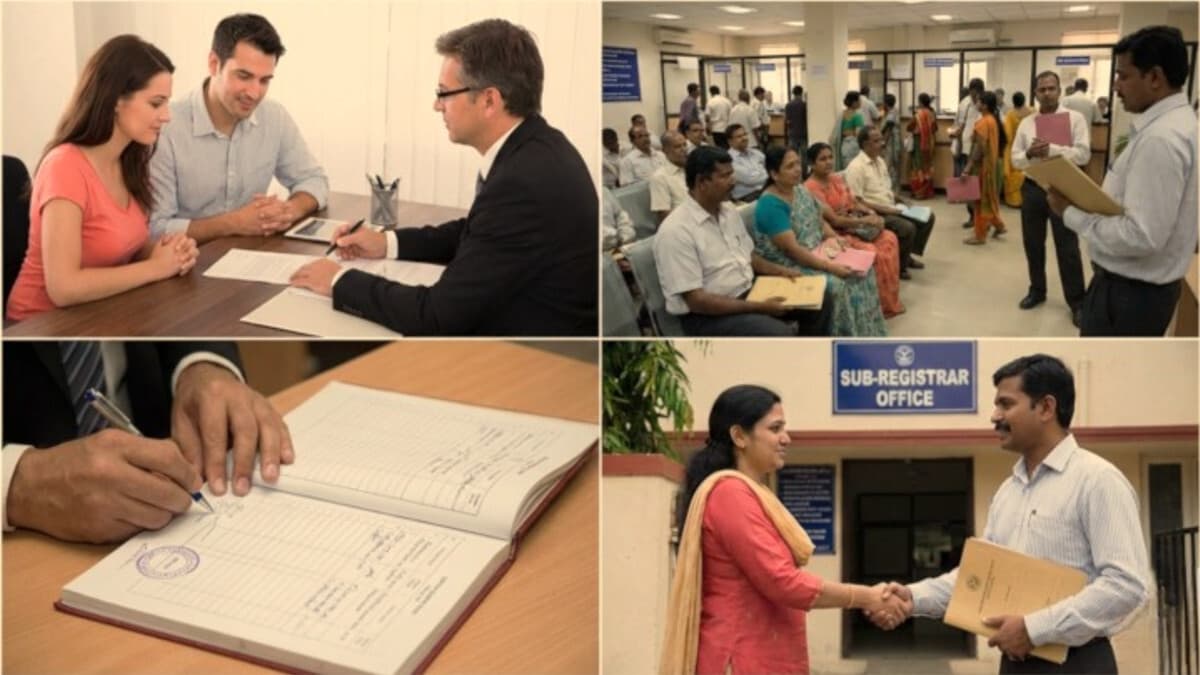
Buying a home in Pune is a life milestone, but the keys aren't truly yours until the government acknowledges the transfer. In 2026, the Department of Registration and Stamps, Maharashtra, has significantly digitized the process with iSarita 2.0, yet the ground reality is still a mix of smooth online forms and very human delays at the Sub-Registrar Office (SRO). This guide details the complete property registration workflow for flats and plots in Pune, helping you navigate the collision of online portals, SRO queues, and stamp duty rules efficiently.
Whether you are buying a pre-launch offer in Wagholi or a resale flat in Kothrud, the goal is to walk out with a clean registered deed instead of a pending file.
1. Why Registration is Non-Negotiable (The Legal Shield)
Under Section 17 of the Registration Act, 1908, any transaction involving the sale of immovable property worth over ???100 must be registered. It is not optional.
- Proof of Ownership: A notarized "Agreement to Sale" is merely a promise. The "Registered Sale Deed" is the proof. Without it, you are not the legal owner.
- Fraud Prevention: Registration enters the transaction into public records (Index II), preventing the seller from selling the same property to another buyer???a critical protection in Pune's fringe areas.
- Legal Recourse: In case of a dispute, courts will not accept an unregistered deed as evidence.
- Tax & Utility Transfer: You cannot transfer the electricity meter or property tax (PMC/PCMC) to your name without a registered deed.
2. Phase 1: Pre-Registration Due Diligence
Most registration failures happen because of what wasn't done before the SRO visit. Do not skip these checks. In Pune's rapidly expanding real estate market, where agricultural land is constantly being converted to non-agricultural (NA) use, due diligence is your only safety net.
A. Title Search (The 30-Year Rule)
For resale properties and plots, hire a property lawyer to conduct a 30-year Title Search. This traces the ownership history to ensure the chain is unbroken and free from litigation.
Why 30 years? In Maharashtra, the limitation period for government claims on land can extend up to 30 years. A 13-year search (common for flats) might miss an old family dispute or a pending court case from two decades ago.
Deliverable: Your lawyer should provide a "Title Search Report" and a "Public Notice" in local newspapers inviting objections.
B. Encumbrance Certificate (EC)
Obtain a 'Nil Encumbrance Certificate' from the SRO (Form 15). This certifies that the property has no registered mortgages or legal dues against it. If there is a loan, you will get Form 16 showing the liability.
Ground Reality: Often, old loans are paid off but the "Satisfaction Charge" is not removed from the EC. Ensure the seller clears this before you sign.
C. RERA Verification (For New Projects)
For under-construction properties, verify the project's RERA status on the MahaRERA website. Check our guide on RERA for more details:
- Litigation History: Are there complaints filed by other buyers?
- Completion Date: Does it match the builder's verbal promise?
- Mortgage Info: Has the builder mortgaged the specific flat/floor you are buying? If yes, get a NOC from their bank.
3. The Ultimate Document Checklist (2026)
Missing a single paper at the SRO means rescheduling your appointment???a major inconvenience you want to avoid. Carry the originals and two sets of photocopies.
For the Buyer
- PAN Card: Mandatory for deals >???50 Lakhs. If you don't have one, Form 60/61 is required (but highly not recommended for property deals).
- Aadhaar Card: For biometric authentication. Ensure your fingerprints are updated if you haven't used them in years.
- Address Proof: If Aadhaar address is different, carry a Passport, Voter ID, or Driving License.
- Payment Proof: UTR numbers for RTGS transfers or Demand Drafts (DD) for the balance payment. The SRO officer will enter these details in the deed.
- TDS Certificate (Form 16B): Proof that you deducted 1% TDS (for properties >???50L). You must pay this to the IT department before registration and carry the certificate.
- Passport Size Photos: Carry 2 recent photos, though webcams are used, backups are essential.
For the Seller
- Original Title Deed: The previous chain of agreements (Chain Deeds).
- Property Card / 7/12 Extract: Latest copy showing their ownership (less than 3 months old).
- Tax Receipts: Latest property tax paid receipt (no dues) from PMC/PCMC.
- NOC from Society: Essential for resale flats to prove no maintenance dues exist.
- Consent Letter: If there is a bank loan, a letter from the bank agreeing to the sale is required.
For Witnesses
Two witnesses are mandatory. They must be adults with valid ID proof (Aadhaar/PAN). They cannot be the buyers or sellers themselves.
Who can be a witness? Friends, relatives, or colleagues. Avoid paying "professional witnesses" or agents hanging around the SRO, as this can be risky.
4. Stamp Duty & Registration Charges (2026)
Pune's stamp duty rates depend on the location (Urban vs. Rural) and the buyer's gender. These are calculated on the Agreement Value or Ready Reckoner Rate, whichever is higher. Read more about Stamp Duty Charges here.
Note: The "Metro Cess" of 1% is applicable in Pune, increasing the effective rate.
| Location |
Men |
Women (1% Concession) |
Joint (M+W) |
| PMC / PCMC (Urban) |
7% (5% Stamp + 1% LBT + 1% Cess) |
6% |
6.5% |
| PMRDA / Rural |
5-6% (Depends on Gram Panchayat) |
4-5% |
Pro-rated |
Registration Fee: Flat 1% of the property value, capped at a maximum of ???30,000 for properties above ???30 Lakhs. For properties below ???30 Lakhs, it is 1% of the value.
5. Phase 2: The Online Process (iSarita 2.0)
You cannot walk into the SRO without online preparation. The entire data entry is now digital. This phase is usually handled by your lawyer or the developer's legal team, but you must verify the data.
Step 1: Data Entry (PDE)
Visit the IGR Maharashtra website and access the Public Data Entry (PDE) module. Enter details of the property, buyer, and seller. Upload drafts of the Sale Deed.
Critical Check: Ensure the "Schedule of Property" (boundaries, area, floor plan) exactly matches the approved building plan.
Step 2: Payment (e-Challan)
Pay the Stamp Duty and Registration fees via the GRAS (Government Receipt Accounting System) portal. You can pay via Net Banking, UPI (limited limit), or generate a challan to pay at a bank branch.
Tip: Always print 5 copies of the e-Challan (MTR Form 6). The Defaced Challan number (GRN) is the most important proof of payment.
Step 3: Slot Booking (e-Step-in)
Once paid, use the 'e-Step-in' feature to book your appointment at the relevant SRO.
Note: Pune SROs are zoned. You must go to the SRO assigned to your property's Tehsil/Zone.
Step 4: Troubleshooting iSarita Glitches
The system can be temperamental.
- Browser: Use the latest version of Firefox or Chrome. Internet Explorer is no longer supported.
- Pop-ups: Enable pop-ups for the IGR website, otherwise, the challan generation window won't open.
- Session Timeout: Save your PDE draft every 5 minutes. The system logs out quickly.
6. Key SRO Locations in Pune (Know Your Office)
Going to the wrong office is a common rookie mistake. Here is a quick guide to major SROs in Pune (subject to change by IGR notifications):
| SRO Name (Haveli) |
Key Areas Covered |
Location/Landmark |
| Haveli No. 1 to 5 |
Central Pune, Kothrud, Shivajinagar |
Photo Zinco Press (Near GPO) |
| Haveli No. 21 & 22 |
Wakad, Hinjewadi, Pimple Saudagar |
Thergaon (Near Dange Chowk) |
| Haveli No. 23 |
Baner, Balewadi, Pashan |
Baner (Near Pan Card Club Road) |
| Haveli No. 25 |
Hadapsar, Kharadi, Wagholi |
Magarpatta City / Hadapsar Ind. Estate |
Always verify your specific jurisdiction on the IGR website as new offices are added frequently.
7. Phase 3: The SRO Visit (Ground Reality)
On the D-Day, arrive 30 minutes early. Here is what happens inside, based on ground reality at busy offices like Haveli No. 23 or Haveli No. 5:
The "Token" System
Even if you have a booked slot (e.g., 11:00 AM - 11:20 AM), you don't walk straight to the officer's desk. You first show your slot booking receipt to the counter clerk to get a physical "Token Number". Then you wait in the seating area until your number is called on the display board.
Document Check & Scrutiny
Before the biometric stage, a scrutiny officer will check your original IDs against the data entered in the PDE.
Critical Tip: Ensure your name spelling on the Deed matches your Aadhaar exactly. "Rahul Kumar" vs "Rahul K." can cause a rejection or delay while you file a correction affidavit.
Biometrics & Photos
When called, the buyer, seller, and two witnesses go to the Sub-Registrar's desk.
- Thumb Impressions: You will give thumb impressions on a digital scanner. If you have worn-out prints (common for senior citizens), bring a wet wipe to clean your fingers or ask the officer for alternative verification (iris scan is rarely available, so thumb is key).
- Webcam Photos: Look straight at the camera. Do not wear hats or dark glasses. The photo taken here appears on the final Index II.
Signatures (Summary 1 & 2)
You will physically sign two summary sheets generated by the system. Check the details on these sheets (Property Description, Amount) before signing. This is your last chance to catch errors.
The "Server Down" Reality
The iSarita server often faces load issues, especially on Mondays and Fridays. Lunch hours (1:30 PM - 2:30 PM) are strictly observed, and no registrations happen then. Plan for a 3-4 hour buffer, even for a 20-minute slot. Bring water and snacks, as facilities at some SROs are basic.
8. Phase 4: Post-Registration Mutation (Ferfar)
Warning: 90% of buyers forget this step. A registered deed makes you the owner, but the government records (Tax/Revenue) don't update automatically.
For Flats (PMC/PCMC)
Submit your Registered Sale Deed and Index II to the local Ward Office. Fill out the transfer form to change the name on the Property Tax bill. This ensures future tax bills come in your name.
Timeframe: 21-45 days.
For Land/Plots (The 7/12 Extract)
Submit your documents to the Talathi office. The Talathi will issue a "Mutation Entry" (Ferfar) notice. If no objections are received within 15 days, your name is added to the 7/12 extract.
Why it matters: Without the Ferfar, you cannot sell the land or get a loan on it later.
9. Common Mistakes to Avoid
- Power of Attorney (POA) Risks: Avoid properties sold via Power of Attorney (POA). Ensure the principal owner is present to sign.
- Cash Components: Never pay cash components. You have no legal claim to money not mentioned in the agreement.
- Ignoring the "Receipt": Always collect the 'Original Document Return' receipt. You need it to claim your deed later.
Conclusion: The Final Seal
Property registration in Pune is not just a bureaucratic formality; it is the definitive proof of your hard-earned asset. While the online iSarita 2.0 system has streamlined data entry, the physical verification at SROs like Haveli requires patience and preparation. By following this guide???verifying titles, paying the correct stamp duty, and ensuring biometric authentication???you secure not just a piece of land, but your peace of mind. Don't leave the final step to chance; own your property, legally and completely.
Frequently Asked Questions (FAQ)
Q1: Can I register online without visiting the SRO?
No, physical presence for biometric verification is mandatory for resale deals. Only first-sale flats from select developers allow full e-registration.
Q2: What if the server is down?
It happens. You'll have to wait. If it's a major outage, you may need to reschedule. Always book morning slots to avoid backlog.
Q3: How much cash should I carry?
Registration is cashless. However, keep small cash for photocopying or incidental expenses nearby.
Q4: Is a lawyer mandatory?
Not legally, but highly recommended for title verification and navigating the iSarita system.
Q5: What is the "Home Visit" facility?
For bedridden or very elderly citizens who cannot travel, the SRO officer can visit the home for registration upon special application and fee payment.