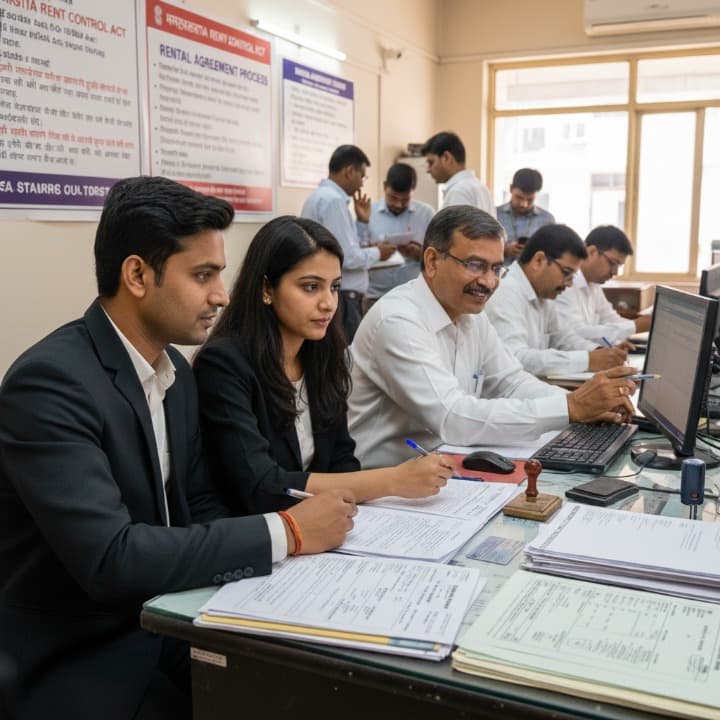
Rental Agreement Registration Process in Pune
Finding a flat on rent in Pune is not difficult today. Whether you are looking near the IT parks of Hinjewadi and Kharadi, older family areas like Kothrud and Karve Nagar, or newer pockets in Wakad and Baner, there is no shortage of options. The real confusion usually starts when it is time to sign the rent agreement.
Many tenants and even some owners still treat the agreement as a small formality. They download a random template, print it on simple paper or low-value stamp paper, sign it quickly, and move in. Problems appear later—during police verification, while updating address proof, or when there is a fight about deposit refund or notice period.
In Maharashtra, and especially in cities like Pune and Pimpri-Chinchwad, a properly stamped and registered leave and licence agreement is now the standard. It protects both landlord and tenant, and it is often required by banks, employers, schools, and government departments as valid address proof.
This guide is written as a practical, human-friendly explanation of the rental agreement registration process in Pune. It covers the basics of leave and licence, required documents, how stamp duty and registration charges are generally calculated, the step-by-step online process on the IGR system, and the most common mistakes people make.
1. Why a Registered Rent Agreement Matters in Pune
Legal position in Maharashtra
Most residential rentals in Maharashtra use a leave and licence agreement rather than a traditional lease. In simple terms, the owner gives the tenant permission to stay for a fixed period, but no long-term tenancy rights are created. This is why owners are usually comfortable with 11‑month agreements in Pune.
Under the Registration Act and the Maharashtra Rent Control Act, agreements that go beyond a certain duration are expected to be registered. In practice, the state has strongly pushed for registration even for standard 11‑month agreements and has made it easy to complete the process online for cities like Pune.
A registered agreement clearly mentions the parties, property, rent, deposit, duration, lock‑in, and other terms. Because it is registered with the government, it carries much more evidentiary value in case there is a dispute about non‑payment of rent, misuse of the flat, or refusal to vacate after the term.
Practical benefits day to day
For tenants and owners in Pune, a registered agreement is useful far beyond the legal theory:
- It works as accepted address proof for opening bank accounts, updating Aadhaar, school admissions, HR records, and passport police verification.
- Many societies in Pune, especially in gated communities and high‑rise towers, insist on a registered agreement plus police verification before giving access cards or stickers.
- Owners get clarity on conditions under which they can ask the tenant to vacate, how much notice is required, and what happens if rent is not paid.
- Tenants get written terms for deposit refund, deductions, and repair responsibilities, which reduces emotional arguments at the time of vacating.
If you are still in the house‑hunting stage, you can first shortlist options using flats for rent in Pune and then use this guide to complete the paperwork correctly.
2. Basics of Rent Agreements in Pune
Leave and licence versus lease
In a leave and licence arrangement, the owner allows the tenant to use the premises for a limited period, subject to the conditions written in the agreement. No permanent tenancy rights are created, so it is comparatively easier for the owner to take back possession when the term ends.
In a traditional lease, the tenant usually gets stronger, more long‑term rights. That structure is less common for typical residential apartments in Pune because it reduces flexibility for owners. As a result, most 1 BHKs near IT parks, 2 BHK family homes, and 3 BHK premium flats in areas like Magarpatta or Koregaon Park are let out on 11‑month leave and licence agreements.
What a good Pune rent agreement should cover
The format may change from broker to broker, but a clear and balanced agreement usually includes:
- Full names, addresses, and ID details (PAN, Aadhaar) of owner and tenant.
- Complete property description: building name, wing, flat number, floor, society name, and exact location.
- Monthly rent, due date every month, and payment mode (bank transfer, UPI, cheque).
- Refundable security deposit amount and conditions for deductions at the end of the term.
- Duration of the agreement, any lock‑in period, and notice period for both parties.
- Responsibility for society maintenance, electricity, gas, internet, and minor repairs.
- Limits on number of occupants, rules about pets, visitors, and prohibition of commercial or illegal use.
When these points are written clearly in a registered document, both sides know what to expect. This reduces misunderstandings and makes the relationship more professional.
3. Documents Required for Rent Agreement Registration in Pune
To complete registration smoothly, it helps if owner and tenant collect their documents in advance.
Owner (licensor) documents
- PAN card.
- Aadhaar card.
- Recent passport‑size photograph.
- Any one ownership proof: electricity bill, property tax receipt, or registered document / Index II.
- Bank details if the agreement mentions rent and deposit to be paid by transfer.
Tenant (licensee) documents
- PAN card (normally expected for salaried professionals and most corporate tenants).
- Aadhaar card or other valid government photo ID.
- Two recent passport‑size photographs.
- Office ID card or employment letter in case of company‑backed rentals.
Witness and property‑related details
- Details of two witnesses with Aadhaar and photographs, as they are also part of biometric verification in online registration.
- Accurate flat details as per society / property records: building name, wing, flat number, carpet area if available, and parking details.
- Society name, registration number (if known), and full postal address with PIN code.
Owners who rent their flats regularly in Pune often keep a small digital folder with scanned documents. This simple habit makes every new agreement faster to complete.
4. Stamp Duty and Registration Charges in Pune
Every registered leave and licence agreement in Maharashtra attracts stamp duty and a separate registration fee. The exact amounts depend on government notifications that can change over time, so you should always confirm current figures on the official IGR Maharashtra website or with a professional.
For typical short‑term residential agreements in Pune (up to five years), stamp duty is generally a small percentage of the total value considered for the agreement. In many common situations, this works out to roughly a fraction of a percent of the total of agreed rent over the term plus a notional value of the deposit. Registration charges are usually a separate fixed amount for properties within municipal corporation limits such as Pune and Pimpri‑Chinchwad.
Illustrative example for a Pune 1 BHK
Consider a standard 11‑month agreement in an area like Wakad or Kharadi with the following terms:
- Monthly rent: ₹20,000.
- Agreement duration: 11 months.
- Refundable security deposit: ₹60,000.
For duty calculation, the system generally looks at:
- Total rent over the term (monthly rent multiplied by number of months).
- A notional interest component on the deposit.
- Any other amounts specifically mentioned as part of the consideration.
On the IGR portal or authorised service provider software, you will see the duty and registration fee calculated automatically once you enter these values. This is the safest way to avoid underpayment or penalties, instead of doing rough calculations on your own.
5. Online Rent Agreement Registration in Pune (IGR System)
For most straightforward residential flats in Pune, the state government encourages full online registration. This saves owners and tenants from standing in long queues at the Sub‑Registrar office.
Step 1: Finalise and draft the agreement
First, owner and tenant should agree on key terms—rent, deposit, duration, notice period, lock‑in, maintenance responsibilities, and any special conditions like pets or painting. Then a draft leave and licence agreement is prepared using these terms. Avoid vague phrases and make sure everything important is written clearly.
Step 2: Start the entry on the IGR e‑registration portal
Visit the official IGR Maharashtra e‑registration website and choose the leave and licence option. Create a login if you do not already have one, select “New Entry”, and fill in the details of owner, tenant, and property. Choose Pune district and the correct police station / locality from the drop‑down list.
Step 3: Upload documents and pay charges
Upload scanned copies of Aadhaar, PAN, photographs, and the draft agreement text as required. The system will display the stamp duty and registration fee payable for your particular case. Payment can usually be completed online through net banking, UPI, or cards.
Step 4: Book and complete biometric verification
After successful payment, you can choose how you want to complete biometric verification. Many people prefer an authorised operator who visits the flat or office with a biometric device, while others go to a nearby centre.
On the scheduled date, fingerprints and photographs of owner, tenant, and witnesses are captured. Aadhaar details are verified at the same time. Once this step is finished, the agreement is digitally signed and submitted into the registration system.
Step 5: Download the registered agreement
After the document is processed, you receive an SMS or email with confirmation and the registration number. The registered rent agreement can then be downloaded as a digitally signed PDF. It is a good idea to store the soft copy safely and keep at least one printed copy for society, HR, or school requirements.
6. Offline Registration at the Sub‑Registrar Office
Some situations still require or justify offline registration at the Sub‑Registrar office—for example, longer‑term agreements, commercial premises, or where the ownership structure is complicated.
Basic steps if you choose offline
- Prepare the leave and licence agreement on appropriate stamp paper or franked paper with the correct duty paid.
- Carry original IDs, photographs, and ownership documents for the owner and tenant.
- Visit the concerned Sub‑Registrar office with both parties and two witnesses.
- Complete token issue, document checking, payment of any remaining charges, biometric verification, and signing before the officer.
- Collect the receipt and later obtain or download the registered copy once it is updated in the system.
For a typical 11‑month residential flat in Pune city, the full online route is usually simpler and faster. Offline registration is more relevant when the transaction is large, complex, or where professional advisers specifically recommend it.
7. Who Usually Pays Stamp Duty and Registration in Pune?
Maharashtra law allows owner and tenant to decide between themselves who will bear stamp duty and registration charges. On the ground in Pune, a common practice for residential agreements is:
- The tenant pays both stamp duty and registration fees for a standard flat on rent.
- For high‑value or corporate leases, the cost is sometimes shared or paid by the company as part of the relocation package.
Whatever arrangement you agree on, mention it clearly in the agreement so that there is no confusion on the day of biometrics or registration.
8. Police Verification of Tenants in Pune
Pune Police and many housing societies strongly encourage or require tenant police verification. This is treated as an important safety measure, not just another formality.
The process can often be started online by filling a simple form and uploading the registered rent agreement, ID proofs, and basic details of the tenant and owner. In some cases, a visit by local police staff may also be scheduled.
From the owner’s point of view, proper police verification records that the flat has been let out with full documentation. If a serious issue arises later, this gives additional protection. For tenants, it proves that they are staying with clear consent of the owner and are not hiding their address.
If you plan to put your flat on rent after completing all paperwork, you can reach genuine tenants by using platforms like post property for free in Pune and sharing the registered agreement and verification status upfront.
9. Common Mistakes Pune Landlords and Tenants Should Avoid
Trying to save a little by skipping registration
Some owners and tenants still sign an unregistered agreement on plain paper or very low stamp duty to save a small amount. This often backfires. In disputes about deposit, rent default, or damage to the flat, an unregistered document carries weaker evidentiary value and creates uncertainty for both sides.
Keeping important terms verbal instead of written
Verbal promises such as “rent will not increase for two years” or “painting will be done before the next cycle” are easy to forget or deny. If a point is important to you—about notice, rent increase, repairs, or use of parking—make sure it is written clearly in the agreement.
Ignoring maintenance, repairs, and appliance responsibilities
Many day‑to‑day fights in Pune’s societies happen because the agreement is silent on who pays for minor repairs, servicing of air‑conditioners, or replacement of small items. A few clear lines about responsibilities can prevent months of arguments.
Not updating documentation when parties change
If the flat is sold to a new owner or if the tenant changes before the term ends, it is safer to execute a fresh agreement instead of making informal changes on an old document. This keeps your paperwork clean and makes future legal checks easier. If there is any doubt about ownership, you can refer to guides like how to check property ownership online in Maharashtra before signing.
10. FAQs on Rent Agreement Registration in Pune
Q1. Is registration compulsory for an 11‑month rent agreement in Pune?
In practice, yes. Many people still speak of 11‑month “unregistered” agreements, but housing societies, banks, and police treat a registered document as the proper standard. For most genuine rentals in Pune, completing registration is the safest option for both owner and tenant.
Q2. How long does online rent agreement registration usually take?
If documents are ready and all parties attend biometrics on time, the process—from filling details on the portal to receiving the registered PDF—can commonly be completed within a few working days. Delays normally happen when information does not match Aadhaar or someone misses a scheduled biometric appointment.
Q3. Can NRI owners register a rent agreement for their Pune flat?
Yes. NRI owners often give power of attorney to a trusted person in India. That authorised person then signs and attends biometrics on their behalf, and the agreement clearly records the power of attorney details.
Q4. Who keeps the original registered agreement?
Modern registered agreements are issued as digitally signed PDFs. Both parties can download and keep identical copies. If any authority needs a hard copy, either party can print it and self‑attest it as a true copy. There is no concept of only one party holding a better “original”.
Q5. What happens if stamp duty is not correctly paid?
If stamp duty is found to be short, authorities can ask for the deficit duty along with penalty, and the agreement may not be treated as properly stamped until the issue is resolved. It is always better to rely on the official calculator or a knowledgeable service provider instead of guessing the amount.
Conclusion
A registered rent agreement in Pune is much more than a piece of paper. It is a simple tool that protects the owner’s asset, gives the tenant stability and clarity, and supports police verification and other KYC processes.
When you understand the basics of leave and licence, keep your documents ready, use the official e‑registration system carefully, and write down key terms clearly, the entire process becomes straightforward. Whether you are moving closer to your office in Hinjewadi, shifting your family to Kothrud, or renting out an investment flat in Kharadi, giving proper attention to documentation is one of the smartest decisions you can make.
If you still have specific doubts about your case—for example, co‑ownership, company leases, or unusual rent structures—it is always wise to speak to a local property lawyer or experienced service provider before you sign.