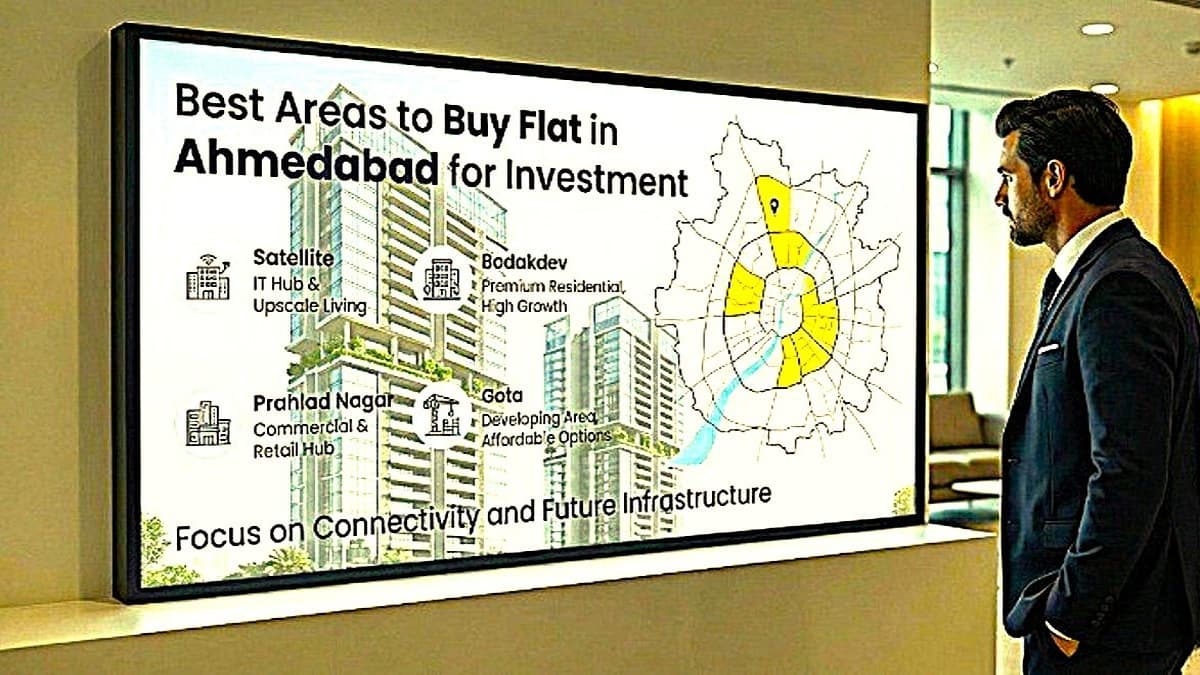
Ahmedabad is a conservative market. Unlike Mumbai or Bangalore, people here don't buy "stories"; they buy land. But in 2026, the game has changed. With the Metro Phase-2 expanding and GIFT City finally hitting critical mass, the old logic of "Buy anywhere in West Ahmedabad" is dead.
If you are an investor looking for ROI (Return on Investment), you need to stop looking at Satellite or Prahladnagar. Those ships sailed 10 years ago. The entry price is too high (???8000+ per sq. ft.), and the appreciation is stagnant. The real money today is in the "Emerging Corridors" where infrastructure is actually being built, not just promised.
Here is the data-backed, street-smart guide to where you should put your money in Ahmedabad this year. We are not selling you a project; we are telling you where the locals are putting their cash.
1. The "Gota-Godrej Garden City" Corridor (The Rental King)
The Logic: Gota is no longer an "upcoming" area; it is the new center of North-West Ahmedabad. Geographically, it acts as a funnel. Everyone coming from North Gujarat (Mehsana, Palanpur, Kalol) hits Gota first. This ensures a permanent stream of migrants looking for rental homes.
The Reality Check:
Why does it work? Because of the S.G. Highway Flyovers. You can reach Sola Civil Hospital, the High Court, and even the corporate offices in Prahladnagar without stopping at a single traffic signal. This connectivity is very strong for tenants.
Investment Potential:
- Entry Price: ???4500 - ???5500 per sq. ft.
- Rental Yield: High (3.2%). A furnished 2BHK rents for ???20,000 - ???24,000.
- Target Tenant: High Court lawyers, Sola Civil doctors, and corporate employees.
The Catch: Traffic at Vaishnodevi Circle is still a nightmare during peak hours (9 AM and 7 PM). Also, verify the water source. Some older schemes in Gota still depend on borewell water with high TDS. Ensure the society has a Narmada connection.
2. Shela & Ghuma (The "Affordable Bopal")
The Logic: South Bopal (SoBo) became too expensive for the middle class (touching ???6000+ per sq. ft.). The natural spillover went to Shela. It is a planned area with wide TP roads, unlike the congested lanes of Bopal.
The Reality Check:
Shela is unique because it hosts "Mega Townships" (like Goyal, Applewoods, Sky City). These are not just buildings; they are mini-cities. This attracts young families who want clubhouses, pools, and security but can't afford Prahladnagar.
Investment Potential:
- Entry Price: ???4000 - ???5000 per sq. ft.
- Capital Appreciation: High. As the SP Ring Road connectivity improves with new flyovers, the price gap between Bopal and Shela will shrink.
- Target Tenant: Young couples, IT professionals working in Makarba/Prahladnagar.
The Catch: Water Scarcity. In the summers of 2024 and 2025, Shela faced severe water issues. While AUDA is laying new pipelines, you must check the "Water Tanker" register of the society before buying. If they are ordering 10 tankers a day, avoid that scheme for investment.
3. The GIFT City Impact Zone (Raysan, Kudasan, Randesan)
The Logic: Everyone is talking about GIFT City. But smart investors know you don't buy inside GIFT City for residential purposes unless you enjoy high maintenance and isolation. You buy near it.
The Reality Check:
Raysan and Kudasan are the "Gurgaon" to GIFT City's "Delhi". They are just across the bridge. They offer a developed social life (cafes, gyms, schools) which GIFT City currently lacks. Employees of JP Morgan, Bank of America, and the new Fintech firms prefer living here and driving 10 minutes to work.
Investment Potential:
- Entry Price: ???5000 - ???6500 per sq. ft. (Cheaper than GIFT's ???8000+).
- Rental Yield: Very High. Corporate leases are common here.
- Future Catalyst: The Metro expansion connecting Gandhinagar to Ahmedabad is a game-changer.
The Catch: The "Agriculture" Scam. Many lands here are still "Proposed NA" or agricultural. Do not buy a plot or flat without seeing the "Raja Chitthi" (Building Permission) and RERA number. Agents will promise "future NA"???do not believe them. For anyone comparing flats with open plots around Ahmedabad, the plot buying and land risk guide explains how "Proposed NA" and fragmented layouts can trap your money. If you are new to RERA, the RERA basics guide for homebuyers helps you read approvals correctly before paying a token.
4. Motera & Chandkheda (The "Stability" Choice)
The Logic: This is not a speculative market. It is driven by two giants: ONGC and the Narendra Modi Stadium. It is a stable, mature market with low risk of a property bubble.
The Reality Check:
Motera is the best-connected area in Ahmedabad today. You have the Metro, the BRTS, and the Ring Road all converging here. For a conservative investor who wants steady rent and easy liquidity (ability to sell quickly), this is the spot.
Investment Potential:
- Entry Price: ???4500 - ???6000 per sq. ft.
- Liquidity: Excellent. You can sell a flat here in 30 days.
- Target Tenant: PSU employees (ONGC), Government staff, and Metro commuters.
The Catch: It is crowded. The roads are narrow in the old pockets. Parking is a major issue in older societies. Always buy in a scheme with allotted parking.
5. Areas where investment returns are weak
Not every area gives a sensible risk-adjusted return. In 2026, be careful with these pockets:
A. Sindhu Bhavan Road (SBR) - Residential
SBR is attractive for cafes and lifestyle, but weak for residential ROI. The property prices are inflated (???10,000+ per sq. ft.), but the rentals haven't kept pace. You may buy a ???3 Crore flat and get about ???50,000 rent. That's roughly a 2% yield???lower than a basic savings product. Most buyers here focus on lifestyle and status, not returns.
B. Naroda / Nikol (Deep East)
These are "End-User" markets. People buy here to live forever. There is no "Migrant Population" or corporate workforce moving in and out. If you buy here, you will struggle to find a tenant, and selling will take months because the demand is purely local.
C. Dholera (The "Paper" City)
Unless you have a 10-year horizon and can hold the asset through multiple policy and infrastructure cycles, be cautious. The ground reality still lags behind the marketing brochures. It remains a long-term, higher-risk bet rather than a 2026-focused investment.
6. The Investment Math: Don't Forget the "Hidden" 10%
In Ahmedabad, the "Builder Price" is just the start. You need to factor in the real acquisition cost. If a builder quotes ???50 Lakhs, your actual cost is:
- Base Price: ???5,000,000
- Stamp Duty & Registration: ~5.9% (???2.95 Lakhs). (4.9% Duty + 1% Reg). Read our Stamp Duty Guide for female waivers.
- GST: 5% (for under-construction) or 0% (for BU permission received).
- AMC Tax & Maintenance Advance: ~???1.5 Lakhs.
- Legal & Loan Charges: ~???50,000.
Total Cost: ~???55-56 Lakhs. Your appreciation calculation starts from this number, not ???50 Lakhs.
Before you commit to any of these areas, cross-check whether your loan and EMI capacity really support this total cost. The home loan eligibility guide for Ahmedabad walks through how banks look at income, FOIR and Jantri gaps.
7. How to match the area with your profile
Not every investor has the same risk capacity or time horizon. Before choosing an area to buy a flat in Ahmedabad for investment, match your own profile to the locality type instead of chasing the latest trend.
- Conservative investor needing stable rent: Focus on Motera, Chandkheda and established parts of Gota where vacancy is low and tenants usually stay longer.
- Working professional planning to shift in later: Shela, Ghuma and parts of South Bopal suit buyers who may live in the flat after a few years and are comfortable with moderate appreciation plus steady rental demand till then.
- Higher risk appetite with longer horizon: The GIFT City impact belt (Raysan, Kudasan, Randesan) can work if you are comfortable holding for 7???10 years and are ready to track legal approvals and infrastructure progress closely.
This simple matching exercise answers a common question???how to choose the best area to buy a flat in Ahmedabad for investment in 2026???without getting distracted by marketing pitches.
Conclusion: Be Boring, Be Profitable
Real estate investment in Ahmedabad is not about finding the "next big thing". It is about following visible infrastructure and demand patterns. The Metro line and the S.G. Highway flyovers have defined the growth corridors for the next 5 years.
Look at the water connection, the traffic node, and the job hub nearby, not just the sample flat. Gota, Shela and the GIFT City impact zone are practical choices for 2026 if the numbers fit your profile.
And finally, ensure your paperwork is complete. A "Banakhat" (Agreement to Sale) is not ownership. A "Sale Deed" is. Follow the Registration Process step by step so that your documents match your investment plan.
Frequently Asked Questions (FAQs)
1. Is it safe to invest in "Pre-Launch" projects in Ahmedabad?
It is high risk. In Ahmedabad, "Pre-Launch" often means the builder hasn't even received the Rajachitthi (Commencement Certificate). You might get a 10% discount, but you risk your capital getting stuck for years. Only invest if the project has a valid RERA Registration Number displayed on the site. No RERA, No Deal.
2. Which area has the highest rental yield in Ahmedabad?
Gota, Chandkheda, and Vaishnodevi Circle. These areas command the highest rent-to-price ratio because of the floating population from ONGC, the High Court, and SG Highway corporates. You can expect a 3% to 3.5% yield here, compared to 2% in Satellite.
3. Should I buy a Plot or a Flat for investment in 2026?
Plots usually win on appreciation (12-15% CAGR), while flats offer rental income. However, plots in Ahmedabad are prone to encroachment and "Title Issues" (Farmers claiming rights later). If you buy a plot, buy in a gated "Plotted Scheme" by a reputed developer (like Adani or Arvind) where boundary walls and security are managed. For pure peace of mind, a Flat is safer. Before finalising, compare the long-term tax and registration costs in the Ahmedabad stamp duty and registration guide as well.
4. Is Ahmedabad real estate expensive compared to Pune or Bangalore?
No, it is significantly cheaper. A premium 3BHK in Shela costs ???80-90 Lakhs. A similar property in Pune (Baner) would cost ???1.8 Crores, and in Bangalore (Whitefield), ???2.5 Crores. Ahmedabad remains an affordable market with steady, non-volatile growth.
5. What is the "Super Built-up" vs "Carpet Area" scam?
In Ahmedabad, builders sell on "Super Built-up Area" (SBA). The "Loading" is typically 40-45%. If you buy a 2000 sq. ft. SBA flat, your actual carpet area (usable space) is only about 1100-1200 sq. ft. Always ask for the RERA Carpet Area before comparing prices. Don't pay for the air in the elevator shaft.