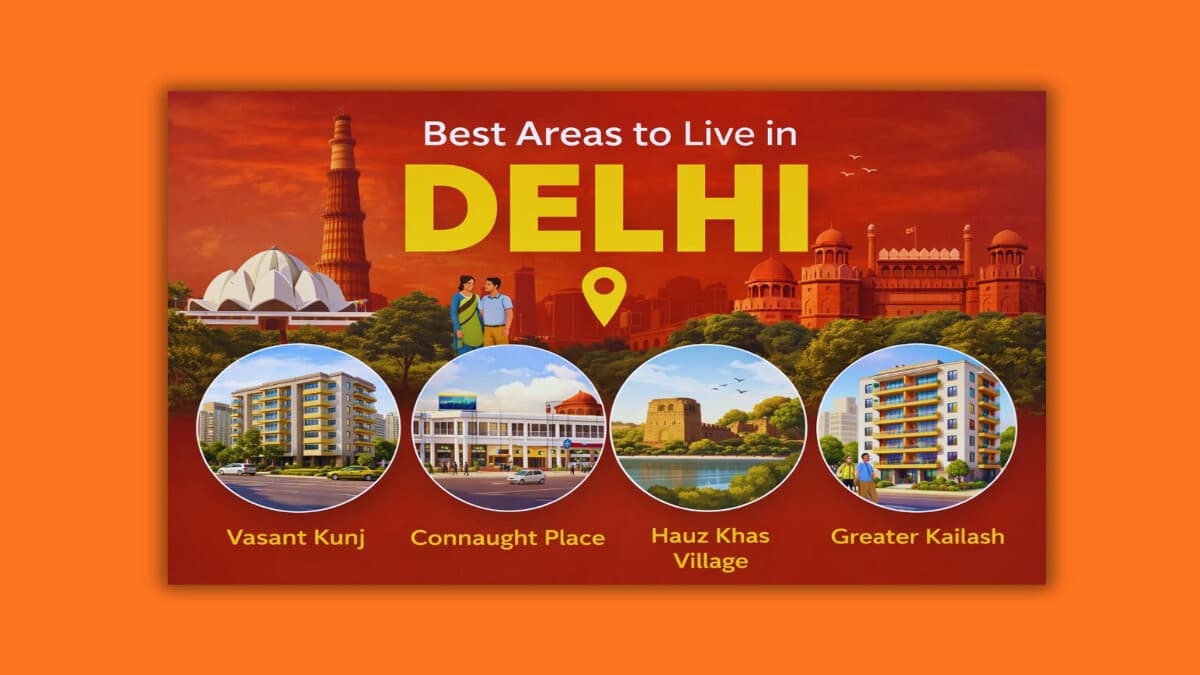
Moving to Delhi is not just about finding a house; it is about choosing a lifestyle. Delhi is not one city; it is seven cities layered on top of each other. A person living in the wide, tree-lined avenues of Chanakyapuri or Jor Bagh experiences a completely different Delhi than someone navigating the chaotic, energetic lanes of Laxmi Nagar or Uttam Nagar.
If you choose the wrong area, Delhi can break you. You might end up spending 3 hours daily in traffic on the Ring Road, or fighting for water tankers in summer, or paying exorbitant rent for a "matchbox" in a posh pincode. But if you choose right, Delhi is the best city in India???green, connected, and incredibly vibrant.
This guide is not a generic "Top 10" list generated by AI. This is a street-level breakdown of Delhi's residential pockets for 2026, categorized by who you are: a student, a corporate professional, a family, or a budget-seeker. We cover the ground realities???from water pressure to metro connectivity???that brokers won't tell you.
1. The "Golden Rule" of Living in Delhi
Before you look at specific colonies, understand the three non-negotiables of Delhi life:
- The Metro Lifeline: Never live more than an ???20 auto-rickshaw ride away from a Metro station. The Delhi Metro is the only reliable way to beat traffic. If your house is "20 mins from Metro," you will hate your life in summer.
- The Parking War: In "Builder Floor" colonies (like Lajpat Nagar, Malviya Nagar), parking is a war zone. If you have a car, do not sign the Rent Agreement until you have a designated, written parking spot.
- The Water Reality: South Delhi generally gets Ganga water (soft). West and South-West Delhi often rely on borewell water (hard/salty) or tankers. Check the TDS level of the water before moving in.
2. South Delhi: The "Status" & "Lifestyle" Hub
Best For: Corporate Professionals, Expats, affluent Families.
South Delhi is what people imagine when they think of "Posh Delhi." It is green, has the best markets, and is centrally located. However, it is also the most expensive.
A. Saket & Malviya Nagar (The Youth Hub)
If you work in Gurgaon but want to live in Delhi, this is your best bet. Located right on the Yellow Line, these areas are vibrant, full of cafes (Champa Gali), and have massive malls (Select Citywalk).
- The Vibe: Young, energetic, slightly chaotic traffic.
- Rent: 1 BHK (???25k - ???35k), 2 BHK (???45k - ???65k).
- Reality Check: Malviya Nagar lanes are extremely narrow. Fire trucks struggle to enter. Check the approach road.
B. Greater Kailash (GK-1 & GK-2) & Defence Colony
This is old money. Big kothis, parked luxury cars, and exclusive markets (M-Block). It is quiet, safe, and expensive.
- The Vibe: Sophisticated, private, guarded.
- Rent: Independent Floors start from ???80k and go up to ???3 Lakhs.
- Reality Check: Even here, parking is an issue if you have more than one car. Also, verify the Property Registration papers if you plan to buy, as many old properties have title disputes.
C. Vasant Kunj (The Green Belt)
Located near the airport and Gurgaon border, Vasant Kunj is famous for its "Sector" layout (DDA flats) and massive farmhouses nearby. It feels open and airy compared to the rest of Delhi.
- The Vibe: Family-oriented, educated crowd, slightly disconnected from the Metro (Chattarpur is the nearest).
- Water Issue: Vasant Kunj has a chronic water shortage history. Ensure the flat has a large overhead tank.
3. West Delhi: The "Family" & "Food" Hub
Best For: Business Families, Foodies, Long-term Residents.
West Delhi is loud, flashy, and incredibly warm. It is famous for its food culture (Rajouri Garden) and strong community bonding.
A. Dwarka (The Planned City)
Dwarka is the most organized part of Delhi. Wide roads, sector-wise planning, and hundreds of Cooperative Group Housing Societies (CGHS). It is ideal for families with kids and elderly parents.
- The Vibe: Calm, spacious, park-heavy.
- Rent: Very reasonable. 2 BHK (???22k - ???30k), 3 BHK (???35k - ???50k).
- Connectivity: Excellent Blue Line and Airport Express connectivity.
- Reality Check: It is far from South Delhi/Noida. If your office is in Noida, do not live here. Also, water is often salty.
B. Rajouri Garden & Punjabi Bagh
These are the "Posh" pockets of West Delhi. Huge bungalows, marble floors, and luxury cars. It is the heart of Delhi's Punjabi culture.
- The Vibe: Flashy, celebration-oriented, busy markets.
- Rent: High. Comparable to South Delhi.
- Connectivity: Pink Line and Blue Line intersect nearby.
4. The Commuter Belts: Noida & Gurgaon Connectors
If you work in the satellite cities but want the "Delhi" tag or lower cost of living, choose these strategic locations.
A. Mayur Vihar (The Noida Gateway)
Just across the Yamuna, Mayur Vihar (Phase 1, 2, 3) is perfect for people working in Noida or ITO. It is leafy, has great DDA societies, and is very safe.
- Rent: 2 BHK (???25k - ???35k).
- Bonus: The Pink Line and Blue Line make it one of the most connected spots in Delhi.
B. Sarita Vihar & Jasola (The South-East Corridor)
Located on the Violet Line, these areas are calm, planned (DDA pockets), and very close to the Apollo Hospital and Okhla Industrial Area.
- Rent: 2 BHK (???30k - ???40k).
- Vibe: Retired officials, doctors, quiet families.
5. The Student Zones: North vs. South Campus
Delhi is India's education capital. If you are a student, your geography is dictated by your campus.
A. North Campus (Hudson Lane, GTB Nagar, Vijay Nagar)
This is "DU" heartland. The entire economy runs on students. PGs, libraries, xerox shops, and cheap cafes are everywhere.
- Rent: A bed in a shared room costs ???10k - ???15k (with food).
- Reality Check: Landlords can be strict. "No visitors" rules are common. Read the Student Rental Guide carefully.
B. South Campus (Satya Niketan, Anand Niketan)
Satya Niketan is the hub for Venkateshwara and other South Campus colleges. It is famous for its cafe culture ("Satya" cafes).
- Rent: Slightly higher than North Campus due to the South Delhi location.
- Vibe: Trendy, safe, walkable.
6. The "Budget" Belts: Affordable but Congested
If you are on a tight budget (under ???15k for a flat), you have to compromise on space and crowd.
A. Laxmi Nagar (The CA/UPSC Hub)
Thousands of students live here. It is crowded, lanes are narrow, but it is cheap and centrally located on the Blue Line.
- Rent: 1 BHK (???10k - ???14k).
- Issue: Waterlogging during monsoons is a nightmare.
B. Uttam Nagar & Nawada
The cheapest housing market in West Delhi. You can get a 3 BHK here for the price of a 1 BHK in Saket.
- Rent: 2 BHK (???12k - ???18k).
- Issue: Extreme congestion. The Metro station is a stampede in the mornings. Building quality is often poor (illegal construction).
7. The Hidden Costs of Living in Delhi
Rent is just one component. Delhi has hidden costs that you must budget for:
- Electricity: Delhi has a subsidy (200 units free), but if you run ACs in summer, the slab rates jump high. In "Commercial Meter" floors (common in builder floors), you might pay ???10/unit flat.
- Water Tankers: In areas like Chattarpur or parts of Sangam Vihar, you might spend ???2,000/month just on private water tankers in summer.
- Security/Maid: In posh colonies (GK, Defence Colony), domestic help rates are double compared to West or East Delhi.
- Brokerage: Standard is 15 days to 1 month rent. In high-demand areas, brokers do not negotiate. Ensure this is documented in your Rent Agreement.
8. Buying vs. Renting in Delhi (2026 View)
Real estate prices in Delhi have stabilized but are still high. If you are planning to buy:
- Yield: Rental yield is low (2-2.5%). Buying purely for rental income is often a bad math in Delhi.
- Resale: Buying a "Resale DDA Flat" is often safer than a "Builder Floor" because the title is cleaner and redevelopment potential is higher. Check our Resale Process Guide for details.
- New Construction: There is very little new land in Delhi. Most "New" options are in Noida or Gurgaon. If you want "New" in Delhi, you are looking at redevelopment projects or luxury floors.
Conclusion: Pick Your Battle
Delhi is a city of trade-offs. You trade space for location (South Delhi), or location for space (Dwarka/Rohini). You trade peace for connectivity (Laxmi Nagar), or connectivity for peace (Vasant Kunj).
My Final Advice: Do not rent a house in Delhi online. Shortlist 3 areas based on your Metro line. Visit them at 8 PM on a weekday. See the traffic, smell the air, check the streetlights. If you feel safe and comfortable walking from the Metro to the flat at night, that is your home. And once you find it, lock it down with a solid Registered Rent Agreement immediately.
Frequently Asked Questions (FAQs)
Which is the safest area for single women in Delhi?
South Delhi pockets like GK, Saket, and Hauz Khas are generally safer due to active nightlife and patrolling. Planned societies in Dwarka and Mayur Vihar with gated security are also excellent choices. Avoid isolated lanes in unauthorized colonies.
Is water problem real in Delhi?
Yes. While NDMC areas (Central Delhi) get 24x7 water, parts of South-West Delhi (Chattarpur, Sangam Vihar) and tail-end colonies rely heavily on tankers. Always check the "Motor Schedule" with neighbors before renting.
How much deposit do landlords ask in Delhi?
Standard practice is 1 to 2 months of Security Deposit plus 1 month advance rent. If a landlord asks for 6 months (like in Bangalore or Mumbai), walk away. It is not the norm here.
Can I get a 1 BHK in South Delhi for ???15,000?
It is very difficult in prime colonies. You might find a single room (barsati) on the terrace or a small unit in "Urban Villages" like Hauz Khas Village, Munirka, or Khirki Extension, but ventilation and parking will be compromised.
What documents do I need to rent a flat?
You need Identity Proof (Aadhaar/PAN), Employment Proof (Offer Letter/ID Card), and Photos. Police Verification is mandatory. Check our Tenant Checklist for the full list.