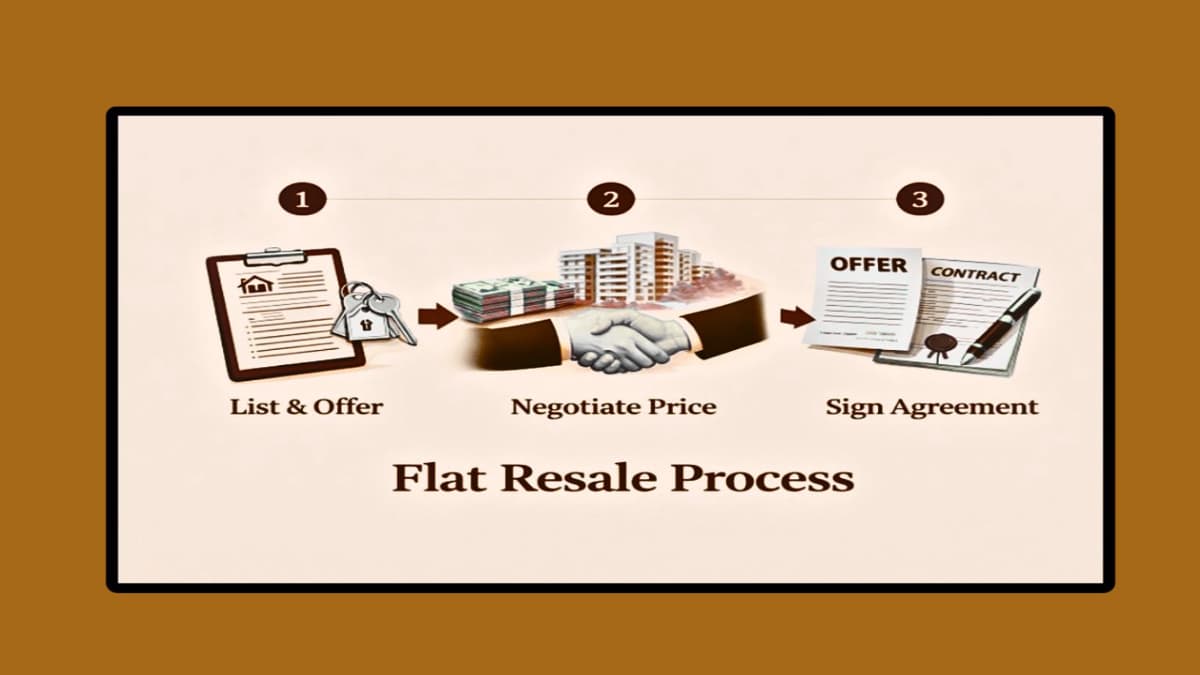
Buying a resale property (one that has had previous owners) in Delhi is fundamentally different from buying a new flat from a builder. In a builder buyer agreement, you deal with a company. In resale, you deal with a person???and people can hide things. From "Power of Attorney" scams to unpaid loans, the Delhi resale market is a minefield.
Whether you are buying a DDA flat in Janakpuri, a Kothi in Greater Kailash, or a Society flat in Patparganj, the due diligence required is massive. This guide decodes the entire resale process, ensuring you don't lose your life savings to a fraudster. If you are still finalising the locality, you can also read our Best Areas to Live in Delhi guide and match your resale search with the neighbourhood that fits your work and family needs.
This article explains how to buy a resale flat in Delhi safely when you are using a home loan and dealing with chain-of-title documents, DDA leasehold complications and society transfer charges in specific colonies, so that a normal buyer or end user does not sign a risky GPA or cash-heavy agreement just because the local property dealer says all papers are clear.
1. The "Chain of Documents" (The Holy Grail)
In a resale deal, the current Sale Deed is not enough. You need the Complete Chain of Title.
What is a Chain?
If Mr. A sold to Mr. B in 1990, and Mr. B sold to Mr. C in 2005, and Mr. C is selling to you now:
- You need the Original Sale Deed of A -> B.
- You need the Original Sale Deed of B -> C.
- You need the Original Sale Deed of C -> You.
The Risk: If one link in this chain is missing (lost), banks will NOT give you a loan. If the seller says "I lost the previous deed," do not buy unless there is a valid FIR and a newspaper public notice from the time it was lost.
2. Freehold vs. Leasehold (The DDA Factor)
Delhi has a unique complication called DDA Leasehold land.
Leasehold Property
The government (DDA/L&DO) owns the land; the "owner" only has a 99-year lease.
Problem: Banks hesitate to fund these. Transfer requires DDA permission (Unearned Increase charges apply).
Freehold Property
The owner owns the land outright.
Solution: Most Delhi properties are now converted to Freehold.
The Document to Check: Ask for the "Conveyance Deed". This is the proof that the property was converted from Leasehold to Freehold. Without this, a DDA flat sale is risky.
Once this title side is clean, the actual registration at the Sub-Registrar follows the standard Delhi purchase flow. For charges, appointment booking and mutation sequence, see our detailed Property Registration Process in Delhi guide and ensure the paperwork you sign on resale day matches those rules.
3. The Process: From "Token" to "Keys"
Don't just hand over money. Follow this strict sequence:
Step 1: The Token Money
Pay a nominal amount (???50,000 or ???1 Lakh) to freeze the deal. Take a receipt. Do not pay 10% yet.
Step 2: The Agreement to Sell (ATS) & Bayana
This is the main contract. You usually pay 10% of the deal value now (called "Bayana").
Crucial Clause: "If the title is found defective during verification, the seller must refund the token money with 18% interest within 7 days."
Register it: Ideally, register the ATS to make it legally binding.
Step 3: Public Notice
Publish a "Notice of Purchase" in two local newspapers (one English, one Hindi). This invites objections. If someone claims "My brother secretly sold our ancestral house," they have to speak up now. If no objection comes in 7 days, you are safer.
Step 4: The Final Deed & Payment
On the registration day, you pay the remaining 90% (via Demand Draft or Pay Order) and sign the Sale Deed.
Step 5: Keys, Vacant Possession and Meter Reading
Never accept a vague promise like "Possession after one month" written casually on a slip. For resale in Delhi, vacant possession should be a clear clause in the Agreement to Sell.
- Insist that the seller hands over all keys, society ID cards and parking stickers on the same day as registration or on a fixed, written date.
- Walk down with the seller to the electricity and water meters and click photos of the readings in front of him. These photos save disputes later when old bills arrive.
- If the seller is staying for a few extra days, put that in writing with a token daily use charge. Otherwise you become a guest in your own new flat.
4. TDS @ 1% (The Buyer's Trap)
This is where 90% of buyers make a mistake.
The Rule: If the deal value is ???50 Lakhs or more, YOU (the buyer) are responsible for deducting 1% TDS from the payment.
Example: Property cost = ???1 Crore.
You pay Seller: ???99 Lakhs.
You pay Govt (Income Tax): ???1 Lakh.
The Process: You must deposit this ???1 Lakh online using Form 26QB. You then give the TDS Certificate (Form 16B) to the seller.
Warning: If you forget this and pay the full ???1 Crore to the seller, the Income Tax Department will send YOU a notice to pay that ???1 Lakh + Penalty. The seller won't help you then.
Remember that this TDS is separate from Stamp Duty and Registration charges. If you want to understand how government taxes stack up on a property transaction, go through our Stamp Duty and Registration Charges guide before you finalise the net price.
5. Foreclosure: Buying a Mortgaged Property
Many sellers sell their flat to pay off their existing home loan. This is safe IF handled correctly.
- Don't pay the seller directly.
- Ask for a "Foreclosure Letter" from his bank. It will show exactly how much is pending (e.g., ???40 Lakhs).
- Make your payment cheque directly in the name of His Bank (e.g., "HDFC Bank Loan A/c No XXXXX").
- Only pay the balance amount to the seller.
- Collect the "List of Documents" (LOD) from the bank immediately upon closure.
Before you even start hunting for resale flats, check your borrowing power with a proper Home Loan Eligibility Guide so you know your real budget and do not over-commit under broker pressure.
6. Transfer Charges (The Society Mafia)
If you are buying in a Cooperative Group Housing Society (CGHS) in areas like Patparganj, Dwarka, or Rohini, watch out for "Transfer Charges."
The Reality: Legally, societies can charge a nominal transfer fee (e.g., ???25,000).
The Practice: Many societies demand ???1 Lakh to ???5 Lakhs as a "Donation" or "Welfare Fund" to issue the NOC (No Objection Certificate).
Who pays? Usually, the Buyer. Clarify this cost BEFORE you sign the deal.
7. Possession Checklist
On the day you get the keys, check:
- Electricity Bill: Has the seller paid the last month's bill? Check the meter reading.
- Water Bill: DJB (Delhi Jal Board) bills can pile up. Ensure it is clear.
- Property Tax: Ask for the latest Property Tax Receipt. If previous years are unpaid, MCD will catch you.
- Original Keys: Get all sets. Ideally, change the main door lock immediately.
8. Home Loan, Valuation and Insurance for Resale Buyers
Most end users in Delhi rely on a bank loan for resale purchases. The bank's valuation is a silent second opinion on the deal you are about to enter.
- Share the full chain of documents and the draft Sale Deed with your bank early. If the bank flags a problem, it's better to lose a token than to force a bad sanction.
- Don't fight for an unrealistically high valuation. If the bank values the flat at ???95 Lakhs and the deal is ???1 Crore, you must fund the extra ???5 Lakhs from savings. Forcing the valuer rarely works and creates stress at disbursement.
- Consider property insurance once the deal is complete. A basic fire and structure policy for Delhi apartments is cheap compared to the total flat cost and protects you against rare but devastating events.
If you later change jobs or refinance the loan with another bank, this original valuation report and clean document set helps you negotiate better terms. Lenders trust resale flats with clear chains, society NOCs and stable cash???flow more than fancy but disputed constructions.
For a genuine end user, the goal is not the "cheapest" resale deal on paper, but a clean, financeable and insurable home that you can live in peacefully and later sell without legal drama.
9. When You Should Walk Away
Every serious buyer in Delhi eventually meets a "too good to be true" resale deal. A big flat at a throwaway price, a seller in a hurry, a broker pushing you to sign in 24 hours. This is exactly when you must slow down.
- If the chain of documents has gaps, or the seller refuses to share photocopies before token, step back.
- If society office staff quietly warn you about internal family disputes over that flat, believe them more than the broker.
- If the seller insists on a large cash component to "save tax", remember that you will face that tax pain when you sell.
A clean resale in a slightly smaller flat is better than a large, cheap flat with legal landmines. In Delhi, the courage to walk away from a doubtful deal is the most important part of your buying strategy. If you are separately considering plot deals or distant belt land offers, read our Plot Buying Safety Guide before signing anything outside regular urban colonies.
Conclusion
Resale properties in established Delhi colonies offer better location, bigger carpet areas, and developed infrastructure compared to new Gurgaon high-rises. But the paperwork is heavy. Don't trust the property dealer who says, "Sab set hai sir, paper ok hai." Verify the papers yourself. A resale home is a great asset, but only if the papers are clean.
If you realise you are not ready to buy and will stay on rent in Delhi for a few more years, take the same cautious mindset into your tenancy and go through our Rent Agreement Rules in Delhi so that your stop-gap rental home is also legally safe.
Frequently Asked Questions (FAQs)
Can I buy a GPA (General Power of Attorney) property?
AVOID IT. The Supreme Court (Suraj Lamp case) ruled that GPA sales do not convey valid title. You can only become a legal owner via a Registered Sale Deed. GPA properties are risky and cannot be sold easily later.
How do I know if the property is mortgaged?
Check the CERSAI registry online. It lists all properties mortgaged to banks. Also, ask a lawyer to run a title search at the Sub-Registrar's office for the last 13 years.
Who pays the broker?
Standard practice in Delhi is 1% from Buyer and 1% from Seller. However, in high-value deals (above ???5 Cr), you can negotiate this down to 0.5%.
What is the "Black vs White" ratio in Delhi?
While illegal, the market reality is that many sellers demand a cash component (e.g., 60:40). As a buyer, always insist on a 100% Cheque deal (White). It safeguards your investment and ensures you can take a higher home loan.
How long should I keep all resale documents safely?
In Delhi, do not treat property papers like old phone bills. Keep the entire chain of documents, tax receipts and loan closure letters for as long as you own the flat and at least a few years after selling it. If a future buyer or their bank raises a query, these papers are your only defence that the title was clean when you bought and sold.