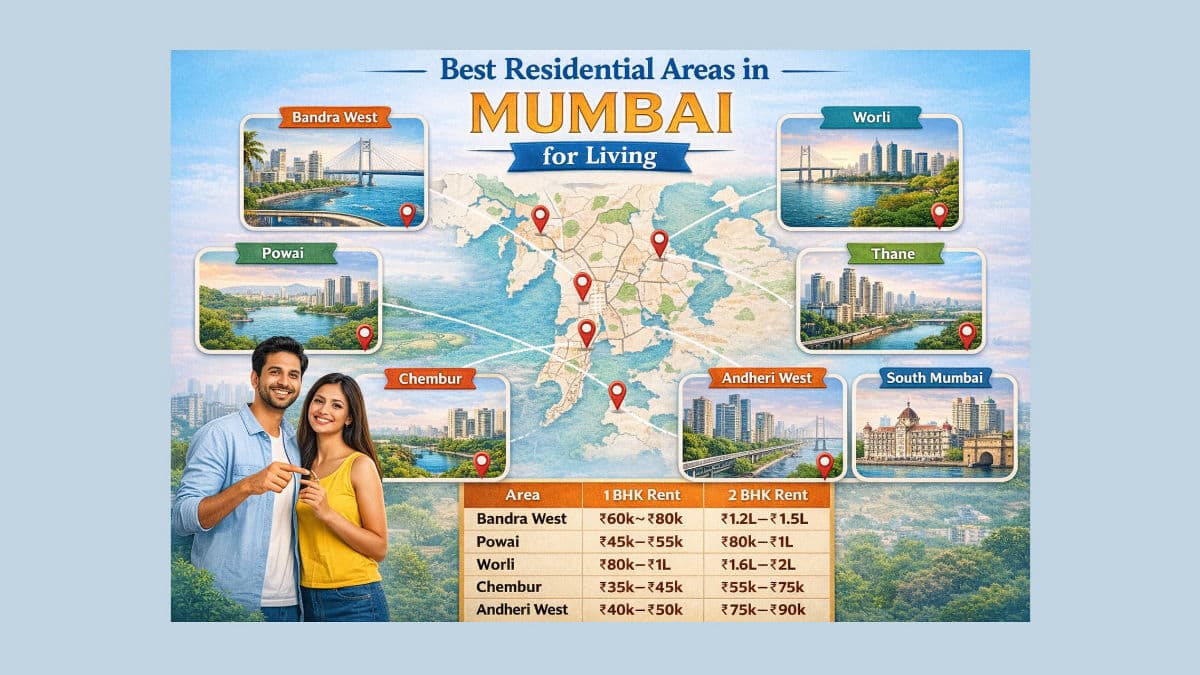
People usually search for the best residential areas in Mumbai by comparing localities. That is useful, but it is incomplete. Your daily comfort is decided by three things you will feel every weekday: your office route, your budget, and how much travel you can tolerate.
In 2026, new Metro links and the Trans-Harbour Link make a few routes easier. They do not erase traffic, but they can change which pockets feel realistic for work, school runs, and family routines.
This guide is built for shortlisting. Use it to pick a few areas, then judge the exact building and lane before you pay token money.
How to use this guide (quick method)
- Start with your office map: BKC, Lower Parel, airport side, or Navi Mumbai changes everything.
- Pick three options: one premium, one balanced, one budget so you see the real trade-offs.
- Visit twice: daytime and after office hours (traffic and parking reality shows up then).
- Choose the lane and building: not just the area name. Two lanes apart can feel like different cities.
If you are unsure, use a simple rule: try to keep your one-way weekday travel around 45 to 60 minutes. In Mumbai, a shorter commute usually improves your quality of life more than an extra room. Also decide if you are a train person or a road person, because that choice changes which areas feel realistic.
Lane and building checklist (Mumbai reality)
- Parking: confirm a real slot vs "adjust kar lenge".
- Water: ask about summer supply, tank schedule, and tanker dependence.
- Lift: ride it once and ask about breakdown frequency.
- Power backup: confirm what stays on during power cuts (lift, common lights, water pump).
- Monsoon: ask if the lane floods and check seepage marks in the flat.
- Society rules: pets, bachelors, move-in timing, and visitor entry.
- Commute test: check the peak-hour route on your phone before you pay token money.
Quick picks by goal
Use this to shortlist quickly. Then validate the exact building and lane, because that decides daily comfort more than the locality label.
| Your goal |
Areas to start with |
Watch out for |
| Family routine |
Powai, Chembur, parts of Thane |
JVLR traffic, monsoon seepage, society rules |
| Commute-first |
Andheri, Bandra side pockets |
Noise, parking, peak-hour traffic |
| More space for money |
Thane, Navi Mumbai |
Office distance, last-mile travel, autos |
| Long-hold premium |
Bandra |
High ticket size, parking reality |
Before you shortlist (10-minute reality check)
Mumbai decisions go wrong when you pick a locality name and ignore the lane. Do this quick check once and you will avoid most bad picks.
- Street sound: stand outside the building for 60 seconds and listen for constant honking.
- Monsoon risk: ask the watchman or a shopkeeper if the lane floods or backs up water.
- Lift and backup: check lift condition and ask if common areas stay lit during power cuts.
- Parking: confirm your exact slot, ramp turns, and guest parking rules.
- Daily essentials: note the nearest supermarket, pharmacy, and a usable walking stretch.
- Commute test: check peak-hour travel time on your phone before you pay token money.
1. Bandra West
Bandra West is a premium pick if you want lifestyle convenience and you are okay paying for it. It has great open spaces and a strong social scene, but most pockets are busy, not quiet.
- Good for: lifestyle-first living and quick access to the South Mumbai side on some routes.
- Check first: parking and lane width. This matters more than the Bandra name.
- Watch out: traffic around popular stretches, especially evenings and weekends.
Pros: strong social life, good public promenades, premium address value.
Cons: traffic, parking stress, high rents (1 BHK often starts around Rs 60k in many pockets).
2. Powai
Powai works well if you like a township-style routine and want a more organised pocket compared to many older areas. It is popular with families, professionals, and people who want amenities close by.
- Good for: family routine, amenities, and a planned feel in some sections.
- Check first: your entry/exit route. Two buildings in Powai can have very different commute pain.
- Watch out: JVLR traffic. It can decide your day.
Pros: township vibe in Hiranandani, walkable internal roads in some pockets, strong family comfort.
Cons: JVLR traffic can be heavy; peak-hour entry and exit can feel slow.
3. Andheri West
Andheri West is a high-demand rental zone because it has strong Metro access and a lot of micro-pockets (Lokhandwala, Versova, Four Bungalows). It is convenient, but it is not calm in most lanes.
- Good for: commute-first renters and people who want many options across budgets.
- Check first: noise and parking on your exact lane.
- Watch out: dust and congestion near main roads.
Pros: strong Metro connectivity, malls and food options, wide rental choice.
Cons: noisy pockets, Link Road traffic, higher dust and pollution near main roads.
Rent Check: A 1BHK in Versova can cost around Rs 45,000.
4. Thane (West side pockets)
Thane is Mumbai's space upgrade for many budgets. You often get newer societies and more usable layouts than older Mumbai suburbs, but you pay with travel time if your work is deep inside Mumbai.
- Good for: more space for money and newer society amenities.
- Check first: your peak-hour route (EEH and Ghodbunder stretches can swing travel time a lot).
- Watch out: station crowding and last-mile travel depending on your exact pocket.
Pros: more space for money, wider roads, mall and township lifestyle.
Cons: toll at Mulund check naka for some routes, trains are crowded in peak hours.
5. Navi Mumbai (Vashi and Seawoods)
Navi Mumbai works for people who want a planned layout and do not mind being outside the traditional Mumbai suburb belt. Vashi is an established base, while Seawoods is popular for station access and newer development.
- Good for: planned roads, more breathing space, and a calmer daily routine in many pockets.
- Check first: your office route. MTHL helps some commutes, but not every commute.
- Watch out: last-mile dependence and your specific sector's evening traffic.
Pros: planned infrastructure, less traffic, cleaner air in many pockets.
Cons: nightlife is limited compared to Bandra/Andheri, autos may not run by meter in some pockets.
6. Chembur
Chembur is a practical connector if you need access toward South Mumbai, BKC, and Navi Mumbai corridors. It has a mix of older, greener lanes and newer redevelopment pockets.
- Good for: central access and a more settled residential feel in many pockets.
- Check first: any industrial-smell pocket near your shortlist and active redevelopment dust.
- Watch out: traffic choke points depending on your exact exit route.
Pros: huge connectivity advantage, older green pockets, strong community clubs.
Cons: some pockets near industrial areas can have smell/pollution, redevelopment dust in active zones.
Cost of Living Comparison (2026 Avg Rent)
These ranges are indicative. In Mumbai, the same area can swing a lot by building age, furnishing, parking, and exact lane.
| Area |
1 BHK Rent |
2 BHK Rent |
Buy Price (per sq.ft) |
| Bandra West |
Rs 60k - Rs 80k |
Rs 1.2L - Rs 1.5L |
Rs 50,000+ |
| Andheri West |
Rs 40k - Rs 50k |
Rs 75k - Rs 90k |
Rs 28,000+ |
| Powai |
Rs 45k - Rs 55k |
Rs 80k - Rs 1L |
Rs 32,000+ |
| Thane (West) |
Rs 20k - Rs 25k |
Rs 35k - Rs 45k |
Rs 14,000+ |
How to Choose? (3-step Mumbai rule)
Step 1: Commute test
Check your real travel time at peak hour, not mid-day. In Mumbai, distance is measured in minutes, not kilometers. If you work in Lower Parel, living too far North can turn into a daily grind.
Step 2: Society rules check
Before renting or buying, confirm society rules early. Some societies are strict about bachelors, pets, and even food preferences. Ask upfront so you do not lose time after paying a token.
Step 3: Monsoon check
Ask residents about flooding, seepage, and water logging in the lane. Avoid ground-floor homes in known flood pockets and always inspect bathroom corners and window frames.
Conclusion
The "best" area in Mumbai is the one that fits your weekday routine. If you want more space and newer societies, North and Navi Mumbai options usually make sense. If you want to cut travel time and stay close to the action, West-side pockets can work, but you pay for it in rent and traffic. If you plan to invest, read the Property Selling Process in Mumbai so you understand paperwork before you decide.
Moving to Mumbai?
Browse rental properties near your office and shortlist faster.
Search Flats in Mumbai
Frequently Asked Questions (FAQs)
FAQs on Mumbai Living
Q1: Which is the safest area for women in Mumbai?
Mumbai is generally safer than many large cities, but safety still varies by lane and late-night access. Areas like Bandra, Khar, Juhu, and Powai are often preferred because they stay active late and have higher footfall. Still, do a late-evening visit and check building security before deciding.
Q2: Is Navi Mumbai cheaper than Mumbai?
Often, yes. For the same budget, Navi Mumbai frequently offers a larger home or a newer society compared to popular Mumbai pockets. Exact pricing depends on the building, station distance, and furnishing.
Q3: What is "Pagdi System"?
It is an old tenancy system in South Mumbai where you pay a lump sum (Pagdi) and get tenancy rights that can feel ownership-like, but the legal and resale aspects are different from a normal sale deed property. Read our Legal Guide before you buy a Pagdi property.
Q4: Can I get a sea-facing flat on a budget?
It is difficult in the premium sea-facing belts. You may find better-value views in pockets like Versova or Mahim, or some Navi Mumbai stretches, but verify the actual view from the unit and confirm that future construction will not block it.
Disclaimer: Rents and property prices mentioned are indicative market averages for 2026 and can vary by building and amenities.