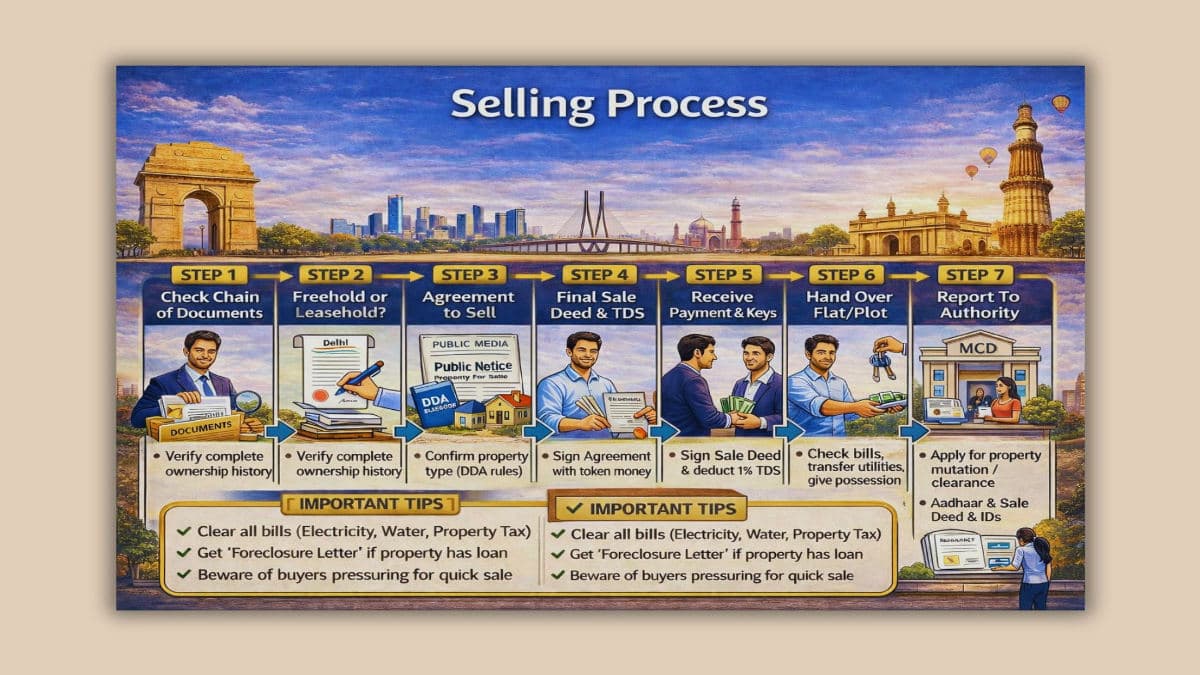
Selling a property in Delhi is not just finding a buyer and exchanging cheques. Most delays happen because paperwork and ground reality do not match: ownership papers are incomplete, a document name does not match the PAN/Aadhaar spelling, or a loan closure is left for the last week. Whether you are selling a DDA flat in Rohini, a builder floor in Lajpat Nagar, or a plot in Dwarka, a clean process depends on a clean file.
The Delhi market has a few Delhi-specific terms that decide how smooth your sale is: freehold vs leasehold, DDA permissions (where applicable), and circle rates. If the deal value and circle rate value are far apart, your stamp duty calculation and documentation checks become stricter. If the buyer needs a loan, missing building approvals or incomplete papers can slow down the bank verification.
This guide is written for sellers who want a clean exit: clear payments, clear clauses, and no last-minute surprises on registration day.
1. The "Paperwork Audit" (Before You List)
Do not even list your property on a portal until you have these documents ready. Serious buyers (and their lawyers) will ask for these in the first meeting.
The "Chain of Title"
You need to prove you own the property. This means holding the original Sale Deed in your name. But in Delhi, you also need the Previous Chain.
The Rule: If you bought the house in 2010 from Mr. Singh, and he bought it in 2000 from Mrs. Gupta, you need the deeds for BOTH transactions. A missing link in the last 30 years is a deal-breaker for banks.
Freehold Conversion (The DDA Factor)
If you own a DDA flat or a plot in an old colony, check if it is Leasehold or Freehold.
Reality Check: Nobody wants to buy a Leasehold property anymore because transferring it requires "Sale Permission" from DDA, which takes months. If your property is Leasehold, apply for Conversion to Freehold immediately. It increases your property value by 15-20% instantly. Read our Freehold Conversion Guide for steps.
Quick checklist before you accept token money
Before you accept any token amount, keep these points clear in writing. This stops most disputes later.
- Who will sign: confirm all owners can sign, or a valid POA is ready.
- Loan status: if a loan exists, decide the closure plan and timeline.
- Property dues: latest society, electricity, water, and property tax receipts.
- Possession plan: vacant or occupied, and exact handover date.
- Deal value clarity: confirm the value used for deed drafting and stamp duty calculation.
- Document copy pack: share a clean list of documents you can provide to the buyer's lawyer/bank.
2. Valuation and "Circle Rates"
Delhi has strict "Circle Rates" (minimum government value) for every colony (Category A to H).
Practical point: Registration offices and banks often compare the sale value with circle rate value. In many cases, stamp duty is calculated on the higher of the two.
Income tax note (Sec 50C): If the sale consideration is below the circle rate value, tax rules can treat the difference as deemed value for calculation. Confirm your exact impact with a CA before you finalise the value.
3. Selling to a Builder (Collaboration/JV)
In Delhi, many plot owners (especially in South and West Delhi) choose to sell to a builder in exchange for a floor + cash. This is called a "Collaboration Agreement."
The Deal: Typically, you give the land, the builder constructs 4 floors, keeps one or two, and gives you back the rest plus some cash.
The Risk: If the builder runs out of money mid-construction, you are stuck with a half-built house. Always insist on a registered collaboration agreement and a bank guarantee if possible.
4. Selling an Old "Dilapidated" Property
If you are selling a 40-year-old house that is basically "Malba" (debris), do not price it as a livable house.
The math: The value is in the land (plot value), not the structure. In some cases, the buyer may ask you to account for demolition costs (often Rs 2-3 lakhs, depending on size). Be realistic and use an "as is where is" clause if both sides agree.
5. Finding a Buyer & The "Token Money"
Once you find a buyer, they may give you a token amount (often Rs 1 lakh to Rs 5 lakhs) to freeze the deal.
The Receipt: Do not just take the cash. Sign a "Token Receipt" or "Bayana Receipt." This is a temporary document valid for 15-30 days until the main agreement is signed.
Refund Clause: Be clear. If the buyer backs out, do you forfeit the token? If you back out, do you pay double? Write this down.
6. The Agreement to Sell (ATS)
This is the detailed contract. It is NOT the final sale, but it defines the rules of the sale.
- Payment Schedule: typically 10% now (including token) and 90% at the time of registration (usually within 45-60 days).
- TDS clause: For higher-value deals, buyers may need to deduct TDS as per applicable rules. Keep the payment language clear in the agreement (sale price and any statutory deduction). Collect the TDS certificate later for your tax filing.
- Vacant Possession: You must promise to hand over the property empty (no tenants, no furniture unless agreed) on the day of registration.
For more on agreements, see our Rent & Sale Agreement Basics.
7. The "No Dues" Run
While the buyer arranges their loan, you (the seller) have work to do. You must obtain "No Dues Certificates" (NDC) from:
- RWA/Society: Clear all maintenance dues.
- Electricity (BSES/Tata Power): Pay the latest bill and get a clearance statement.
- Water (DJB): This is critical. Delhi Jal Board bills often have arrears. Clear them.
- Property Tax (MCD): You must have the latest tax receipt for the current financial year. The buyer cannot mutate the property without this.
Common delays that waste the registration slot (and how to avoid them)
Most registration-day failures are not big legal disputes. They are small gaps that show up only when everyone is already at the office.
- Name mismatch: one paper says "S. Kumar" and another says "Sourav Kumar". Fix spellings early across deed draft and IDs.
- Missing signer: a co-owner cannot attend and the POA is not acceptable for registration. Confirm who must sign and keep authority papers ready.
- Witness issues: witnesses arrive late or bring an ID that does not match the name used in the deed. Keep two reliable witnesses and their IDs.
- Loan closure confusion: the buyer and your bank are not aligned on the closure letter, NOC, and original document release. Plan the closure date before you book registration.
- Dues not clear: society dues or property tax are unclear, so the buyer pauses payment. Keep latest receipts and a no-dues position if available.
If you get these five points right, the day becomes routine, which is exactly what you want.
8. The Registration Day (SRO Office)
This is the final step. You, the buyer, and two witnesses go to the Sub-Registrar's Office.
The Payment Handover
Usually, the buyer hands over the Demand Drafts (DD) or confirms the RTGS transfer inside the Sub-Registrar's cabin.
Safety Tip: Do not sign the Sale Deed until the money is in your account or the DD is in your hand. Once you sign, the property is gone.
The "Key Handover"
At the same time, you hand over the keys and the "Possession Letter." This letter states that you have physically vacated the property and handed it over to the buyer.
9. Capital Gains Tax (The Aftermath)
Selling property brings money, and money brings tax.
LTCG vs STCG: The holding period rules and tax rates can change, and the calculation depends on your situation. As a simple rule of thumb, longer holding periods are usually treated differently from short holding periods.
How to plan: If you want to reinvest or claim exemptions, keep your deed date, payment proof, and expense proofs ready. Confirm the exact sections and timelines with a CA for your case.
10. Selling to an NRI? (Special Caution)
If the buyer is an NRI, the rules change slightly. The money must come from an NRE/NRO account. Ensure you have the "Foreign Inward Remittance Certificate" (FIRC) if funds came from abroad, as you might need it for your tax assessment. Conversely, if you are an NRI selling property in India, the buyer must deduct TDS at 20%+ (not 1%). You will need to file a return to claim a refund if your actual tax liability is lower.
11. What if the Buyer Needs a Loan?
Most buyers in Delhi will take a home loan. This adds a step: The Bank.
Originals to Bank: The buyer's bank will ask for your original chain of documents before the registration to verify them. Do not hand over originals to the buyer. Hand them over directly to the bank lawyer against a receipt.
The Cheque: The bank will issue the loan amount via a Banker's Cheque directly in your name. This is the safest form of payment.
12. Wrapping Up: The Clean Exit
Selling a property in Delhi is a high-value transaction. Keep the process clean: traceable payments, clear clauses, registered paperwork, and proper tax filing.
Do not leave loose ends. Close your electricity account, surrender your gas connection (or transfer it), and inform the RWA that you have left. A clean break ensures that three years later, you don't get a notice for someone else's unpaid bills.
For more insights on the legal transfer process from the buyer's side, check our Property Transfer Guide.
Planning to Sell?
Get a free valuation estimate based on current Delhi circle rates.
Get Valuation Help