← Back to ArticlesArea Guide
By FlatsCare Team
May 7, 2026
10 min read
Moving a family in Delhi is not just about finding a flat with an extra bedroom; it is about building a daily routine that does not break your spirit. In a city where traffic can turn a 5-kilometer drive into a 45-minute ordeal, the "perfect" location is entirely dependent on where your kids go to school and where you work. If you choose an area based on a fancy name but ignore the school bus route, you will spend half your life in a car.
This guide looks at family friendly residential areas in Delhi through a practical lens. We are not ranking them by prestige, but by how well they support a family's day-to-day needs???things like having a usable park within walking distance, a 24/7 pharmacy nearby, and a society gate that actually manages visitors. This is local information to help you shortlist; always visit a specific lane at 8:00 AM and 8:00 PM before you sign anything.
What actually makes an area "family friendly" in Delhi?
Before looking at specific names, let's define the criteria that matter for a family home. Most online listings use "family friendly" as a generic tag, but on the ground, it comes down to these four pillars:
1. The School-Run Logic
If your child???s school is in Dwarka and you live in GK, you are doing it wrong. The school bus should be the first thing you check. Some areas have "clusters" of schools, making them natural hubs for families. If you are new to the city, identify the school first, then look for homes within a 4-6 km radius. Anything more, and you are inviting daily stress.
2. The "Evening Walk" Factor
Does the locality have a park where children can actually play? Many colonies have small green patches that are "for display only" or restricted by local RWAs. Look for areas with DDA district parks or large society gardens. Walkability within the colony???without dodging heavy traffic or stray dogs???is a major quality-of-life metric for families with young children or elderly parents.
3. Healthcare and Emergency Access
A family home needs to be within a 15-minute reach of a multi-specialty hospital. In Delhi, this means checking the route at 6:00 PM, not 2:00 AM. If the main access road to your colony gets choked every evening, that "prime" location is a risk. Check for 24-hour pharmacies and local clinics for the usual coughs and colds.
4. Water and Infrastructure Reality
This is the unglamorous side of Delhi living. Some of the most expensive areas face severe water shortages in June. Ask the neighbors about the municipal water schedule and whether the building has a functional borewell or relies on tankers. For a family, a home without 24/7 water is a dealbreaker, no matter how good the interiors look.
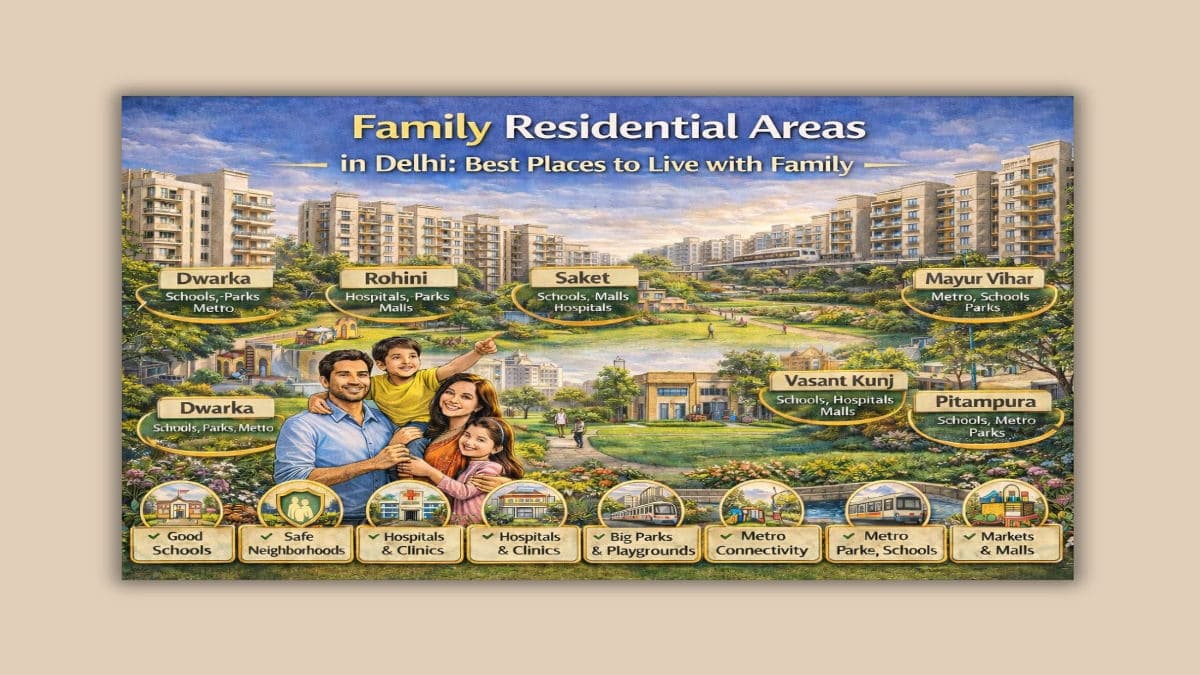
Top family friendly residential areas in Delhi: The Shortlist
Dwarka (The Society Culture)
Dwarka is often the first choice for families moving from other cities. It is a planned sub-city where the concept of "Sector" living actually works. Most housing consists of Co-operative Group Housing Societies (CGHS), which means you get gated security, internal play areas, and a community of other families.
- The Reality: Wide roads and dedicated markets in every sector make errands easy. The Blue Line Metro connects most sectors, making it a strong base for professionals.
- The Catch: Some sectors face water issues, and parking can get cramped in older societies. If you have a large SUV, check the parking slot width specifically.
- Who it???s for: Families who want a predictable, gated environment and don't mind living slightly away from the "happening" parts of South Delhi.
Rohini (The Self-Sufficient North-West)
Like Dwarka, Rohini is divided into sectors. It is one of the oldest planned residential areas in Delhi and has a very deep-rooted family culture. From Sector 3 to Sector 24, the experience changes, but the core theme is the same: everything you need is within 2 km.
- The Reality: The schools in Rohini (like DPS and Bal Bharati) are some of the best in the city. The local markets are affordable, and the Red Line Metro provides a solid commute path.
- The Catch: Traffic around Rithala and the main sector roads can be intense in the evenings. Some older sectors have very narrow internal lanes.
- Who it???s for: Families who want a settled community with high-quality schools nearby and a lower cost of living compared to South Delhi.
Vasant Kunj (The Green Lungs of the South)
If you want South Delhi but hate the congestion of South Ex or Lajpat Nagar, Vasant Kunj is the middle ground. It is surrounded by the Ridge (forest area) and consists of DDA flats divided into sectors (A to D). It feels significantly cooler and quieter than the rest of the city.
- The Reality: You are close to the airport, top-tier malls like Emporio/Promenade, and some of the city???s best hospitals (ILBS, Spinal Injuries). The air quality here is often slightly better than the city average.
- The Catch: No direct Metro inside most sectors (you???ll need a cab to Chattarpur or Vasant Vihar). Water is a perennial issue in summer???check the tank capacity of the flat.
- Who it???s for: Families who value greenery and quiet over Metro proximity and can afford a slightly higher rent.
Janakpuri (The West Delhi Hub)
Janakpuri is the "old money" family area of West Delhi. It is known for its wide blocks, massive parks, and a very strong network of schools and coaching centers. It is arguably the best-connected area in West Delhi thanks to the Blue and Magenta Lines.
- The Reality: The District Centre provides a massive commercial hub, while the residential blocks remain surprisingly calm. It???s a very safe area for families who have lived in Delhi for generations.
- The Catch: Finding a new builder floor can be expensive, and older houses might have maintenance issues. Parking on the street is a common point of friction between neighbors.
- Who it???s for: Families who want a mix of traditional Delhi culture and modern Metro connectivity.
Mayur Vihar Phase 1 (The East Delhi Gateway)
For families working in Noida or Central Delhi (CP), Mayur Vihar Phase 1 is a strategic choice. It offers a mix of DDA flats and private societies. It???s one of the few areas in East Delhi that feels organized and family-centric.
- The Reality: You can reach Noida in 10 minutes and CP in 20. The local pocket markets are excellent for daily needs, and the Sanjay Lake nearby offers a massive green space for weekend walks.
- The Catch: The DND flyover traffic can be a nightmare during peak hours. Some pockets are very crowded, so choose your "block" carefully.
- Who it???s for: Professionals working in Noida who want their children to grow up with a Delhi address and better civic facilities.
Greater Kailash (GK) 1 & 2 (The Premium Standard)
GK is the benchmark for South Delhi family living. It???s not just about the pin code; it???s about the access to high-end markets (M-Block), elite clubs, and a very active neighborhood watch system. Housing here is mostly premium builder floors.
- The Reality: Everything???from high-end pediatricians to gourmet groceries???is within a 5-minute drive. The infrastructure is well-maintained by active RWAs.
- The Catch: The cost of entry is very high. Rental prices are steep, and the "maintenance" costs can be significant. Parking for more than two cars is almost impossible in most blocks.
- Who it???s for: Families with high disposable income who want the best South Delhi has to offer in terms of lifestyle and services.
The hidden costs of "cheap" family areas
Sometimes, a 3 BHK in an unauthorized colony or a peripheral area looks like a great deal. However, for a family, the "savings" often disappear into hidden costs:
- Commute costs: If you save Rs 10,000 on rent but spend Rs 12,000 extra on cabs and school vans, you haven't saved anything.
- Safety and security: Gated societies in Dwarka or Rohini might cost more, but the peace of mind of having a secure play area for kids is worth the premium.
- Power and Water: In cheaper areas, you might spend heavily on water tankers and high-capacity inverters/UPS systems.
Practical Checklist for Families (The "Before You Pay" List)
Before you commit to a home in any of these family friendly residential areas in Delhi, do this 30-minute audit:
- Test the lift: If the building is 5+ years old, check the lift's maintenance records. A stuck lift is a nightmare for elders and kids.
- Check the "School Bus Stop": Ask the guard where the school buses usually stop. Is it a safe, well-lit spot?
- Identify the nearest park: Walk to it. Don't just look at it from the balcony. Is it usable, or is it a dump yard for construction waste?
- Verify the water: Open the taps. Check the overhead tank. Ask the previous tenant (if possible) about the summer reality.
- Check the lane at night: Some areas look great at 2:00 PM but turn into noisy thoroughfares or dark, isolated stretches after 9:00 PM.
Budgeting for your family home
Rent in Delhi varies wildly. A 2 BHK in Rohini might cost Rs 20,000, while the same size in GK 2 could be Rs 70,000. For a detailed breakdown of costs, you should check our 2 BHK rent guide or the more compact 1 BHK rent guide for smaller families. If you are planning to stay long-term and buy, ensure you understand the property transfer process to avoid legal traps.
| Locality |
Vibe |
Key Strength |
Typical 3 BHK Rent |
| Dwarka |
Modern Society |
Gated Security |
Rs 35,000 - 55,000 |
| Vasant Kunj |
Quiet/Green |
Air Quality |
Rs 60,000 - 90,000 |
| Rohini |
Traditional/Settled |
School Network |
Rs 25,000 - 40,000 |
| GK 1 & 2 |
Elite/Busy |
Lifestyle/Markets |
Rs 1.2L - 2.5L |
| Janakpuri |
Spacious/Connected |
Metro Access |
Rs 30,000 - 50,000 |
Conclusion
There is no "best" area in Delhi, only the area that best fits your family's current stage of life. If you have toddlers, Dwarka???s gated societies are a blessing. If you have teenagers who need to commute for coaching, Janakpuri???s Metro connectivity is unbeatable. Don't be swayed by marketing brochures or dramatic "top 10" lists. Use this guide to shortlist 2-3 areas, visit them personally, and talk to the local grocery store owners???they often know more about the building's problems than the landlords do. Once you find a place, make sure your rental agreement is legally sound and covers all maintenance clauses. For a broader look at all parts of the city, see our guide on the best residential areas in Delhi.
Common Questions (FAQs)
Q1: Which area in Delhi has the best schools for families?
Areas like Rohini, Janakpuri, and Dwarka have a very high density of reputed private schools. South Delhi areas like Vasant Kunj and RK Puram also house some of the city's most elite institutions, but the "best" school is the one that is closest to your home to minimize travel time.
Q2: Are gated societies better than builder floors for families?
Generally, yes. Gated societies (like those in Dwarka) offer dedicated play areas, 24/7 security, and power backup, which are easier for families. Builder floors offer more privacy and often better locations in South Delhi, but they usually lack common amenities and dedicated security guards.
Q3: How do I check the water situation in a new locality?
Don't ask the landlord; ask the neighbors or the building guard. Check if the building has a "Dual Pipe" system (municipal + borewell) and ask how often they need to call for private water tankers in May and June. This is a common issue in Vasant Kunj and parts of South Delhi.
Q4: What is the typical security deposit for family rentals in Delhi?
In most family-friendly areas, the security deposit is 2 months' rent. In premium South Delhi pockets like GK or Vasant Vihar, it can sometimes go up to 3 months. Always ensure the refund terms and painting deduction clauses are clearly mentioned in your agreement.
Q5: Is it safe for families to live near Metro stations?
Living within 500 meters of a Metro station is very convenient for commuting, but it can also be noisy and crowded. For a family, the ideal distance is usually 1-2 km???close enough for a short e-rickshaw ride, but far enough to avoid the commercial chaos and traffic of the station entrance.