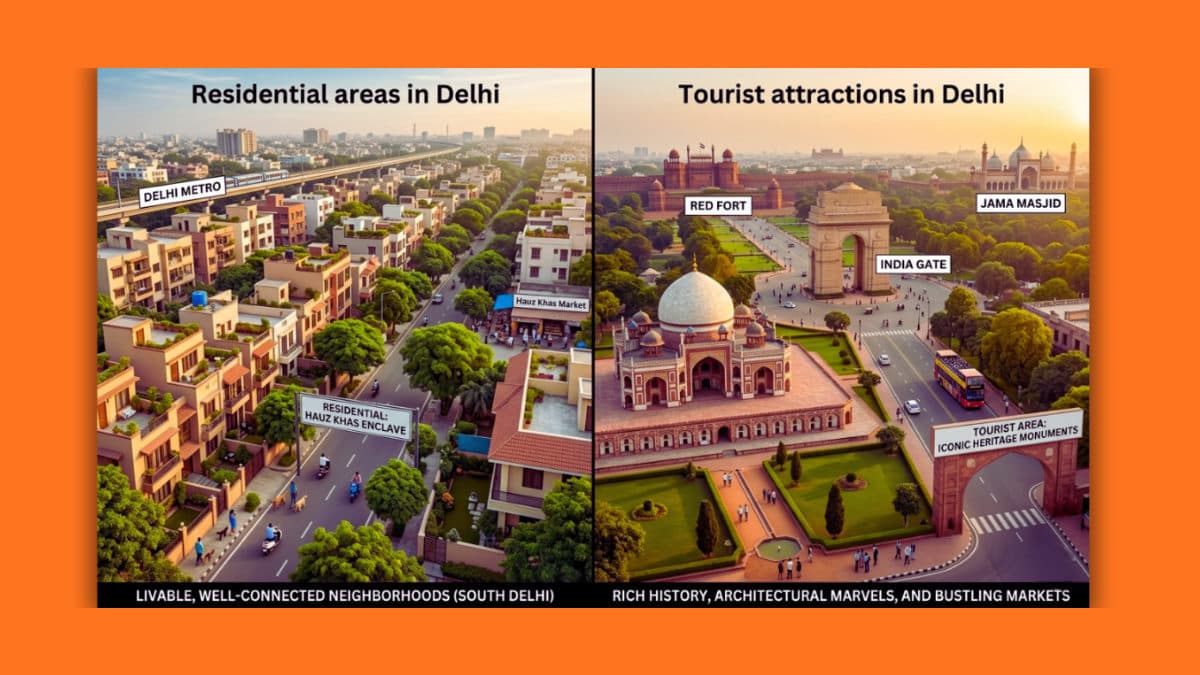
Delhi can feel like multiple cities stitched together. A neighbourhood that is great for visiting (busy markets, late-night food, constant movement) can be tiring as a home base. A neighbourhood that is comfortable to live in (quiet lanes, parks, predictable errands) can be underwhelming on a short trip.
This guide is for both moving and visiting. It covers the best residential and tourist areas in Delhi that people usually shortlist, and focuses on practical questions: what the streets feel like, how commute works in real life, what kind of homes you will find, and what to check before you sign a rental.
Note: This is general local information. Rules and policies (society bylaws, parking rules, visitor access, rent paperwork) vary by building and colony. Always verify details for your specific property and dates.
Best residential and tourist areas in Delhi: how to shortlist
Start with your daily travel route
In Delhi, the easiest daily routine usually comes from being on the right Metro corridor, not from picking a "famous" colony. If your work is near the Yellow Line, living near a Yellow Line station reduces day-to-day stress. If your work is on the Noida side, being near the Blue Line can matter more than the neighbourhood label.
Know what housing stock looks like in each zone
Many pockets are builder floors (smaller buildings, fewer shared facilities, and parking constraints). Other pockets are DDA or society flats (more predictable maintenance, clearer entry rules, and often better common services). The same rent budget can buy very different living conditions depending on the building type.
Check the basics that affect comfort
Two flats can look similar online and still feel different in daily use. Shortlist with these checks in mind: lane width and parking, water arrangement in summer, generator backup (if you need it), lift condition, and how far the last 500 metres are from your Metro station or main road.
South Delhi (easy access to parks, cafes, and landmarks)
Hauz Khas, Green Park, and nearby pockets
This cluster sits on the Yellow Line and stays popular because it is connected, walkable in parts, and has green spaces nearby. You will find a mix of older builder floors, some renovated units, and a constant flow of students, working professionals, and visitors.
Good fit for: people who want quick access to South and Central Delhi and prefer to run errands without long drives.
For visitors: Deer Park and the Hauz Khas complex are easy additions to a South Delhi day plan. You can combine a park walk, a monument stop, and a meal without crossing the city.
Greater Kailash (GK) I & II
GK is often shortlisted for its markets and steady footfall. The routine is very "everything is nearby". Housing is largely builder floors, and the best parts of GK feel more residential than commercial, especially away from market roads.
Usually suits: families and professionals who value predictable shopping and services, and are comfortable with higher overall monthly costs (rent plus maintenance, parking arrangements, and daily expenses).
Renting note: read the building???s maintenance and common-area rules carefully. Put expectations on repairs, painting, and monthly charges in writing, because they can differ by owner.
Saket, Malviya Nagar, and South Extension (practical South Delhi)
For many people, this is the workable South Delhi band: good access to hospitals, malls, and multiple Metro stations, with a wider range of rent options than the more premium clusters. The local markets are busy but functional, and day-to-day errands are straightforward.
Works well for: office-goers and families who want South Delhi access without building a lifestyle around one market road.
For visitors: this is a practical base if you plan to cover Qutub Minar/Mehrauli, Lodhi Garden, and central monuments without long cross-city drives.
Central Delhi (best for first-time visitors and short-stay convenience)
Connaught Place (CP), Janpath, and Mandi House
For tourists, CP is the simplest base because it is a Metro hub and sits close to major sights. You can get to Old Delhi, South Delhi, and the airport corridor without complex changes. For living, the residential options are limited and often depend on the specific building and access rules.
Best for visiting: people who want quick routes to India Gate, museums, markets, and multiple Metro lines.
If you are staying near CP: choose accommodation with clear pickup/drop points. Some inner lanes are not friendly for larger vehicles at peak hours.
Karol Bagh and Rajendra Nagar
This belt is known for shopping streets, coaching hubs, and mid-city convenience. It can be crowded, and the noise level depends heavily on the exact lane and how close you are to market roads. Many rentals here are practical rather than premium.
Often suits: students and working professionals who want quick access to Central Delhi and value affordability over quiet.
Rent planning tip: If you are comparing compact units, check how micro-markets differ lane by lane across Delhi, not just colony by colony.
West Delhi (family neighbourhoods and strong local markets)
Rajouri Garden
Rajouri Garden is popular for its mix of local markets, malls, and Metro connectivity. It has many builder-floor homes, and it attracts families and professionals who want a lively "everything is available" routine. The busy parts can feel crowded on weekends, especially near malls and main roads.
Good fit for: families who value markets, food options, and quick Metro access.
Janakpuri (and nearby residential pockets)
Janakpuri tends to feel more residential than market-heavy areas. It is often shortlisted by families because schools, parks, and daily services are spread across the colony. The exact experience changes a lot by block and proximity to Metro stations.
Often suits: families who want stable residential streets and predictable daily services.
North Delhi (heritage pockets and student corridors)
Civil Lines
Civil Lines is known for older, quieter residential streets and access to North Delhi institutions. It is not a nightlife hub, and most people choose it for a calmer home base and proximity to parts of Old Delhi and North Campus.
Good fit for: people who prefer quieter surroundings and do not mind being farther from many South Delhi hotspots.
North Campus and Kamla Nagar side
If you are studying around Delhi University, being close to the student corridor saves time and daily travel costs. Rentals here are often compact, and the building quality varies. The area has constant movement, food options, and a straightforward day-to-day routine for students.
Often suits: students and early-career professionals who want a short commute to campus and nearby markets.
East Delhi (balanced commute to Noida side and central access)
Mayur Vihar and Patparganj
These areas are often shortlisted by people who work in Noida or on the east side of Delhi. You will see more society-style living in some pockets, along with local markets and planned residential blocks. Day-to-day routines can be smoother when the Metro station is genuinely walkable from your building.
Good fit for: office-goers who commute toward Noida and want a more residential feel than the central market areas.
Preet Vihar and Laxmi Nagar (practical and budget-focused)
This belt stays popular because it is connected, busy, and often more affordable. It can feel crowded, and the lane-to-lane difference is real: one lane can be relatively calm while the next is a constant stream of traffic and shopfront activity.
Often suits: renters who prioritise access and budget, and are willing to trade off quieter streets.
Old Delhi (visit-focused: food, markets, and monuments)
Chandni Chowk and Jama Masjid area
Old Delhi is worth visiting for its food streets, markets, and monuments. It is easiest as a day trip (or a half-day trip) from a Metro-connected base. If you are planning to spend time here, go with a realistic plan: crowd levels and traffic are part of the experience.
Map or Location Overview
A simple mental map that helps while shortlisting:
- South: parks, markets, hospitals, and easy tourist day plans.
- Central: the most convenient base for museums and monuments.
- West: family neighbourhoods with strong local markets.
- North: heritage pockets and student corridors.
- East: practical commute for the Noida side and central access.
Quick comparison table (shortlist view)
| Area |
What it feels like |
Works best for |
Tourist Highlight |
| Hauz Khas |
Connected, walkable pockets, parks nearby |
South & Central Delhi commutes |
Hauz Khas complex, Deer Park |
| Connaught Place |
Central hub, heavy footfall |
Short stays, first-time visitors |
Janpath, museums nearby |
| Rajouri Garden |
Busy markets, good Metro access |
West Delhi routines |
Markets, malls, food options |
| Civil Lines |
Quieter residential lanes |
North Delhi base, calmer home |
Easy access to Old Delhi |
| Mayur Vihar |
Residential blocks, practical commute |
Noida-side office commutes |
Good base for East Delhi plans |
Where to stay as a tourist (simple shortlists)
- First-time in Delhi: stay near CP/Mandi House for simple Metro connections to most sights.
- Food and heritage focus: use a Central Delhi base and visit Old Delhi as a planned day trip.
- Budget-led stay: pick a place with an easy walk to a Metro station and clear pickup points for cabs.
Practical checks before you rent in Delhi
Most rental problems come from unclear expectations and missing paperwork. Before you pay a token amount, confirm what is included, what is extra, and how the handover works.
- Put terms in writing: use a clear rental agreement checklist so repairs, painting, and notice period are not left to memory.
- Verify entry rules: some buildings have specific rules for visitors, delivery timings, and parking.
- Ask about verification: in many cases, landlords and tenants complete tenant police verification; confirm what your building and landlord expect.
- Sanity-check rent: compare your shortlist against the 2 BHK rent guide and the 1 BHK rent guide to see how far a quote is from the usual range.
Related guide for buyers and planners
If you are shortlisting areas not just to live but also to plan for resale and rent demand, see best real estate areas for investment in Delhi.
Conclusion
The best residential and tourist areas in Delhi are the ones that match your daily route. For a visitor, Central Delhi is the easiest base because it reduces travel time. For residents, South, West, East, and North Delhi each work well when the Metro line and the day-to-day services fit your routine. Shortlist with commute, building type, and basic comfort checks first, then use neighbourhood vibe as the final filter.
Common Questions (FAQs)
Q1: Where should a first-time visitor stay in Delhi?
Central Delhi (around CP/Mandi House) is a practical base because Metro connections are simple and you can reach most sights without long road travel. Choose your exact stay based on walkability to a Metro station and clear pickup points.
Q2: Is Old Delhi a good place to live?
Old Delhi is excellent to visit, but living comfort depends heavily on the lane and building. Many people prefer staying in a nearby residential pocket (for example Civil Lines side) and visiting Old Delhi as a planned trip.
Q3: How do I estimate rent quickly for a shortlist?
Start with the unit type (1 BHK vs 2 BHK), building type (builder floor vs society flat), and walkability to Metro. Then compare with a city reference rent range and adjust for your exact lane, floor, lift, and parking reality.
Q4: What should I check before signing a rental in Delhi?
Confirm the written terms (repairs, notice period, and charges), the building rules (visitor access and parking), and the verification expectation. A simple checklist prevents misunderstandings later.