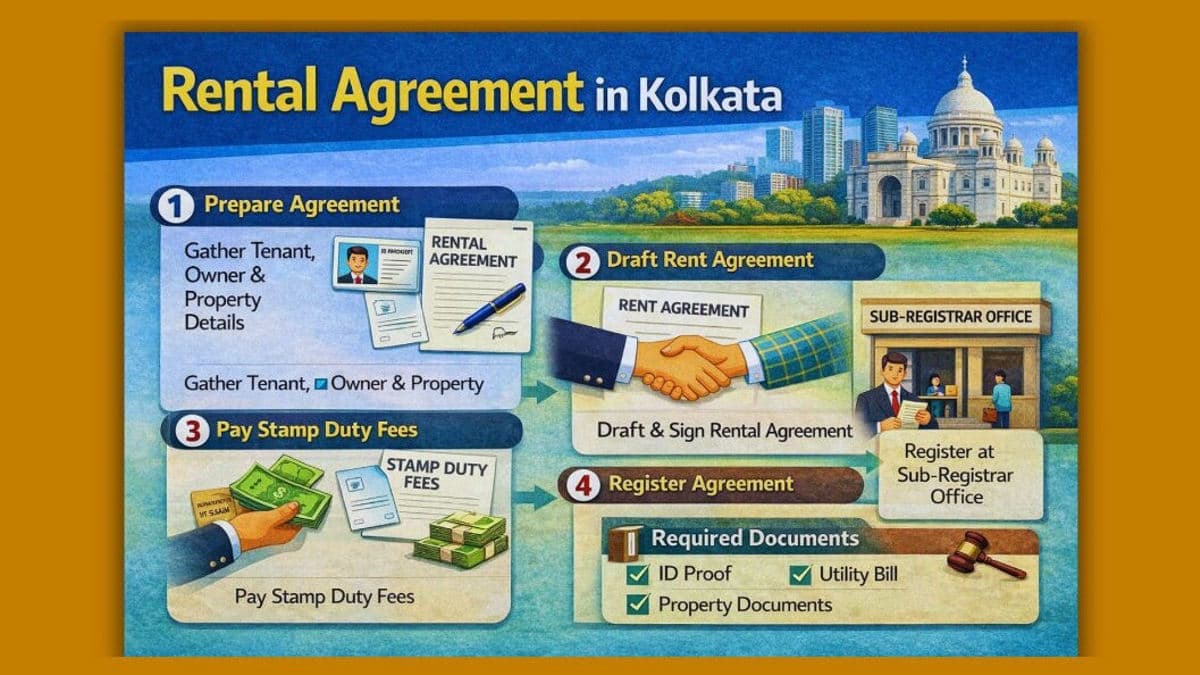
Renting in Kolkata feels simple until the paperwork starts. In many buildings, the first questions are the same: "Agreement done?" and "IDs ready?" That is because the rental agreement is not just a formality. It is what you use later for address proof, society entry, tenant verification, and deposit disputes.
If you are trying to finish the rental agreement process in Kolkata without last-minute surprises, use this as a working checklist. The points below reflect how rentals play out in places like Salt Lake, New Town, Rajarhat, Garia, Behala, Ballygunge, and the Howrah-commuter pockets. It focuses on the areas where people actually get stuck later: deposit deductions, society paperwork, and the stamp duty or registration step.
Note: This is general information. It is not legal or financial advice. If you are unsure about documents or charges, take help from a qualified professional.
Registered vs notarised: what is practical in Kolkata?
In Kolkata, you will hear "11-month agreement" very often. Many people use a short-term agreement and get it notarised because it is faster. The difference is simple: a notarised agreement is mainly a private paper between two people, while a registered agreement becomes part of the registration record and usually faces fewer questions when an office asks for proof.
If you are renting in a society that is strict on paperwork (common in gated communities and newer buildings), a registered agreement often makes onboarding easier. If the tenant needs address proof for a bank, employer, or any formal work, registration helps. If it is a short stay and both sides are comfortable, notarisation may be used, but it still will not replace proper terms and payment proof.
Before you start: fix the terms in writing
Most rental fights are not courtroom fights. They start because the basics were never written down clearly. Before anyone prints a draft, decide these points on WhatsApp or email so there is a written trail:
- Rent and due date: Monthly rent, date of payment, and mode (UPI/bank transfer).
- Security deposit: Amount, refund timeline, and deductions rules.
- Duration: 11 months, 1 year, or longer, plus renewal plan.
- Notice period and lock-in: Exit notice, lock-in (if any), and early-exit penalty (if any).
- Maintenance and utilities: Who pays society maintenance, water, electricity, and any generator charges.
- Occupancy: Names of all occupants, and rules for guests or additional residents.
If you want a quick clause checklist, use our rental agreement process guide as a reference for what a complete agreement usually includes.
Documents required in Kolkata (tenant + owner + property)
Keep documents ready before you pay a token or advance. In Kolkata, delays often happen because someone is travelling, IDs have an old address, or the owner is not in town to sign.
Tenant documents
- Photo ID: Aadhaar / Passport / Voter ID / Driving Licence.
- Passport-size photos: Keep a few physical copies; some processes still ask for them.
- Current address proof: If your Aadhaar address is different, keep an additional proof.
- Employment/education proof (optional): Some owners ask for offer letter or student ID for comfort.
Owner documents
- Photo ID: Aadhaar / Passport / Voter ID.
- Ownership proof (copy): A document that reasonably shows the owner’s name against the property.
- Bank details: Account details for rent and deposit transactions to keep everything on record.
Property details
- Full address: Flat number, tower/block, locality, and PIN code (match the society records).
- Inventory list: If furnished, write down appliances and furniture, plus working condition.
- Meter readings: Note the electricity meter reading on move-in day (photo helps).
Rental agreement process in Kolkata: step-by-step
Step 1: Draft the agreement (don't copy a random template)
A good rental agreement is short and specific. The draft should match your flat and your building rules, not generic lines. Keep it practical: maintenance, repairs, guests, subletting, deposit deductions, and notice are where most disputes start.
If you are adding a lock-in clause, write it in plain words. Tenants often sign lock-in without understanding the penalty. If you want to understand how exit terms work in real life, read the exit clause guide before you agree to a penalty.
Step 2: Decide whether you are registering or notarising
In Kolkata, registration is usually chosen when either side wants stronger documentation, or when a society/employer/bank asks for a registered agreement. Notarisation is used when speed is the priority and both sides are comfortable with a simpler process.
Whichever route you choose, keep payments through bank/UPI and keep receipts. When a dispute happens, payment proof is usually the first thing both sides look for.
Step 3: Estimate stamp duty and registration fee (don’t guess)
Charges depend on rent amount, tenure, and how the agreement is structured. Instead of guessing, calculate it using the official calculator (or a deed writer who uses it).
For West Bengal, the Directorate of Registration and Stamp Revenue provides online services and calculators on the state registration portal. Use the official site to check the latest process and fee calculation method: IGR West Bengal portal.
If you want a general explanation of how stamp duty works and why undervaluing documents creates problems later, see our stamp duty guide.
Step 4: Pay the required charges and prepare the final print
Once the draft is final and fees are calculated, the payment step produces a receipt or reference number. Keep a PDF copy and a printed copy. This is the part people misplace, and later it becomes hard to prove what was paid.
Step 5: Sign with witnesses and complete the registration formalities (if applicable)
If you register, both parties usually need to appear with identity proofs, and witnesses may be required. Photo and biometric capture is commonly part of the process. Go with originals and a couple of photocopies. If one party is unavailable, the process will slip, so plan dates in advance.
Step 6: After the agreement: society paperwork and tenant verification
After signing, most societies ask for copies of the agreement and IDs. Some owners also do tenant verification through the local police station. Even when it is not demanded, it makes expectations clearer for both sides. For a quick checklist, read tenant police verification.
Kolkata-specific checks that save headaches later
Kolkata has old apartment buildings, co-operative societies, and newer gated communities. Before you sign, do a quick real-world check along with the paperwork.
What tenants should clarify
- Guest policy: How long guests can stay and whether the society has entry restrictions.
- Parking: If you have a car, confirm whether parking is included or paid separately, and where it is allocated.
- Move-in documents: Whether the society wants photos, forms, and an owner letter.
What owners should clarify
- Occupancy: Names of actual occupants, and whether sharing is allowed.
- Subletting: Keep it clearly disallowed unless you explicitly want to allow it.
- Move-out condition: Basic expectations for cleanliness, small repairs, and handover timing.
If you are comparing more than one rental, keep your clause checklist consistent and don’t rush the draft on move-in day.
Charges in Kolkata: what you should budget for
Exact charges depend on rent, tenure, and the route you choose (registration or notarisation). For planning, budget across these heads:
- Stamp duty: Depends on rent and tenure, and the type of agreement.
- Registration fee: Applicable when you register the agreement.
- Drafting/help fees: If you use a deed writer or advocate to draft and coordinate.
- Notary charges: If you choose notarisation instead of registration.
- Printing and photocopies: Small, but don’t ignore them if multiple sets are required.
Who usually pays these charges?
In Kolkata, you will see all three patterns: tenant pays, owner pays, or the cost is split. What matters is consistency. If the owner wants the tenant to pay, the tenant usually expects the agreement to be completed before move-in and expects proper receipts. If costs are split, write the split clearly and keep proof of who paid what.
Typical timeline (realistic, not “best case”)
If both parties are in the city and documents are ready, the process can move quickly. Delays usually come from small issues: one person is out of town, witnesses are not available, photos are missing, or clauses get changed at the last minute. To keep things smooth, start the draft a few days before move-in and avoid booking movers until the agreement text is final.
Many buildings will ask for paperwork before they issue gate passes or parking access, so plan for that.
For a step-by-step rental journey (shortlisting, negotiating, paying token money safely), see how to take a rental home.
Who this guide helps (tenant + owner + buyer + seller + general)
- Tenant: Keep deposit and exit terms clear, and keep payment proof.
- Owner: Verify occupants, keep guest/subletting rules clear, and avoid cash handling.
- Buyer: Learn what affects tenancy before you buy a flat to rent out.
- Seller: Keep tenancy paperwork clean so resale discussions stay simple.
- General user: Use the step-by-step section and the clause checklist.
Common mistakes people make in Kolkata rentals
- Unclear maintenance split: Society maintenance can be significant in newer complexes. Write who pays what.
- No inventory list: Without an inventory, deposit deductions become “your word vs their word”.
- Handing over cash deposit: Cash makes disputes harder. Use bank transfer and keep proof.
- Lock-in without understanding: A strict lock-in can trap a tenant who needs to relocate quickly.
- No move-in condition record: A simple phone video on day one avoids arguments later.
Quick clause checklist (keep it practical)
| Clause |
What to write clearly |
| Deposit refund |
Timeline and what counts as a valid deduction (with bills where possible) |
| Repairs |
Minor repairs vs major repairs, and who pays |
| Painting |
Whether painting cost is deducted, and how it is calculated |
| Notice / lock-in |
Notice period and early exit penalty in plain language |
| Guests / occupancy |
Guest stay limits and whether sharing is allowed |
Conclusion
The rental agreement process in Kolkata becomes easier when you treat it like a checklist: fix terms in writing, keep documents ready, choose registration vs notarisation based on your need, and keep payment proof. It saves time during society onboarding, and it reduces deposit and notice disputes later.
Common Questions (FAQs)
Q1: Is rental agreement registration mandatory in Kolkata?
Not every rental is registered in practice, but registration is useful when you need stronger documentation or when a society, employer, or bank asks for it. If you are unsure, decide based on how long you plan to stay and what proof you will need.
Q2: Who pays the stamp duty and charges in Kolkata?
There is no single rule followed by everyone. Many owners ask tenants to pay, many split it, and some owners pay it themselves for longer leases. The important part is to decide the split before finalising the draft.
Q3: How long does it take to complete a rental agreement?
If both parties have documents ready and dates match, the agreement can be completed quickly. Delays usually come from missing IDs, parties being out of town, or last-minute clause changes. Plan the paperwork before move-in day.
Q4: What should a tenant do on the move-in day?
Take photos of meter readings, record the condition of walls and appliances, and keep an inventory list signed. These small steps reduce deposit disputes later.