Introduction
Buying a flat or plot in Hyderabad feels exciting right up to the paperwork stage. Then the paperwork starts: registration is the step that converts a ???deal??? into legal ownership. In 2026, Telangana has more online steps than before, but the basics remain the same: your title must be clean, the deed must be drafted correctly, and the fees must be paid on the right value.
This article walks you through the property registration process in Hyderabad. It covers what to do before the SRO visit, what to carry on the appointment day, how charges are generally structured, and which small mistakes cause delays.
Detailed explanation of the topic
What property registration means
Property registration is the government???s record of a property transfer. When the sale deed is registered at the Sub-Registrar Office (SRO), it becomes the main document banks and future buyers rely on. Receipts, notarised papers, or messages can show intent???but a registered deed is what puts ownership transfer on official record.
How the property registration process in Hyderabad works in 2026
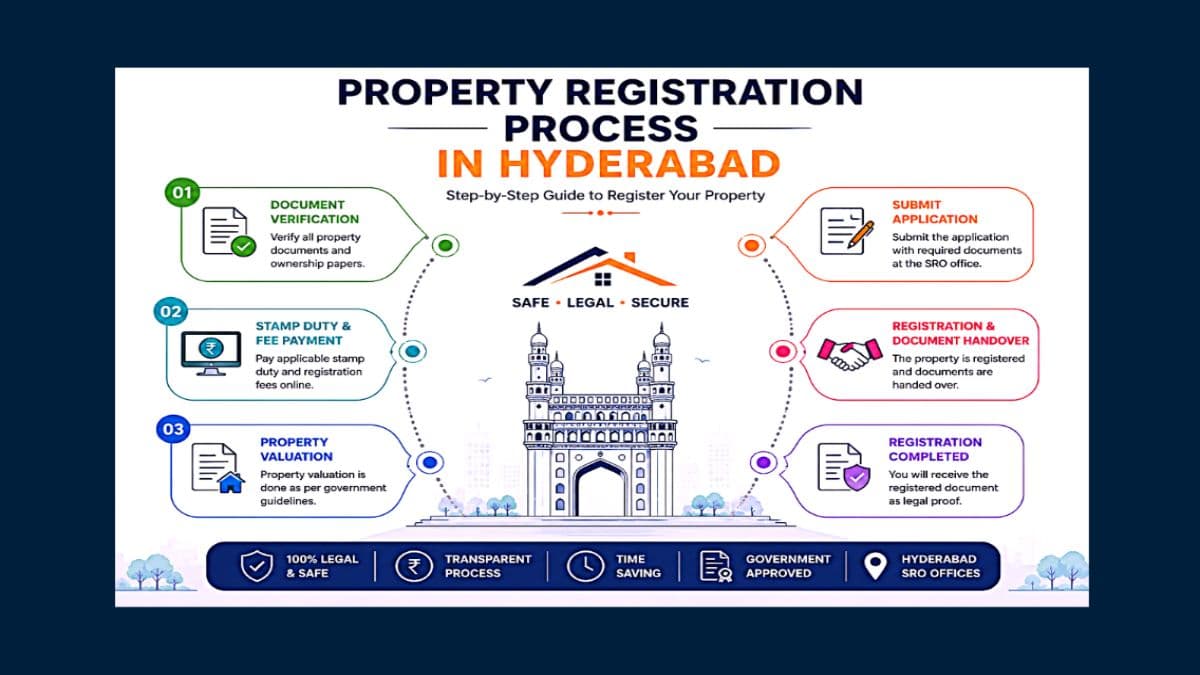
In practice, it???s a sequence, not a single day. A smooth registration looks like this:
- Before the appointment: title + EC check, draft review, valuation clarity, and duty/fee payment receipts ready.
- At the SRO: buyer/seller + two witnesses, biometrics, verification, scanning, and registration acknowledgement.
- After registration: mutation/property tax transfer, utilities transfer, and society transfer (for apartments).
If you want a general registration workflow reference, see: property registration basics (step-by-step).
Documents required for property registration in Hyderabad (2026)
Exact requirements can vary based on property type and SRO, but most cases need a mix of people documents (buyer/seller/witness IDs) and property documents (title + approvals). Carry originals and a photocopy set.
People documents (buyer, seller, witnesses)
- ID + address proof: Aadhaar, PAN, Passport/Driving License (as applicable).
- Witnesses: two witnesses with valid ID proof who can attend the appointment.
- Photos: passport-size photographs (carry extras).
- Payment trail: UTRs/cheque copies/receipts for payments made.
- Name matching: deed spellings should match PAN/Aadhaar exactly (initials and spacing included).
Property documents (what changes by flat/plot/resale)
- Resale flat: earlier registered deed(s), link documents (if needed), latest EC, property tax paid receipts, society transfer letter/NOC (if applicable), and loan closure/release papers if the seller had a loan.
- New flat from a builder: allotment/agreement documents, key approvals (as applicable), and clarity on OC/CC status (where applicable).
- Plot/land: layout approval documents (as applicable), boundaries/survey/extent details, latest EC, and clarity on access road.
If your property is inside a project, keep a compliance mindset from day one: RERA basics for homebuyers.
Official Telangana online checks (do these before you finalise)
Before you pay any token amount or fix an SRO appointment, use the official Telangana Registration & Stamps portal for a few basic checks. It???s a quick way to catch issues early and avoid last-minute surprises.
- Encumbrance Search (EC): use it to see registered transactions/charges for the period you select. Start from the official dashboard and open Encumbrance Search: Citizen Service Dashboard.
- Market Value Search: check the guideline/market value used for duty calculations so you don???t get surprised at the last moment. It???s available from the same official dashboard: Market Value Search.
- Know your SRO: confirm you are going to the correct SRO for your property location: Know Your SRO.
- Duty/Fee Calculator: do a quick estimate (then confirm final numbers with your advocate based on deed type and location): Duty Fee Calculator.
Always use the official home page link if you want to navigate from scratch: registration.telangana.gov.in.
Step-by-step property registration process in Hyderabad
Step 1: Title verification and EC check (before paying any token amount)
This is where many ???cheap deals??? turn into expensive problems. In Hyderabad, whether it???s a resale flat in Kondapur or a plot near Shamirpet, start with title clarity.
- Chain of ownership: check the prior deeds and link documents so the ownership trail is clear.
- Encumbrance Certificate (EC): confirm there are no registered loans or claims for the period you are checking.
- Loan closure plan: if a home loan exists, confirm the closure + release document sequence before you commit.
Step 2: Confirm property type and approvals
Your checks should match what you are buying:
- Resale apartment: society dues, transfer process, loan closure documents, and a clean EC.
- Builder sale: approvals and the deed terms matching what is promised in writing.
- Plot/land: boundaries, survey/extent, layout approval (if applicable), and access road clarity.
If you are using a home loan, keep your file ready for the bank from the start: home loan documentation and eligibility checklist.
Step 3: Review the sale deed draft carefully
Many SRO delays happen because the deed has incorrect or inconsistent details. Before printing, check:
- Property schedule: flat number, floor, area details, boundaries, and parking (if included).
- Parties: buyer/seller names must match ID proofs exactly.
- Consideration + payment references: amounts, dates, and UTR/cheque details.
- Loan references: wording should match the actual loan status and documents.
A quick Hyderabad-style example (why tiny details matter)
Say you???re buying a resale flat in Gachibowli and your Aadhaar has an initial, but the deed draft uses your full middle name. On paper it looks ???close enough???, but at the SRO it can turn into a correction loop???especially if the seller has travelled in from another city for the same appointment. Fix spellings first, then print. The same applies to the property schedule: a wrong flat number, wrong survey/extent, or missing parking detail can create confusion later when you apply for a loan, sell the flat, or transfer it in the society.
Step 4: Understand stamp duty and registration charges (budgeting)
In Telangana, government charges for a sale deed commonly include stamp duty, registration fee, and (in many municipal areas) transfer duty. Rates can change, and the exact breakup can vary by location and deed type. Use this section for planning, and confirm the final numbers for your exact case.
For planning, many Hyderabad buyers in municipal limits often see a structure close to:
| Charge |
Indicative rate |
What it depends on |
| Stamp duty |
~4% |
Value used for registration and deed type |
| Transfer duty |
~1.5% |
Often applicable in municipal limits |
| Registration fee |
~0.5% |
May have caps; verify current rules |
Always verify the latest rates for your jurisdiction on Telangana Registration & Stamps: registration.telangana.gov.in.
If you want to understand how government valuation can affect your fees, read: Ready Reckoner / Jantri explained with examples.
Step 5: Make payments and keep the receipts ready
Complete the duty/fee payments in the prescribed format before the SRO visit. Keep receipts and payment references handy. A mismatch or missing proof is a common reason for delays.
Step 6: Attend the SRO appointment (biometrics and verification)
On the appointment day, the buyer and seller attend the SRO with two witnesses. The officer verifies the deed data and IDs, collects biometrics (fingerprints/photo), and records the document. After acceptance, you receive an acknowledgement and later the registered document copy as per the system in use.
Step 7: After registration (don???t stop at the deed)
After the sale deed is registered, complete the next steps so all records reflect your ownership:
- Mutation / property tax transfer
- Utility transfers (electricity/water, as applicable)
- Society transfer (for apartments)
Important factors or key points related to the topic
1) Correct names and matching IDs
Even small spelling mismatches can create last-minute corrections. Match names and initials exactly with Aadhaar/PAN before you print the deed.
2) Valuation clarity (agreement value vs guideline value)
Charges are usually calculated on the value used for registration, which can be based on guideline valuation rules. If you check valuation early, you avoid surprises on registration week.
3) Loan closure clarity for resale
If the seller has an existing loan, confirm the closure and release documents clearly. Many resale delays happen because one key release paper is missing.
4) Witness planning
Choose witnesses who are available and can bring valid ID. Don???t leave this to the last minute.
5) SRO jurisdiction matters
Going to the wrong SRO wastes time. Confirm jurisdiction based on the exact address/revenue mapping, not just a locality name.
Practical tips or advice
Keep a simple ???registration folder???
Maintain one folder (physical + scanned) with the EC, deed draft, IDs, payment proofs, and key title documents. It makes the final week much smoother.
Do one rehearsal check before printing
Check names, property schedule, and payment references once more before printing. It takes 10 minutes and saves hours at the SRO.
Budget beyond government charges
Set aside a buffer for advocate fees, society transfer charges (for resale), and small handling costs. If you plan only for stamp duty and registration, the final stage can feel tight.
Don???t accept shortcuts that avoid registration
If someone suggests a ???notarised??? shortcut instead of a registered deed, treat it as a red flag. Proper registration is what keeps your property file clean for resale and loans.
Conclusion
The property registration process in Hyderabad becomes easy when you handle it in order: title and EC check first, a clean deed draft, correct fee calculation, and a planned SRO appointment with the right people and documents. Do the basics early and your registration week stays calm.
Common Questions (FAQs)
Q1: Can I register a property in Hyderabad without visiting the SRO?
In most regular cases, no. Registration typically involves biometrics and signatures at the SRO. Special cases can have separate procedures, but they need formal approval.
Q2: What are the most common documents required for property registration in Hyderabad?
Usually, you need buyer/seller IDs, two witness IDs, payment proofs, the sale deed draft, and core title documents (especially for resale). Requirements can vary, so confirm with your advocate.
Q3: How many witnesses are needed?
Typically, two witnesses are needed. They should be available on the appointment day and carry valid ID.
Q4: Do stamp duty and registration charges change in Telangana?
Yes. Rates and caps can change through government notifications. Always verify the latest rates for your exact jurisdiction and deed type before you budget.
Q5: What should I do after the sale deed is registered?
Complete mutation/property tax transfer, transfer utilities, and finish society transfer for apartments. These steps keep all records aligned with your ownership.
Q6: Is hiring an advocate necessary for registration?
It???s not legally mandatory in every case, but it is strongly recommended. A good advocate helps you verify title, avoid drafting mistakes, and reduce the risk of future disputes.