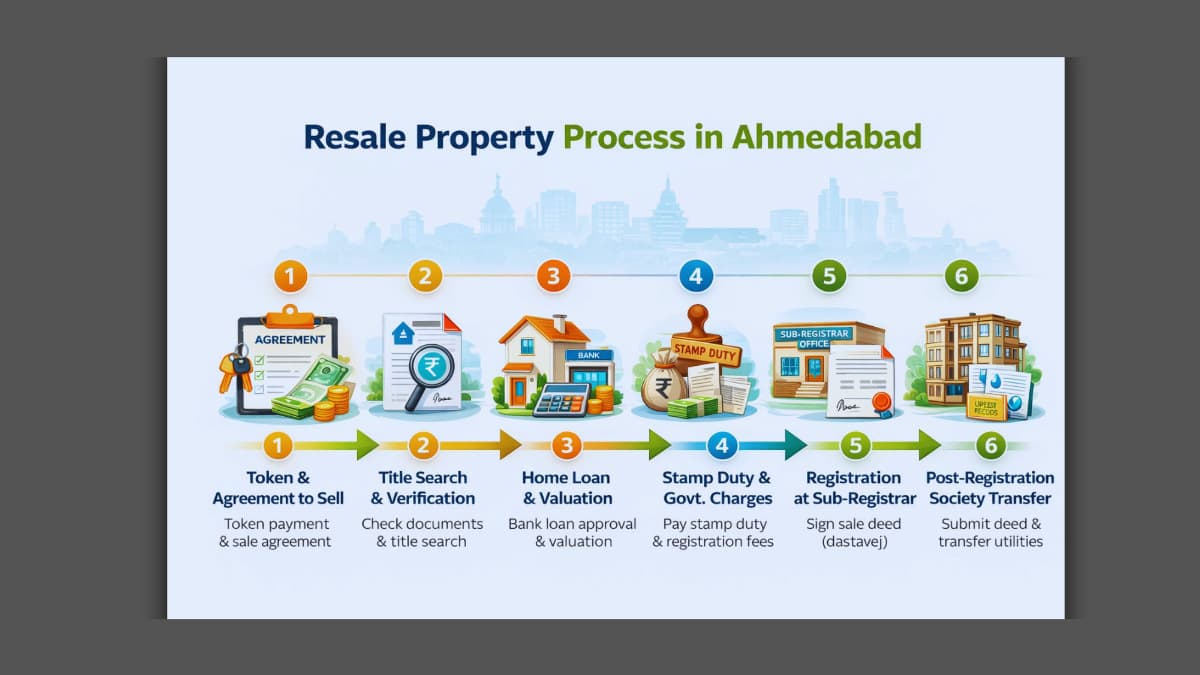
Buying a resale flat in Ahmedabad is a battlefield. It is not the same as walking into a shiny sales office in GIFT City or Shela, drinking coffee, and signing a printed form. When you buy a new home from a builder, you are the first owner. The paperwork is standardized, the RERA protection is strong, and the bank loans are pre-approved. But in a resale property deal in Ahmedabad, you are stepping into someone else's shoes???and often, their mess.
Whether you are looking for a spacious 3BHK in Satellite with a 2005 construction date or a modern 2BHK in Gota, the resale process has its own "Ahmedabadi" flavor. You will hear terms that don't exist in textbooks: "Banakhat," "Satakhat," "Dastavej," "Title Clear," and the infamous "Transfer Fee."
If you don't know what these mean, you are walking blind. In 2026, with property prices in areas like Bodakdev and Thaltej hitting ???8,000+ per sq. ft., a small mistake in the paperwork can cost you lakhs. We have seen buyers lose their token money because they didn't check the "Society Share Certificate" or get stuck with a flat that has a pending litigation in the Civil Court.
This guide is your ground-reality roadmap. Written from the perspective of a local real estate insider, it covers the entire Flat Resale Process in Ahmedabad???from the initial token negotiation to the final name transfer in the society records. We will strip away the legal jargon and tell you exactly what papers to check, where the hidden costs are, and how to handle the "Society Chairman" who wants a "donation."
Part 1: The "Search" Phase (Ground Reality)
Before you even pay a rupee, you need to understand what you are buying. In Ahmedabad, the biggest advantage of resale flats is the Carpet Area.
The "Super Built-up" vs. "Carpet" Truth
In new projects today (2024-2026), the "Loading" is high (40-45%). A 2000 sq. ft. flat gives you only 1100 sq. ft. inside. But in older societies (built before 2010) in areas like Vasna, Paldi, or Memnagar, the loading was low (20-25%). You actually get what you pay for.
Local Tip: When viewing a flat, don't just look at the walls. Open the taps. Ask the neighbors about the "Water Supply" schedule. In many parts of Bopal, water comes only for 2 hours. In Maninagar, parking is the biggest fight. These are things no broker will tell you.
Part 2: The "Token" & The Agreement to Sell (Banakhat)
Once you like a flat and negotiate the price, the seller will ask for a "Token" amount. Usually, this is ???51,000 or ???1 Lakh. This locks the deal verbally. But be careful.
The "Satakhat" vs. "Banakhat"
Locals often confuse these words.
1. Token Receipt (Satakhat): This is a raw, initial paper signed when you pay the token. It just mentions the price and the time limit (e.g., 3 months).
2. Agreement to Sell (Banakhat): This is the formal legal document.
The 10% Rule & The Notary Trap
Within a week or two, you are expected to pay 10% of the deal value. This is when you sign the formal Agreement to Sell.
Warning: Many brokers in Ahmedabad will ask you to just "Notarize" this agreement on a ???300 stamp paper to save money. Don't do it. A notarized agreement has very little legal standing if the seller backs out or sells the flat to someone else (a practice called "Double Selling"). Always insist on a Registered Banakhat at the Sub-Registrar Office, especially if the deal period is long (3-6 months). It costs more (Stamp Duty is involved), but it protects your 10%. Read more in our Ahmedabad Buying Guide.
Part 3: The "Title Clear" Search (The Lawyer's Job)
This is the most critical step. You need to verify that the seller actually owns the property and hasn't mortgaged it to three different banks or sold it to his cousin in 1995.
The Documents You Need (The "Original File")
Ask the seller for the "Original File." It must contain:
- Original Sale Deed (Index-2): The document that proves their ownership. Check the name spelling carefully. "Ramesh" vs "Rameshbhai" can cause issues later.
- Share Certificate: If it's a Co-operative Housing Society (most old flats in Ahmedabad are), this is the ultimate proof of membership. The name on the Share Certificate MUST match the Sale Deed.
- Chain of Documents: If the flat has been sold 4 times before, you need the sale deeds of ALL previous 4 owners. The bank will ask for this "Chain."
- Raja Chitthi & BU Permission: Essential to prove the construction is legal. Without a valid BU (Building Use) Permission, nationalized banks like SBI will NOT give a loan. You should also cross-check the project's original details on the RERA Gujarat Portal if it's a newer building.
- Latest Tax Bill: Check the AMC Property Tax bill. It shows if there are any pending dues.
The "Public Notice" Ritual: Your advocate will issue a public notice in a local newspaper (like Gujarat Samachar or Sandesh) inviting claims against the property. If no one objects within 7-14 days, the title is considered clear. This is mandatory for a "Title Clearance Certificate" (TCC). Check Real Estate Market Analysis for more on land titles.
Part 4: The "Cash" (Black) Component Reality
We need to have an honest conversation. In Ahmedabad's resale market, especially in premium areas like C.G. Road or Sindhu Bhavan Road, sellers often demand a "Cash Component." They might ask for a 60:40 ratio (60% White via Cheque, 40% Cash).
Why you should avoid this:
1. Loan Eligibility: Banks only fund the "Agreement Value" (White part). If the flat is ???1 Cr and you show only ???60 Lakh on paper, the bank gives 80% of ???60 Lakh. You have to arrange the rest from your pocket.
2. Legal Risk: It is illegal. If the deal cancels, you cannot prove you paid the cash. You lose it.
3. Capital Gains: When you sell it later, your buying cost will be low on paper, so your tax liability will be huge.
Our Advice: Stick to 100% White deals. It might take longer to find a seller, but you will sleep better.
Part 5: Home Loan & Valuation
If you are taking a loan, the bank will do the heavy lifting for you. They will send a lawyer and a technical valuer to the property.
The Valuation Trap (Older Areas)
The bank will fund 80% of the Lower of two values:
1. The Market Value (what you are paying).
2. The Technical Valuation (what the bank thinks it's worth).
In older areas like Naranpura or Navrangpura, the bank's valuation is often lower than the market price because they depreciate the building value. This means your down payment requirement will go up. Be prepared for this "Funding Gap." Check your eligibility in our Home Loan Guide.
Part 6: Stamp Duty & Registration (The Government's Cut)
In Gujarat, the government takes a significant slice of your budget. The Stamp Duty is calculated on the Jantri Value (Govt Circle Rate) or the Agreement Value, whichever is higher.
The 2026 Math
- Stamp Duty: 4.9% (approx). Women get a 1% concession in some cases (check latest rules).
- Registration Fee: 1% of the value.
- Advocate Fee: ???15,000 - ???25,000 for drafting the deed.
Use our Stamp Duty Calculator to get the exact figure. Remember, this amount must be paid before you go to the Registrar's office via e-challan (Cyber Treasury).
Part 7: The Registration Day (Dastavej)
This is the big day. You, the seller, and two witnesses must go to the Sub-Registrar Office (SRO). In Ahmedabad, the SROs are zone-wise. For example:
- Memnagar SRO: Covers Thaltej, Bodakdev.
- Gandhinagar SRO: Covers Motera, Chandkheda.
- Narol SRO: Covers Maninagar, Vatva.
The SRO Process (Step-by-Step)
- Token: Reach early (9:30 AM). You get a token number.
- Verification: The clerk checks the Stamp Duty payment challan and the TDS certificate (if deal > ???50 Lakh).
- Biometric: Your photo and thumb impression are taken digitally. Smile for the webcam!
- Payment Proof: You must show the proof of payment (Cheque/DD/RTGS) for the full deal amount in the document itself.
- Signing: You sign the "Dastavej" (Sale Deed) in front of the officer.
Once this is done, the property is legally yours! But wait, you aren't done yet. For more details on the SRO process, see Property Registration Guide.
Part 8: Post-Registration (The "Namfer" Process)
Many buyers think the job ends at the Registrar's office. It doesn't. You are the legal owner, but the society and the municipal corporation don't know that yet.
1. Society Transfer & The "Chairman" Hurdle
You must submit the registered Sale Deed copy to the Society Chairman/Secretary. This is where things get tricky in Ahmedabad.
Transfer Fee: The society will charge a "Transfer Fee." Legally, under the Cooperative Societies Act, this is capped (usually ???25,000). But in reality, many premium societies in Bodakdev or Ambli ask for ???1 Lakh, ???2 Lakh, or even more as a "Voluntary Donation" to the amenity fund.
The Interview: Some posh societies conduct an "Interview" of the new buyer. They check your profile, eating habits (Veg/Non-Veg is a big issue in some zones), and profession.
Local Advice: Negotiate the Transfer Fee before you buy the flat. Ask the seller to clear this up with the Chairman. Don't let it become a surprise after you have paid the money.
2. Torrent Power & AMC Tax Bill
You need to change the name on the electricity bill (Torrent Power or UGVCL) and the Municipal Tax bill.
Documents Required: Index-2, Sale Deed copy, and the last paid bill. This usually takes 30-45 days. You can do the Torrent Power transfer online now, but for AMC Tax, you often have to visit the ward office (Civic Center).
Conclusion: Is Resale Worth the Hassle?
Buying a resale flat in Ahmedabad is not easy. It involves digging through old papers, negotiating with tough brokers, and navigating the SRO bureaucracy. But the rewards are huge. You get a home in a prime, developed location where no new land is available. You get bigger rooms, better carpet area, and an established community.
If you value Location over "New Amenities," resale is the way to go. Plus, with Ahmedabad's Future Infrastructure (Metro Phase 2, Ring Road) expanding, resale properties in established areas like Drive-In Road or Vijay Cross Roads are gold mines.
Don't rely solely on the broker's word. Hire a good advocate to do the Title Search. Ensure the "Chain of Agreements" is complete. And never, ever pay the full amount until the bank approves the property.
Your dream home in Ahmedabad is waiting. Just make sure the keys come with a clean title.
Frequently Asked Questions (FAQs)
Can I pay for a resale flat in cash in Ahmedabad?
Avoid it completely. While some sellers in areas like C.G. Road insist on a cash component (Black money), it is illegal and risky. If the deal gets cancelled, you will lose that money. Also, you cannot take a loan on the cash amount. Stick to 100% white deals via Cheque or RTGS.
What is the "TDS on Property" rule?
If the property value is above ???50 Lakhs, you (the buyer) must deduct 1% TDS from the payment and deposit it with the government using Form 26QB. You must give the TDS certificate to the seller. If the seller is an NRI, the TDS rate is much higher (20% + Cess).
Is a "Power of Attorney" (GPA) sale valid in Gujarat?
No. The Supreme Court has ruled that General Power of Attorney (GPA) sales do not convey valid title. You must have a registered Sale Deed (Dastavej) to be the legal owner. Banks will not give a loan on a GPA property.
How long does the whole resale process take?
If you are taking a loan, expect 30 to 45 days. The Title Search takes 7-10 days, the Bank Valuation & Approval takes 10-15 days, and the Registration takes 1 day. Post-registration transfer takes another 30 days.
Can the society reject my membership?
Legally, no, unless you have a criminal record or violate bylaws. However, societies often create hurdles over "Transfer Fees" or "Community Preferences." It is highly recommended to meet the Chairman/Secretary before finalizing the deal to avoid conflict later.