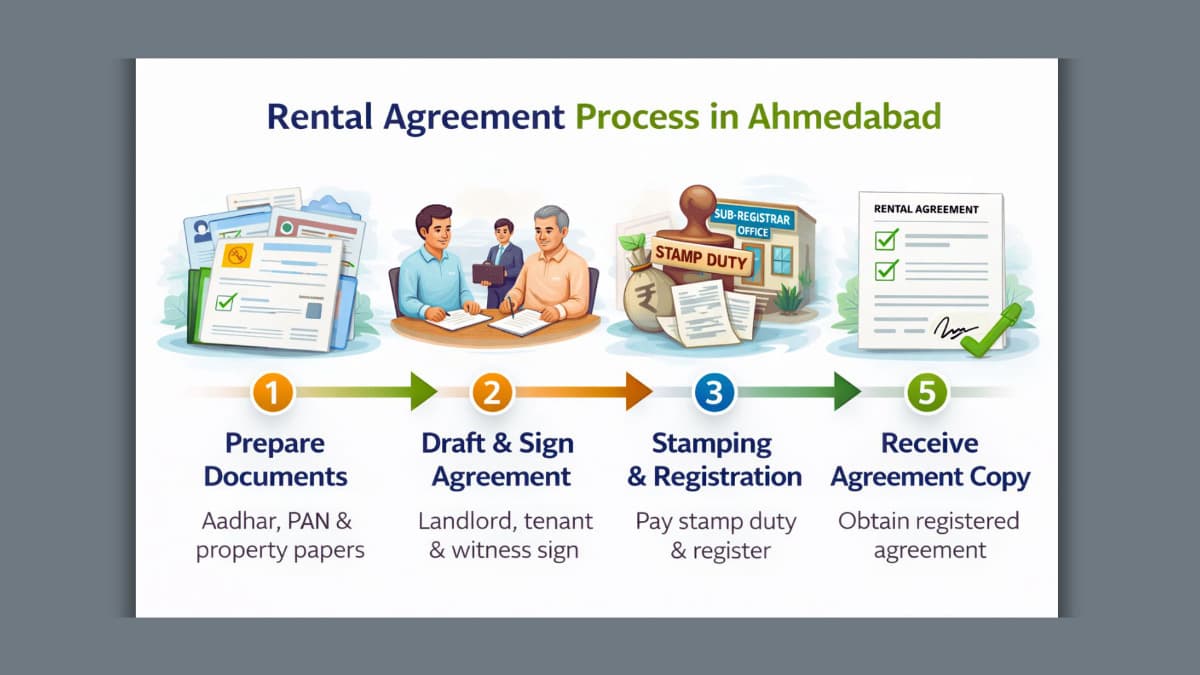
This guide explains how tenants and owners in Ahmedabad can make a clean, legal, and practical 11-month rental agreement. The steps below reflect how it works on the ground in the city - from deciding terms, drafting, e-stamp duty and registration, to police verification and handover. The aim is to avoid confusion and disputes later.
Quick Snapshot: What You Need
- Owner's and Tenant's ID proof (Aadhaar/Passport/PAN)
- Passport-size photos (owner and tenant)
- Property document (latest tax bill or index copy)
- Two witnesses with IDs for registration day
- Rent, deposit, and maintenance terms agreed in writing
- Police tenant verification form after signing
Step 1: Decide the Terms Clearly
In Ahmedabad, most apartments follow an 11-month "Leave and License" model. Decide the points below before drafting. Put them in simple, direct language.
- Monthly Rent: Amount and payment date. Add a 5-7 day grace window to avoid friction.
- Security Deposit: Market norm is two months' rent. Some premium societies may ask for three for fully furnished flats.
- Lock-in Period: Typical 6 months. If either party ends earlier, forfeit a part of the deposit or pay one month's rent.
- Maintenance: In most Ahmedabad societies this is extra. State who pays how much and whether it is included in the rent.
- Utilities: Electricity, piped gas, and water usage are the tenant's responsibility. Property tax (AMC) is the owner's responsibility.
- Usage Rules: Clarify Veg-Only or bachelor restrictions if the society has them. Better to be transparent.
- Notice Period: 30 days is common. Mention handover condition and cleaning.
If you are still searching areas and rents, compare local ranges in our Ahmedabad 2 BHK rental guide. For resale-side paperwork perspective, see the Ahmedabad resale process.
Step 2: Draft a Clear Agreement
Use a simple 11-month Leave & License draft. Avoid vague clauses. These are the clauses that prevent disputes in Ahmedabad societies:
- Parties and Premises: Flat number, building, survey number if available.
- Term: Start and end dates, lock-in, and notice period.
- Rent & Deposit: Amounts, due date, bank details, and refundable deposit terms.
- Maintenance & Taxes: Who pays society maintenance and that AMC property tax remains owner's liability.
- Damage & Repairs: Owner handles structural repairs; tenant handles day-to-day consumables (taps, bulbs) caused by usage.
- Use & Subletting: Residential use only, no subletting without written consent.
- Handover: Keys, cleaning, and inventory checklist attached as Annexure.
If you want a quick refresher on what a rental agreement contains (by structure), skim our Rental Agreement basics and adapt to Ahmedabad norms above.
Step 3: Calculate Stamp Duty
For a standard 11-month residential agreement in Ahmedabad, most people use a Rs 300 stamp paper and get it notarized. However, for legal safety, registration is better. If you register, the stamp duty is approximately 1% of the average annual rent plus registration fees.
To understand the difference between notarized and registered rent agreements, see our Rental Agreement basics. Always cross-check the latest rates with a local stamp vendor or advocate.
Registered vs notarised: what is practical in Ahmedabad?
In Ahmedabad, you will hear "11-month agreement" a lot. Many people notarise because it is faster. A registered agreement is stronger because it becomes part of the registration record and usually creates fewer questions when a society office, employer, or bank asks for proof.
- Choose registration when: the society is strict on documentation, the tenant needs address proof for formal work, or you want stronger dispute protection.
- Choose notarisation when: it is a short stay and both sides agree, but still keep payments through bank/UPI and keep receipts.
- In both cases: write maintenance, repairs, guest rules, and deposit deductions clearly. Most disputes start here, not in court.
Step 4: Buy E-Stamp or E-Challan
You can buy an e-stamp from authorized counters or use the state's e-challan route. Keep owner and tenant names exactly as per ID proofs. Print the agreement draft on plain A4 and attach the e-stamp certificate (no need for green legal paper).
Step 5: Register the Agreement
Registration is strongly recommended because it becomes valid address proof for KYC updates and avoids disputes. Ahmedabad SROs follow a token/appointment system. Plan a weekday morning to avoid long queues.
On Registration Day
- Carry original IDs (owner, tenant, two witnesses) and two photocopies each.
- Carry two passport photos each and e-stamp printout.
- Sign in front of the registrar and biometric if asked.
- Pay the registration fee at the counter (amount shown on receipt).
- Collect receipt and tracking number. Soft copy is usually available later.
For a refresher on office flow and queues, read the Property Registration field guide and apply the same time-saving habits here.
Step 6: Police Tenant Verification
Ahmedabad Police require landlords to submit a tenant verification form. This protects both parties and is often checked by society offices. Complete it within a few days of move-in.
- Owner and tenant IDs, photos, and a copy of the signed agreement.
- Fill the tenant details form (online/at the local police station).
- Submit to the station or as directed online; keep the acknowledgement slip.
Societies near Prahlad Nagar and Gota usually insist on this before issuing access cards. If you are new to rental prices and areas, cross-check with our area-wise rent guide to avoid overpaying.
Step 7: Handover & Inventory
Do a 30-minute joint inspection on the day you receive the keys. Note wall seepage, door locks, water pressure, and electrical points. Attach a simple inventory list (fans, lights, appliances, furniture) with conditions and photographs to the agreement as Annexure-A. This prevents end-of-term disputes over deposit.
Move-out checklist (to protect the deposit)
Most deposit disputes are not about fraud. They happen because the handover is not documented. Keep this simple checklist and you avoid most arguments.
- Meter readings: take photos of electricity and gas meters on move-out day.
- Final bills: clear electricity, gas, and any pending maintenance before handing keys.
- Inventory match: compare the inventory list item-by-item and note any damage in writing.
- Paint and cleaning: agree in writing whether painting is required and what is considered normal wear.
- Key handover: hand over all keys and access cards and take a written acknowledgement.
Step 8: Renewal or Exit
For renewal, draft a short addendum with the new term and revised rent and buy e-stamp for the delta if required. For exit, serve written notice, clear utilities, and hand back in the same condition as per the inventory. If you plan to buy in the same area later, the resale process guide for Ahmedabad will help you understand title checks and negotiation flow.
Common Mistakes to Avoid
- Not clarifying maintenance: In most gated societies, it is extra. Write the exact amount.
- Mixing furniture with deposit: Keep furniture value outside the refund calculation unless damaged.
- Skipping police verification: Societies and lenders increasingly ask for it; avoid later trouble.
- Vague notice clause: Always state notice method (WhatsApp/email) and date deemed served.
- No annexure photos: Photos save hours of debate at vacating time.
Location Tips from Ahmedabad
The city's rental customs vary by neighborhood:
- Bodakdev/SBR/Ambli: Higher deposit, stricter society bylaws, furnished flats common.
- Prahlad Nagar/Makarba: Corporate crowd, owners are usually flexible with documentation.
- Gota/Jagatpur: Newer towers with better amenities; check maintenance add-ons carefully.
- Navrangpura/Paldi/Vasna: Older buildings, larger rooms; check lift and parking in advance.
- Maninagar/Nikol: Budget-friendly; confirm water timings and society gate rules.
Future connectivity around SG Highway and GIFT City continues to evolve; see infrastructure updates if you are planning a longer stay and negotiating a lock-in.
Conclusion
Keep the agreement simple, write every money point in one place, register it, and finish police verification within a week. Most rental disputes in Ahmedabad come from unclear maintenance and deposit clauses or missing inventory records. If you follow the steps above, you avoid 90% of problems and save time for the real move. Keep a soft copy of the agreement and verification acknowledgement for quick society checks.
Deposit deductions: what is fair (common practice)
Most owners deduct money at move-out for two reasons: unpaid bills and repainting/cleaning. You avoid surprise deductions by writing two lines in the agreement and keeping a basic photo record. If you want it simpler, agree one fixed cleaning charge in advance and attach it to the agreement. Keep the handover photos in one folder until the deposit is fully returned.
- Unpaid bills: agree that electricity/gas/maintenance arrears will be adjusted from the deposit based on actual bills.
- Painting: decide upfront whether painting is mandatory after 11 months or only if there is visible damage beyond normal wear.
- Cleaning: set a simple standard (kitchen/bathrooms cleaned, no broken fittings) and do a joint handover.
- Refund timeline: write a clear timeline (for example, within 7-14 days after final bill settlement) to avoid endless follow-ups.
FAQs
Is registration compulsory for an 11-month rental agreement?
Legally, registration makes the agreement stronger and accepted as address proof. Many society offices in Ahmedabad strongly advise it even for 11-month terms.
What stamp duty should I budget?
For a standard 11-month notarized agreement, budget for a Rs 300 stamp paper plus advocate/notary fees. If registering, budget around 1% of annual rent plus registration charges.
Is police tenant verification mandatory?
Yes, landlords should file tenant details with Ahmedabad Police. Many societies require the acknowledgement slip before issuing access cards.
Who pays society maintenance and AMC property tax?
Typically, the tenant pays monthly maintenance if it is not included in rent; the owner pays AMC property tax. State this clearly in the agreement.
What deposit is common in Ahmedabad?
Two months' rent is common. Fully furnished premium flats may be three months. Take a receipt and link deposit return to a clean handover against the inventory.