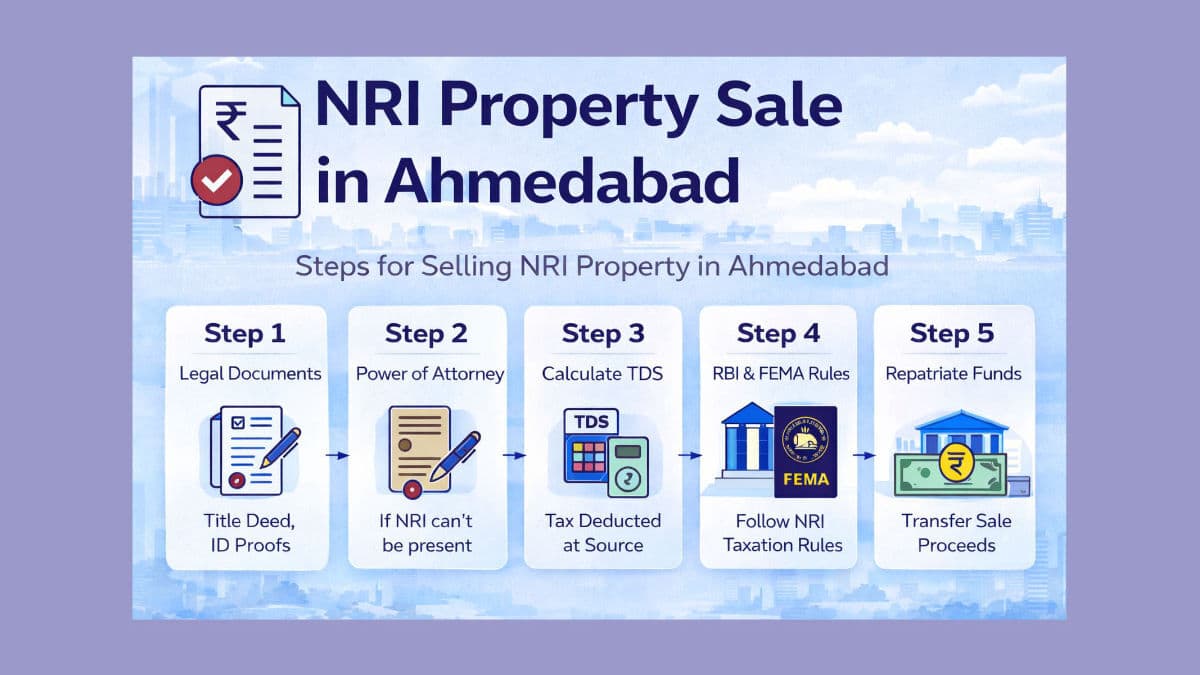
Selling a property in Ahmedabad is complex enough for a local resident. For a Non-Resident Indian (NRI) sitting in New Jersey, London, or Dubai, it can feel like navigating a maze blindfolded. The rules are different, the taxes are higher, and the paperwork is unforgiving.
Whether you own a bungalow in Bodakdev, a flat in Satellite, or an ancestral plot in Naranpura, the process of liquidating your asset requires precise planning. One mistake in your TDS calculation or Power of Attorney (POA) draft can freeze your money for years.
This comprehensive guide breaks down the entire process of selling NRI property in Ahmedabad in 2026. We cover everything from the "Jantri" valuation to the final repatriation of funds to your foreign bank account.
Step 1: Determine Your Legal Status (Who is an NRI?)
Before you list your property, confirm your status under FEMA (Foreign Exchange Management Act).
NRI: An Indian citizen residing outside India for employment, business, or uncertain duration.
OCI (Overseas Citizen of India): A foreign citizen of Indian origin holding an OCI card.
The rules for selling property are largely the same for NRIs and OCIs, but the documentation (PAN card status) might differ. Ensure your PAN card is linked to your Aadhaar (if eligible) or updated to "NRI Status" to avoid banking hurdles.
Step 2: The "Power of Attorney" (POA) ??? Your Legal Avatar
Unless you plan to fly to Ahmedabad twice (once for the Agreement to Sell and once for the Final Deed), you need a Power of Attorney (POA) holder. This is usually a blood relative (parent, sibling, or child) who is currently in Ahmedabad.
Specific POA vs. General POA
General Power of Attorney (GPA): Gives broad powers. Avoid this for property sales if possible, as it can be misused.
Specific Power of Attorney (SPA): Gives power only for selling a specific property (e.g., "Flat 402, Galaxy Tower, Prahlad Nagar"). This is safer and preferred by buyers.
How to Execute a POA from Abroad
- Drafting: Get a lawyer in Ahmedabad to draft the POA on a digital file.
- Embassy Attestation: Print it on plain paper. Visit the Indian Embassy or Consulate in your country. Sign it in front of the Consular Officer, who will stamp and attest it.
- Sending to India: Courier the original attested POA to your relative in Ahmedabad.
- Adjudication (The Critical Step): Your relative cannot use it yet. They must take it to the District Collector???s Office (e.g., near Subhash Bridge/RTO in Ahmedabad) or the relevant revenue office. They will pay the difference in Stamp Duty (check our Stamp Duty Guide for rates) and get it "Adjudicated" (stamped).
Without Adjudication, the POA is invalid in Gujarat. Many NRIs skip this step and their sale gets rejected at the Sub-Registrar Office.
Step 3: Valuation ??? Jantri vs. Market Rate
You need to know the fair value of your property. In Ahmedabad, there are two prices:
- Jantri Rate (Government Value): The minimum price at which you can register the sale. This was doubled in 2024-25. Check our Ready Reckoner Guide to find the Jantri for your area.
- Market Rate: The actual price buyers are willing to pay. In premium areas like Sindhu Bhavan Road (SBR) or Ambli, the market rate is often 2-3 times the Jantri rate.
Warning: Never agree to sell below the Jantri rate. It attracts penalties from both the Stamp Duty authority and the Income Tax department.
Step 4: Finding a Buyer & The "White" Deal
When you list your property (or hire a broker), be clear upfront: "I am an NRI, and I want a 100% White deal."
In Ahmedabad's resale market, cash components are common. However, as an NRI, you cannot accept cash.
- You cannot deposit large cash amounts into NRO accounts without scrutiny.
- You cannot repatriate (send back) cash funds abroad.
- It complicates your Capital Gains calculation.
Stick to a cheque/RTGS deal. It might take longer to find a buyer in areas like Vastral or Naroda where cash is king, but it is the only legal way for you. Refer to our Ahmedabad Resale Process Guide for more tips on negotiation.
Step 5: The "Banokhat" (Agreement to Sell) & Token
Once you find a buyer, you sign an "Agreement to Sell" (Banokhat). This documents the price, payment schedule, and handover date.
The Token Money Rule:
Usually, the buyer pays 5-10% as a token. Ensure this money goes into your NRO Account (Non-Resident Ordinary). Do not use your NRE account for property sale receipts (except in specific cases of repatriation, but NRO is standard for local income).
Crucial Clause: Mention clearly in the agreement that the buyer will deduct TDS as per NRI rates. Many local buyers don't know this and might deduct only 1%.
Step 6: The Tax Trap ??? TDS @ 20% (Plus Surcharge)
This is where most NRIs get a shock.
For a Resident seller, the buyer deducts 1% TDS.
For an NRI seller, the buyer must deduct 20% TDS (plus Surcharge and Cess), totaling roughly 20.8% to 23.92% of the Total Sale Value.
The "Lower Deduction Certificate" (LDC) - Form 13
Scenario: You bought a flat in 2010 for ???50 Lakhs. You are selling it in 2026 for ???1 Crore.
Capital Gain: ???50 Lakhs (approx).
Tax Liability: You owe tax only on the Profit (???50L), not the Sale Value (???1Cr).
The Problem: The buyer is forced to deduct 20% on the Full ???1 Crore (i.e., ???20 Lakhs), even if your actual tax is much lower.
The Solution:
Apply for a Lower Deduction Certificate (Form 13) with the Income Tax Department in Ahmedabad.
- You prove your actual buying cost and indexation.
- The Income Tax Officer (ITO) calculates your actual capital gains tax (say, ???8 Lakhs).
- The ITO issues a certificate authorizing the buyer to deduct only ???8 Lakhs instead of ???20 Lakhs.
Time taken: 30-45 days. Plan your sale timeline accordingly.
Step 7: Capital Gains Tax ??? Long Term vs. Short Term
Your tax liability depends on how long you held the property.
- Short Term (Held < 24 months): Taxed as per your income slab in India. (Avoid selling this soon if possible).
- Long Term (Held > 24 months): Taxed at 12.5% (without indexation) or 20% (with indexation), depending on the purchase date and latest budget rules.
Saving the Tax (Section 54):
You can claim exemption if you reinvest the Capital Gains into another residential property in India (within 2 years) or in 54EC Capital Gains Bonds (within 6 months). Read more in our Capital Gains Investment Guide.
Step 8: The Final Registration (Dastavej)
Once the TDS is sorted and the full payment is received in your NRO account, your POA holder will go to the Sub-Registrar Office (SRO) to sign the Sale Deed.
Documents Required for NRI Sale:
1. Original Title Deed of the property.
2. Adjudicated Power of Attorney (Original).
3. PAN Cards (Seller and Buyer).
4. Passport Copy of the NRI Seller.
5. Address Proof of the NRI (Overseas address).
6. Passport size photos.
The SRO (e.g., Memnagar, Gandhinagar, or Narol) will check the TDS payment proof (Form 27Q challan) before registering. See our Property Registration Guide for the office workflow.
Step 9: Repatriation ??? Taking Your Money Back
The money is now in your NRO account. To transfer it to your foreign bank account (US/UK/Canada), you need to follow the RBI's repatriation process.
The 15CA and 15CB Forms
- Form 15CB: A certificate from a Chartered Accountant (CA) certifying that the tax on this money has been paid.
- Form 15CA: A declaration you file online with the Tax Department based on the CA's certificate.
Once you submit these to your Indian bank, they will allow the wire transfer.
Limit: Under the Liberalised Remittance Scheme (LRS), you can repatriate up to USD 1 Million per financial year per person. This is usually sufficient for most residential sales in Ahmedabad.
Step 10: Post-Sale Responsibilities
Don't just walk away. Ensure the handover is clean.
- Society Transfer: Sign the share certificate transfer forms. If there is a transfer fee, clarify who pays it (Buyer usually).
- AMC Tax & Torrent Power: Hand over the latest paid bills so the buyer can change the name.
- Close the Loan: If you had a home loan, ensure you get the "No Dues Certificate" and retrieve the original deeds from the bank before the sale.
Conclusion: Patience is Key
Selling property in Ahmedabad as an NRI is not a quick cash-out. It involves a chain of dependencies: POA Adjudication -> Buyer Search -> Agreement -> Lower Deduction Certificate (30 days) -> Final Deed -> Repatriation (Forms 15CA/CB).
Expect the process to take 3 to 5 months. Don't rush and skip the legal steps, or your money might get stuck in an NRO account with a 20% tax hold. Hire a competent local CA and a lawyer who understands cross-border transactions. With Ahmedabad's real estate market booming, your patience will be rewarded with a profitable and legally clean exit.
Frequently Asked Questions (FAQs)
FAQs on Selling NRI Property
Q1: Can I sell to another NRI?
Yes, an NRI can sell residential or commercial property to another NRI, PIO, or Resident Indian. However, agricultural land can only be sold to a Resident Indian.
Q2: Do I need to come to India for the sale?
No. If you have a valid, adjudicated Specific Power of Attorney (SPA) given to a trusted relative, they can sign on your behalf. You do not need to be physically present.
Q3: What if the buyer deducts only 1% TDS by mistake?
This is a major issue. The Income Tax Department will come after YOU (the seller) for the remaining tax. Always verify the TDS challan (Form 27Q) before signing the final sale deed.
Q4: Can I deposit the sale proceeds in my NRE account directly?
Generally, no. Sale proceeds of property acquired via inheritance or local funds must go to the NRO account first. Only if the property was originally bought using foreign exchange (NRE funds), you might be allowed to credit NRE account directly (subject to bank approval). Standard practice is NRO -> Repatriation.
Q5: How much time does the Lower Deduction Certificate take in Ahmedabad?
Currently, the Assessing Officers in Ahmedabad take about 30 to 45 days to issue the certificate after you submit Form 13 with all documents.
Disclaimer: This guide is for informational purposes only and does not constitute legal or financial advice. Tax laws (especially TDS and Capital Gains) change frequently. Please consult a qualified Chartered Accountant (CA) or property lawyer in Ahmedabad before executing any transaction.