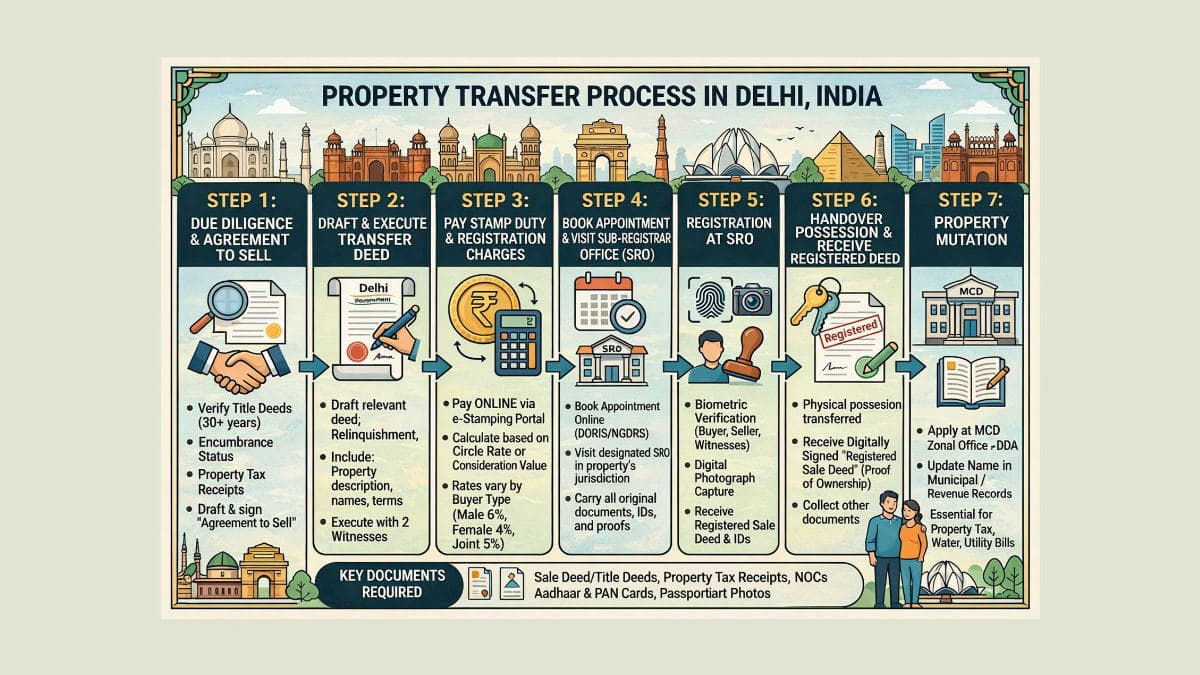
Property transfer in Delhi is complete when ownership is recorded through a registered transfer document (most commonly a registered sale deed) and the records used for property tax and local services are updated. In everyday language, many buyers call this "registry + mutation".
This guide explains the property transfer process in Delhi in practical steps: what to check before you pay token money, what happens at the Sub-Registrar Office (SRO) on registration day, and what to do after registration so that property tax and utilities can be moved to your name. This is general information, not legal advice. Procedures and forms can change, so verify the latest steps on the official portals for the Delhi Revenue Department, MCD Online, and DDA.
What "property transfer" means in Delhi (who updates what)
Three places matter for most transactions:
- Sub-Registrar Office (SRO): registers the sale deed or other transfer deed.
- Municipal authority: updates property tax records (MCD or NDMC, depending on the area).
- Allotment authority (where applicable): DDA and some other bodies can have additional rules for certain properties and allotment formats.
That is why registry and mutation are treated as separate steps in Delhi. Registry is the legal transfer document registration. Mutation is the update in local records used for tax and services.
Understand what you are buying in Delhi (freehold, leasehold, DDA, CGHS)
In Delhi, the property type affects your paperwork. Confirm the ownership format early, not after the price negotiation.
- Freehold property: transfer is usually through a registered sale deed, assuming title history is clean.
- Leasehold property: may require additional permissions or lessor documentation. Ask what document proves ownership and what document enables transfer.
- DDA property: DDA flats and plots can have allotment history and conversion status. If conversion to freehold is relevant, use the DDA freehold conversion process as a reference.
- CGHS/society flats: apart from registry, there can be membership transfer steps and "no dues" processes for maintenance.
Before paying token money: the shortlist checks that prevent delays
Most problems start when token money is paid before the buyer understands the seller???s documents and liabilities.
- Seller identity: name on the title document matches PAN/Aadhaar. Confirm who all must sign if there are joint owners.
- Title document set: latest registered deed plus supporting documents (allotment/conversion, if applicable).
- Loan status: confirm if there is any active home loan and how it will be closed before registration day.
- Tax and dues: latest paid property tax receipt and society maintenance status.
- Property details match: unit number, floor, parking rights, and area description in the deed match the site.
Documents usually needed for property transfer in Delhi
Exact requirements can vary by SRO and property type, but these are commonly asked at different stages.
Seller-side documents
- Latest registered title document and earlier chain documents (where available)
- PAN and Aadhaar, plus photographs where required
- Loan closure papers or bank NOC if a home loan exists (if applicable)
- Latest property tax receipts and society "no dues" documents (if applicable)
Buyer-side documents
- PAN and Aadhaar, plus photographs where required
- Bank documents if you are taking a loan (as required by your lender)
- Two witnesses with ID proofs (commonly needed for registration)
Property transfer process in Delhi (step by step)
Step 1: Title search and chain verification
A title search confirms ownership and highlights common issues such as missing link documents, mismatched names, and unclear inheritance transfers. In many resale transactions, lawyers and banks ask for a longer history (often around 25???30 years), but what matters is whether the chain is continuous and explainable for your specific property.
If something is unclear, resolve it before you pay a large token amount.
Step 2: Agreement to Sell (ATS) with clear payment and possession terms
The Agreement to Sell is where most disputes are prevented. Keep it specific: price, payment schedule, possession date, and what is included.
- Payment schedule: write the exact dates/conditions and modes (bank transfer/DD/RTGS).
- Possession: specify the possession date and whether it will be vacant.
- TDS and tax compliance: TDS rules can apply based on transaction value and the seller???s tax residency. Use the capital gains and TDS guide as a checklist and confirm your exact case with a CA where needed.
Step 3: Drafting the sale deed
The sale deed is the main transfer document in most Delhi resale purchases. Read the basics carefully: parties??? names, property description, share/undivided share (where applicable), consideration amount, and how payment is recorded.
If the flat is in a society, make sure the deed description matches the society???s flat details and the seller???s ownership format.
Step 4: Stamp duty, registration fee, and appointment booking
Registration is done at the SRO linked to the property???s location. Before the appointment, you typically plan stamp duty payment, deed print sets, and witness availability. Rates and appointment rules can change, so confirm the latest process on the Delhi Revenue Department portal.
If you want a clear checklist of cost heads and the registration-day workflow, use the Delhi property registration guide.
Step 5: Registration day at the Sub-Registrar Office (SRO)
On the day of registry, the buyer, seller, and witnesses attend the appointment. The office verifies identity, completes signatures on the deed set, and captures biometrics where applicable.
- Carry originals and copies: the SRO may check originals for ID and deed chain.
- Payment trail: keep the payment method consistent with what is written in the ATS and sale deed.
- Final detail check: confirm names, property description, and consideration details before signing.
Step 6: Possession letter and document handover
After signing, take possession in a documented way. Many buyers use a simple possession letter and an inventory note (only if fixtures/appliances are included). Keep copies of the key handover record and any society gate pass process, if applicable.
Step 7: Mutation in Delhi (MCD / NDMC / DDA)
Mutation is the update in the authority???s records used for property tax and related municipal services. The process differs depending on jurisdiction.
- MCD areas: start on mcdonline.nic.in.
- NDMC areas: NDMC has its own jurisdiction for central zones.
- DDA-linked formats: some properties may need DDA-side updates depending on allotment history; check dda.gov.in.
Keep the registered deed copy, tax receipts, and any society NOC/no-dues documents ready. Timelines vary by case and document completeness, so plan for follow-ups.
Step 8: Utility transfers (electricity, water, gas)
Utility name changes are usually easier when you have a registered deed copy and the seller???s last paid bill copies. Confirm whether any dues exist and how they will be cleared as part of handover.
- Electricity: name change is typically based on the deed and the latest bill; the process differs by distribution area (BSES/TPDDL).
- Water: check the latest paid status and meter details before applying for updates.
- Piped gas: if applicable, confirm transfer requirements and whether the seller???s signature is needed.
If the seller has an active home loan
An active home loan does not automatically stop a sale, but it changes coordination. Banks may hold original documents until the loan is closed, and the closure/payment steps should be written clearly in the ATS.
If you are arranging a buyer-side home loan, this guide helps you plan the document flow: home loan eligibility guide.
Family transfers (gift deed and relinquishment deed)
Not all transfers are sales. In families, common formats include registered gift deeds and registered relinquishment deeds. The right document depends on the relationship, ownership history, and whether there are multiple legal heirs.
- Gift deed: used when an owner gifts property to a relative. Registration is still required for the transfer to be recorded.
- Relinquishment deed: used when one heir gives up their share in favour of another heir. Registration and correct heir documentation matter.
Common mistakes in the Delhi property transfer process
- Relying only on possession: keys and physical possession do not replace registered transfer paperwork.
- Leaving mutation for later: delays can create confusion in tax and service records.
- Mismatch in names or unit details: small spelling differences or incorrect flat details can slow down registration and later updates.
- Unclear inclusion list: if parking, fixtures, or any furniture is part of the deal, write it clearly.
Conclusion
To complete property transfer in Delhi, treat it as a sequence: verify title and ownership format, sign a clear Agreement to Sell, register the deed at the correct Sub-Registrar Office, and then complete mutation and utility updates. When the paperwork is consistent end to end, the process is smoother and future resale becomes easier.
For neighbourhood planning before you buy, see the best areas to live in Delhi guide.
Frequently Asked Questions (FAQs)
Q1: Is registry and mutation both required for property transfer in Delhi?
Registry (usually a registered sale deed) is the core transfer step. Mutation is the follow-up update in municipal/authority records used for property tax and related services. In practice, most buyers complete both.
Q2: Which Sub-Registrar Office (SRO) will handle my registry?
It is typically based on the property location and the district mapping used by the Revenue Department. Confirm the correct SRO and appointment rules on the official portal before booking.
Q3: Can the full property transfer process be done online?
Many steps can be initiated online (information, payments, appointment booking), but registration usually requires physical presence for verification and signatures. Follow the latest process shown on the Revenue Department portal.
Q4: How long does mutation take in Delhi?
Timelines vary by authority and document completeness. Keep the registered deed copy and latest tax receipts ready, and plan for follow-ups.
Q5: What changes if the seller is an NRI?
Tax compliance can change based on the seller???s residency status, including TDS rates and documentation. Confirm your exact case with a CA and use a capital gains and TDS checklist before making payments.