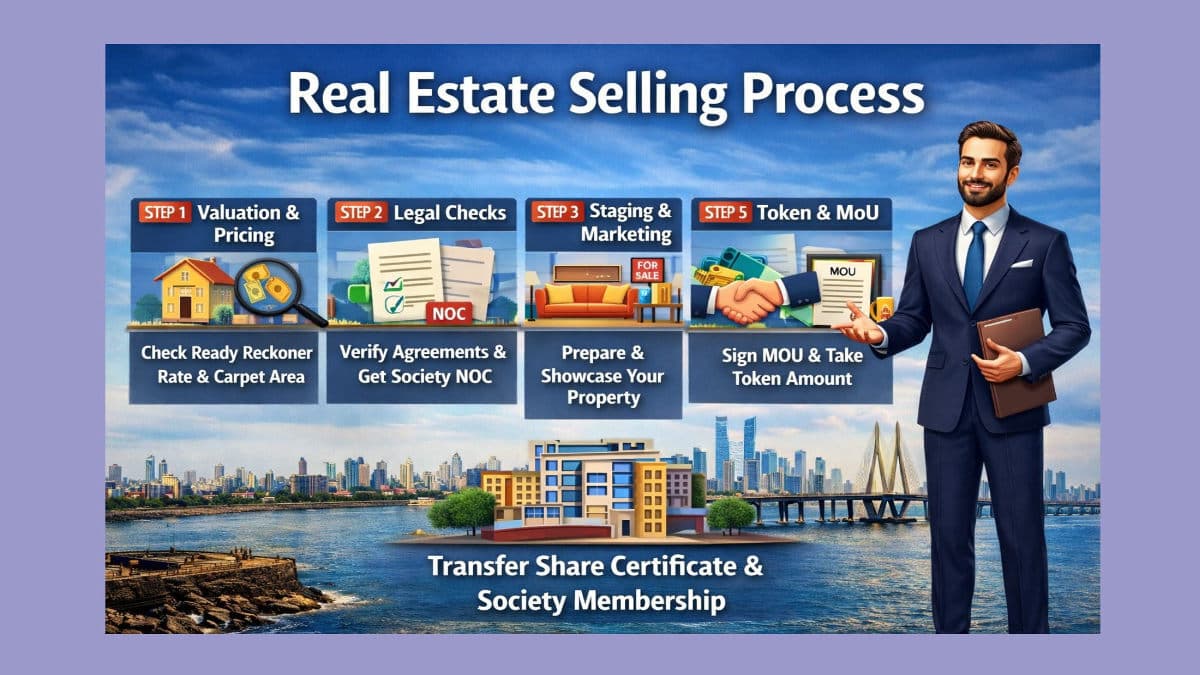
Everyone talks about how hard it is to buy a house in Mumbai. But ask anyone who has tried to sell one, and they will tell you it is even harder. In a city where every square inch is gold, selling a property isn't just about finding a buyer; it is about navigating a minefield of Society NOCs, old chain agreements, and the infamous "Link Documents."
I have guided dozens of sellers who thought they had a "clean deal" only to find out on registration day that their grandmother's name was spelled wrong in a 1985 agreement, stalling the whole process. This guide is your roadmap. From setting the right price in Bandra or Borivali to handing over the keys, here is exactly how to sell your flat in Mumbai without losing your mind.
Step 1: Valuation – What is Your Flat Actually Worth?
Don't just look at the asking prices on property portals. Those are "wish lists," not sale prices. To get a real number:
- Check Recent Registrations: Look at the actual registered value of similar flats in your building or the one next door on the IGR Maharashtra website (IGRMumbai). This data doesn't lie.
- The "Floor Rise" Factor: In Mumbai, a 15th-floor flat commands a significantly higher premium (often ₹500/sqft per floor) than a 2nd-floor flat. Don't compare apples to oranges.
- Carpet Area vs Saleable Area: Buyers in 2026 only care about RERA Carpet Area. If you are quoting a price based on "Super Built-up," you will be laughed out of the room. Be honest about the carpet.
Step 2: Pre-Sale Legal Hygiene (Clean the Slate)
Before you even talk to a broker, you need to "audit" your own property. In Mumbai, buyers are suspicious. If they smell a legal issue, they will walk away or demand a 20% discount.
The "Chain of Deeds" Check
Open your file. Do you have the complete Chain of Agreements? This means every sale deed from the builder to the first buyer, then to the second buyer, and finally to you.
Mumbai Reality: If your flat is in an old building in Chembur or Ghatkopar, chances are one of the previous agreements (maybe from 1995 or 2002) was not registered or stamped properly. If the "Chain" is broken, you cannot sell. You might need to pay a penalty on the old document to regularize it first. This is called "Adjudication of Past Documents."
Clear Your Dues
Ensure you have paid:
- Property Tax: Check the BMC portal. Arrears stay with the property, not the person.
- Maintenance Bills: Get a "No Dues Certificate" from your society secretary.
- Electricity Bill: Pay the latest bill. Buyers ask for the last 3 months' bills.
Step 3: Staging and Marketing (The "Wow" Factor)
In a slow market, presentation is everything.
1. The "De-Clutter" Rule: Remove 50% of your personal items. Buyers need to visualize their life in the flat, not look at your family photos.
2. Paint Job: A fresh coat of "Off-White" or "Cream" paint costs ₹20,000 but can increase the sale price by ₹2 Lakhs. It makes the flat look bigger and brighter.
3. Lighting: Ensure all bulbs are working. Use "Warm White" (Yellow) lights in the living room for a cozy feel during evening visits.
Step 4: Finding a Buyer and The "Token"
Once you find a serious buyer, they will give you a "Token Amount" (usually ₹1 Lakh to ₹5 Lakhs). This is "Good Faith Money."
- The Receipt: Always give a formal receipt for the token.
- The Condition: Clearly state that if the buyer backs out without a valid legal reason (like loan rejection due to property title), the token is forfeited. If you back out, you usually have to return double the token (market norm, though legally contested).
Step 5: The MoU (Memorandum of Understanding)
This is the pre-marriage engagement. The MoU outlines the timeline. In Mumbai, the standard timeline is 45 to 60 days for the buyer to arrange a Home Loan.
What to include:
- Total Sale Price: Break it down into "Agreement Value" and "TDS to be deducted."
- Payment Schedule: e.g., 10% on MoU, 80% on Registration, 10% on Possession.
- Furniture List: If you are leaving the ACs or wardrobes, list them explicitly to avoid disputes later. I've seen deals fight over a ₹20,000 geyser.
Step 6: Negotiation Psychology
Buyers in Mumbai will always low-ball.
The "Anchor" Price: If you want ₹2 Cr, ask for ₹2.15 Cr.
The "Walk Away": If a buyer offers ₹1.8 Cr, politely refuse and stop following up. In Mumbai, silence is a powerful negotiation tool. It shows you are not desperate.
Handling Multiple Buyers (The Bidding War)
If you have a great flat in a prime location like Powai or Vile Parle, you might get multiple offers. Do not say "Yes" to the first one. Schedule visits back-to-back on a Sunday. When Buyer B sees Buyer A leaving, the "Fear of Missing Out" (FOMO) kicks in. This is the only way to get your asking price in a buyer's market.
Step 7: Society NOC and Transfer Fees
You cannot sell a flat in a Cooperative Housing Society (CHS) without their No Objection Certificate (NOC).
The "Voluntary Donation" Trap
By law (Bylaw No. 38), the society cannot charge more than ₹25,000 as a transfer fee. However, reality in South Mumbai (Colaba, Worli) is different. Many societies ask for a "Voluntary Donation" or "Amenity Fund" contribution that can run into lakhs.
Strategy: Negotiate this early. Who pays it? Usually, the buyer and seller split it 50-50. Do not hide this cost from the buyer; it will come up during the NOC interview.
Documents for NOC:
1. Copy of Sale Agreement.
2. Form 20(1) and 20(2) (Membership Forms).
3. No Dues Certificate (ensure you pay all maintenance bills).
Step 8: The TDS Liability (1% vs 20%)
This is where tax compliance hits you.
- Resident Seller: If property > ₹50 Lakhs, buyer deducts 1% TDS. You claim this back in your ITR.
- NRI Seller: Buyer deducts 20% to 23.92% TDS on the *entire sale value*. See our NRI Guide for details on how to lower this.
Seller's Job: Ensure the buyer actually deposits this TDS using Form 26QB. If they don't, the Income Tax department will send YOU a notice, not them. Ask for the Form 16B certificate before handing over possession.
Step 9: Registration Day (The Grand Finale)
This happens at the Sub-Registrar Office (SRO). In Mumbai, SROs are notorious for being crowded and having "Server Down" issues. See our Property Registration Guide for a detailed walkthrough.
Which SRO?
- Andheri/Bandra/Borivali: You are assigned an SRO based on your CTS number. You cannot just pick "any" office.
- Time Slot: Your lawyer must book a slot online via the IGR portal.
- Lunch Break: Avoid the 1 PM - 2 PM slot. Staff is often missing.
The Process on the Day:
- Drafts Ready: The buyer hands over the Pay Orders/Demand Drafts for the final balance amount. verify the spellings on the DDs immediately.
- Biometrics: You (Seller), the Buyer, and two witnesses give thumbprints and photos.
- The "Admission": The officer asks you, "Did you receive the money?" You say "Yes" (after verifying the DDs).
- Handover: You hand over the keys and the "Possession Letter" right there.
Safety Tip: Never sign the final deed until you have the Demand Drafts in your hand or the RTGS transfer is confirmed in your account. If the buyer says "RTGS will come in 2 hours," WAIT. Do not sign.
Step 10: Post-Sale Formalities
You sold the house, but you aren't done yet. Make sure to complete the official Property Transfer Process with the society.
- Electricity Meter: Apply to Adani/Tata Power/BEST to transfer the meter to the new owner's name. If you don't, and the new owner defaults, you are liable.
- BMC Tax: Inform the local ward office (Assessment Dept) to change the name on the Property Tax bill.
- Close Loan Account: If you had a loan, get the original deeds back from the bank and hand them to the buyer. Ensure the bank issues a letter stating "List of Documents Returned."
Taxation: Capital Gains (LTCG)
The money you made is "Capital Gain."
- Short Term: Sold within 24 months? The profit is added to your income and taxed at your slab rate (30%+ for most).
- Long Term: Sold after 24 months? Taxed at 12.5% (New Rules 2024).
- Saving Tax: You can save this tax by investing in another house (Section 54) or Bonds (Section 54EC) within 6 months.
Common Pitfalls to Avoid
1. The "Pagdi" System Trap: If you live in an old Pagdi building in South Mumbai, you are a tenant, not an owner. You cannot "sell" the flat; you can only transfer tenancy rights, and the landlord usually takes a 33% cut of the transaction value. Be very clear about this before negotiating price.
2. Lost Originals: If you lost the original sale deed, you need to file an FIR, put a notice in two newspapers, and get a "Certified Copy" from the registrar. Most buyers will run away from such deals because banks hesitate to give loans on certified copies.
3. Parking Wars: Is your parking "Owned" or "Society Allotted"? You cannot sell a society-allotted parking slot. It goes back to the society pool. Only parking bought from the builder (and mentioned in the deed) can be transferred. Don't promise parking you don't legally own.
4. The "Female Buyer" Rebate Lock-in: If you are selling to a woman who is claiming the 1% Stamp Duty rebate, remind her of the 15-year lock-in period. This doesn't affect you directly, but it affects her resale value, and if her lawyer catches it later, the deal might stall.
Conclusion
Selling a property in Mumbai is a test of patience. The paperwork is heavy, the government offices are slow, and the negotiations are tough. But if your "Chain of Deeds" is clean and your society NOC is ready, you are in the driver's seat. Don't rush the process. A well-documented sale ensures that once you hand over the keys, you never have to look back. Treat the buyer as a partner in compliance, not an adversary, and the deal will close faster. If you're selling to move to a rental, check out the latest 2 BHK Rents in Mumbai.
Need Help with Documentation?
Get a property lawyer to verify your "Chain of Deeds" before you list your flat.
Verify My Documents
Frequently Asked Questions (FAQs)
Seller Queries Answered
Q2: Can I sell if I have an ongoing home loan?
Yes. The buyer's bank will pay off your outstanding loan directly to your bank, take the original papers, and pay the balance amount to you. It's a standard process called a "Foreclosure Letter based disbursement".
Q3: How much commission does the broker charge?
The standard rate in Mumbai is 2% of the sale value + GST. Some brokers might negotiate to 1.5% for high-value tickets (above ₹5 Cr), but 2% is the norm. Don't try to cheat the broker; they control the local network.
Q4: Is the sale agreement valid without registration?
No. An unregistered agreement for sale has no legal validity in transferring ownership. It must be registered to be legal. The "Notarized Agreement" has zero value for property transfer.
Q5: What happens if the buyer's loan gets rejected?
If the rejection is due to your property's title issue (e.g., illegal extension), you must refund the token. If it's due to the buyer's poor CIBIL score, you can forfeit the token (if mentioned in the receipt).